Reviewing Gwangju's Cultural Budget and Policy Issues
Exploring Directions for a Sustainable Cultural City
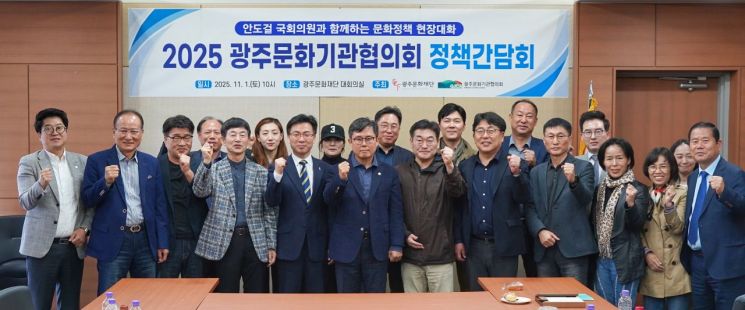 The Gwangju Cultural Institutions Council held a cultural policy meeting with Congressman Ando-gul on the 1st at the Gwangju Cultural Foundation. Photo by Gwangju Cultural Foundation
The Gwangju Cultural Institutions Council held the "2025 Cultural Policy Meeting with Congressman Ando-gul" on November 1 at the Gwangju Cultural Foundation, inviting Congressman Ando-gul (Democratic Party of Korea, Dong-gu and Nam-gu Eul).
This event was organized to review Gwangju's cultural budget and policy issues, strengthen the cooperation system among local cultural institutions, and explore directions for the sustainable development of Gwangju as a cultural city.
Approximately 25 heads and policy and planning officials from 13 major cultural institutions attended the meeting, including the Gwangju Cultural Foundation, Gwangju Design Center, Gwangju Biennale, Gwangju Information & Culture Industry Promotion Agency, Gwangju Media Center, Asia Culture Center Foundation, Gwangju Culture & Art Center, Gwangju Museum of Art, National Gwangju Science Museum, National Gwangju Museum, Gwangju Technopark, Gwangju Tourism Organization, and the Asian Culture Hub City Support Forum.
The participating institutions shared new project proposals related to Gwangju's cultural policies, such as expanding cultural facilities, establishing cultural content infrastructure, and revitalizing the region in connection with the Asia Culture Center (ACC). They also engaged in in-depth discussions on ways to create synergy through inter-institutional cooperation.
Congressman Ando-gul emphasized, "Gwangju is a city that must compete through culture, and culture is its future competitiveness. While Gwangju already has abundant cultural resources and infrastructure, efforts are needed to develop these into competitive tourism products and content." He further suggested, "Just as Daejeon's Sung Sim Dang has become a beloved cultural brand among citizens, Gwangju should discover and expand such brands into its cultural economy." He added, "The national and local governments must work closely together on cultural budgets and policies, and cultural institutions and artists should communicate openly to create and promote new brands for the development of Gwangju's cultural tourism."
The Gwangju Cultural Institutions Council plans to use this meeting as an opportunity to institutionalize policy cooperation among institutions and focus on establishing practical policy proposals and implementation foundations that reflect voices from the field.
Jeon Eunok, Acting CEO of the Gwangju Cultural Foundation, stated, "This meeting was a meaningful occasion where the central and local governments discussed Gwangju's cultural vision together. We will strengthen a collaborative system centered on connection and integration so that on-site opinions can be reflected in policy, and we will enhance practical consultations at the working level."
Meanwhile, the Gwangju Cultural Institutions Council was launched in 2013 with seven institutions. It currently consists of 16 member organizations, including the Gwangju Cultural Foundation (the current secretariat), Gwangju Design Center, Gwangju Research Institute, Gwangju Biennale, Gwangju Museum of Art, Gwangju Information & Culture Industry Promotion Agency, Gwangju Media Center, Asia Culture Center, Asia Culture Center Foundation, National Gwangju Museum, Gwangju Culture & Art Center, Gwangju History & Folk Museum, National Gwangju Science Museum, Gwangju Tourism Organization, Gwangju Technopark, and the Asian Culture Hub City Support Forum.
© The Asia Business Daily(www.asiae.co.kr). All rights reserved.
![Clutching a Stolen Dior Bag, Saying "I Hate Being Poor but Real"... The Grotesque Con of a "Human Knockoff" [Slate]](https://cwcontent.asiae.co.kr/asiaresize/183/2026021902243444107_1771435474.jpg)
















