November 3: Gijang County, Southeast Regional Radiation Medical Center, and BISTEP Sign MOU
Busan, Known for Highest Cancer Mortality Rate, Steps Up as Advanced Particle Therapy Hub
Busan City is taking full-scale action to shed its reputation as the city with the highest cancer mortality rate by building advanced particle therapy infrastructure.
On November 3, the city held a "Memorandum of Understanding Signing Ceremony for the Establishment of a Proton Therapy Center" at the Grand Josun Busan in Haeundae, together with Gijang County, the Southeast Regional Radiation Medical Center, and the Busan Institute for Advanced Science and Technology Education (BISTEP).
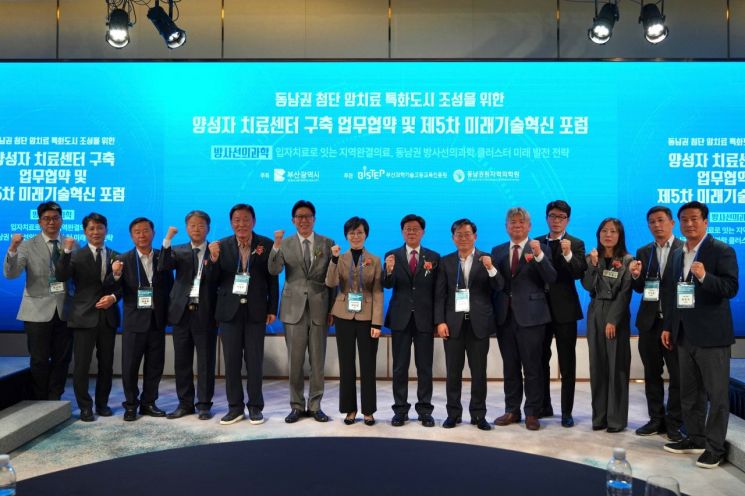 Busan City held a "Business Agreement Ceremony for the Establishment of a Proton Therapy Center" together with Gijang County, the Southeast Regional Radiation Medical Center, and the Busan Institute for Advanced Science and Technology Education.
The agreement aims to develop the "Southeast Region as a Specialized City for Advanced Cancer Treatment" and includes cooperation in various areas: promoting the establishment of the Proton Therapy Center, creating a comprehensive local cancer treatment system, building a customized treatment base for pediatric and intractable cancer patients, and generating local jobs and revitalizing the regional economy.
The signing ceremony was attended by Busan Mayor Park Hyungjoon, Gijang County Governor Jeong Jongbok, Director Lee Changhoon of the Southeast Regional Radiation Medical Center, and Director Kim Youngbu of BISTEP. Congratulatory remarks were delivered by National Assemblyman Jeong Dongman and Lee Jinkyung, Director of the Korea Institute of Radiological and Medical Sciences.
Busan is known for having the highest cancer incidence and mortality rates in the country, yet all advanced treatment equipment, such as proton therapy machines, are concentrated in the Seoul metropolitan area. Currently, proton therapy machines are installed only at the National Cancer Center in Goyang and Samsung Medical Center in Seoul. It is estimated that about 8,000 patients-approximately 10% of the 80,000 annual candidates for radiation therapy-require this treatment.
Through this agreement, Busan City plans to resolve the "Seoul-centric cancer treatment structure" and establish a comprehensive medical system that enables patients to receive precision cancer care within the region.
The Proton Therapy Center will be established within the Southeast Regional Radiation Medical Center and will specialize in treating cancers where protecting normal tissues is critical, such as pediatric cancer, brain tumors, and facial tumors.
If linked with the heavy ion therapy machine currently being installed at the Seoul National University Hospital Gijang Cancer Center, Busan is expected to become the nation’s only "advanced particle therapy complex cluster."
Heavy ion therapy machines are mainly used for treating solid cancers that are difficult to operate on or have a high recurrence rate, such as pancreatic cancer, sarcomas, and head and neck cancers. Proton therapy machines offer the advantage of minimizing damage to healthy cells through more precise dose control.
According to the "Strategy for Establishing a Southeast Region Advanced Cancer Treatment Hub" commissioned by Busan City, the establishment of the Proton Therapy Center is expected to generate an economic impact of 251.2 billion won in production, 77.8 billion won in added value, and 1,286 jobs.
Mayor Park Hyungjoon stated, "This agreement is the first step in changing the paradigm of cancer treatment in Busan," and added, "We will build a 'comprehensive medical system in the Southeast region' so that local patients can receive the most advanced treatment without having to travel far to Seoul."
The second part of the signing ceremony featured a forum on "The Advancement of Radiological Medical Technology through Particle Therapy and Cluster Cooperation."
The forum was chaired by Professor Son Dongwoon of Pukyong National University, with presentations by Professor Son Jaeman of Seoul National University Hospital, Director Kim Minhwan of the Korea Atomic Energy Research Institute, Dr. Kim Haksoo of the National Cancer Center, Director Kim Jeongyoung of the Korea Institute of Radiological and Medical Sciences, and Director Yoo Dosol of the Southeast Regional Radiation Medical Center. The participants discussed directions for the development of particle beam-based radiological medical technology.
© The Asia Business Daily(www.asiae.co.kr). All rights reserved.
![Clutching a Stolen Dior Bag, Saying "I Hate Being Poor but Real"... The Grotesque Con of a "Human Knockoff" [Slate]](https://cwcontent.asiae.co.kr/asiaresize/183/2026021902243444107_1771435474.jpg)
















