Ha Ki-tae of Yeongcheon City Council Urges Immediate Reform of Cafeteria Operations
Local Businesses Left "Empty"
"Suspension or Price Adjustment Needed to Revitalize the Local Economy"
"Most local government employees pay 5,000 to 7,000 won per meal, and in particular, Gyeongju and Mungyeong have stated that they do not operate staff cafeterias in order to 'revitalize the local economy.' This is something Yeongcheon City should also learn from."
There have been claims that the meal prices at the Yeongcheon City Hall cafeteria are nearly at the level of free meals, resulting in significant damage to local small businesses.
According to Ha Ki-tae, a member of the Yeongcheon City Council (Dongbu-dong and Jungang-dong), on November 3, Yeongcheon City employees receive a separate fixed meal allowance of 140,000 won per month, while the City Hall cafeteria charges only about 35,000 won per month, making it possible for employees to dine there at virtually no cost.
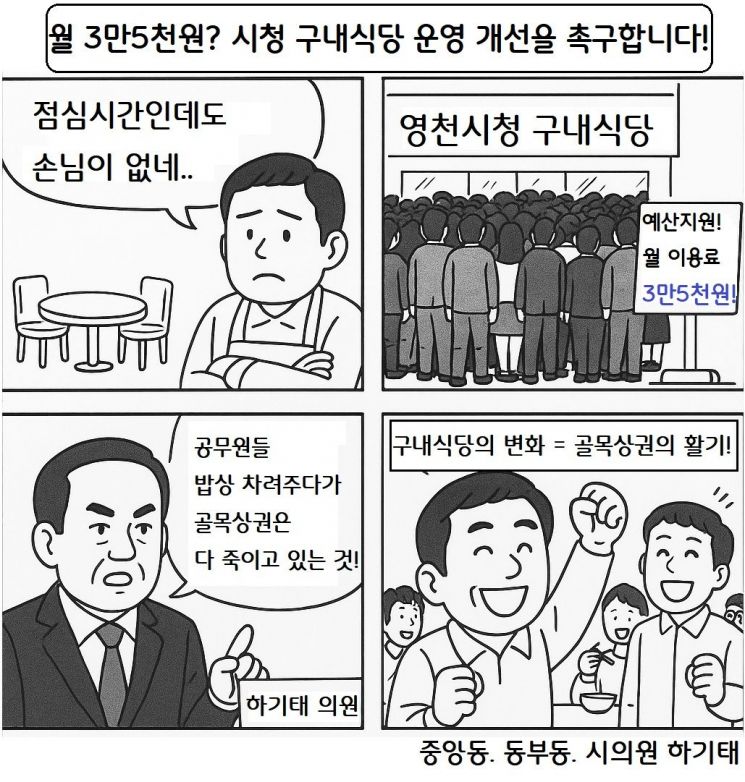 An image related to Ha Ki-tae, a member of Yeongcheon City Council (Dongbu-dong and Jungang-dong), urging a complete review of the operation of the city hall cafeteria.
As a result, there are concerns about a vicious cycle in the local economy: reduced sales for restaurants lead to job cuts, which in turn result in decreased local tax revenue. This is compounded by an increase in vacant storefronts, which diminishes urban vitality and accelerates population outflow.
In fact, the perceived cost of a single meal at the City Hall cafeteria is less than 2,000 won, compared to the average lunch price at nearby restaurants, leading to a distortion in demand.
During a recent five-minute free speech at the 7th plenary session of the Yeongcheon City Council, Assemblyman Ha pointed out these issues with the operation of the City Hall cafeteria. He argued, "A single lunch is the warmest investment in reviving tomorrow's local businesses," and emphasized that "public officials, as members of the community, should share the burdens faced by local small business owners."
As alternatives, he proposed either suspending cafeteria operations until the economy recovers or converting it to a paid system at the national average rate (5,000 to 7,000 won per meal). He called on the executive branch to completely review the cafeteria's operation and to develop a realistic roadmap.
Assemblyman Ha criticized the current structure, stating, "In addition to hiring contract employees to operate the cafeteria in 2025, about 80 million won (including labor and insurance costs) is being allocated to the cafeteria. This means that while citizens are not provided with meals, only public officials are being served, which does not meet public expectations."
Ha Ki-tae suggested that, as a solution, the cafeteria should be suspended until the economy recovers and public officials should be encouraged to use private restaurants, or the system should be converted so that employees pay typical cafeteria prices.
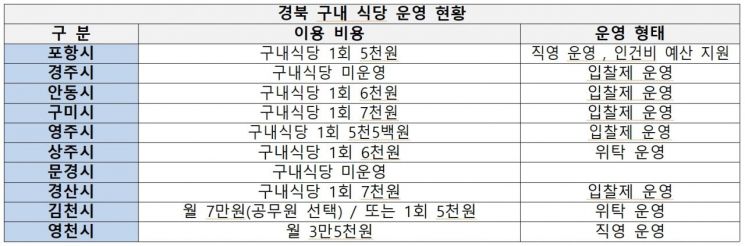
Additionally, if the cafeteria is to be maintained, he urged that all ingredients be purchased from local farmers as a measure to support the community. He also pointed out that, compared to other cities (Pohang: directly operated at 5,000 won per meal, Gumi: contracted at 7,000 won per meal, Andong: contracted at 6,000 won per meal), the meal prices at the Yeongcheon City Hall cafeteria are unreasonably low.
Ha Ki-tae reiterated, "If demand for the cafeteria shifts to outside restaurants, the resulting increase in customers will be like the first drops of rain for the parched local business districts, bringing much-needed relief."
© The Asia Business Daily(www.asiae.co.kr). All rights reserved.


















