Survey of Over 2,700 STEM Professionals in Korea and Abroad
Urgent Need for Innovation in Monetary Compensation and Scaling Up R&D Investment
Strengthening the Foundation for Technology Startups and Expanding the Strategic Technology Innovation
An analysis has found that an urgent overhaul of the monetary compensation system, which currently offers nearly twice as much overseas compared to Korea, is necessary to prevent the outflow of science and technology (STEM) talent abroad. There are growing calls for government policy to focus on strengthening the effectiveness of research and development (R&D) investment, expanding the foundation for technology startups, and fostering an innovation ecosystem through the opening of strategic technologies.

According to the "BOK Issue Note - Determinants of Overseas Outflow of STEM Talent and Policy Response Directions (Choi Jun, Jeong Sunyoung, Ahn Byungtak, Yoon Yongjun)" published by the Bank of Korea on November 3, a survey of more than 2,700 STEM professionals in Korea and abroad found that 42.9% of respondents currently working in Korea are considering moving overseas within the next three years. Additionally, 5.9% are already making concrete plans to do so. Among those in their 20s and 30s, the proportion considering overseas employment within three years reached as high as 70%.
Korean STEM professionals have been steadily moving abroad, especially to the United States. The number of Korean STEM PhDs working in the US increased rapidly from 9,000 in 2010 to 18,000 in 2021. The net outflow has also expanded since 2015, particularly in the bio and information and communication technology (ICT) sectors.
Choi Jun, Director of the Macroeconomic Analysis Team at the Bank of Korea's Research Bureau, pointed out that "STEM talent forms the core human resources for building a foundation for sustainable economic growth through technological innovation and productivity improvement. However, in Korea, a significant portion of top high school students are choosing to enter the medical field (a concentration in medical schools). Even those who choose STEM fields are showing a tendency to move abroad in search of better research environments and career opportunities."
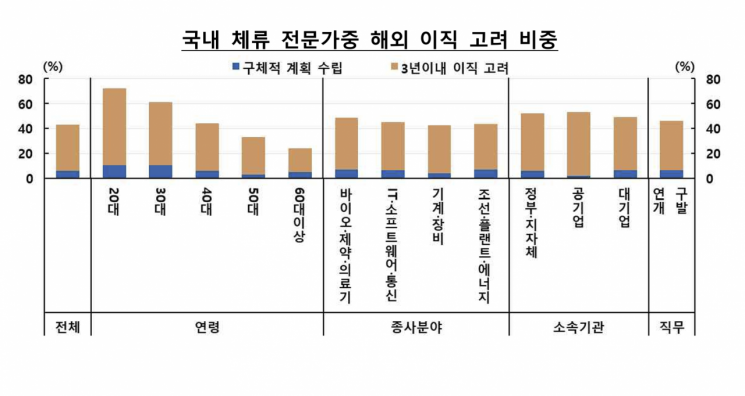
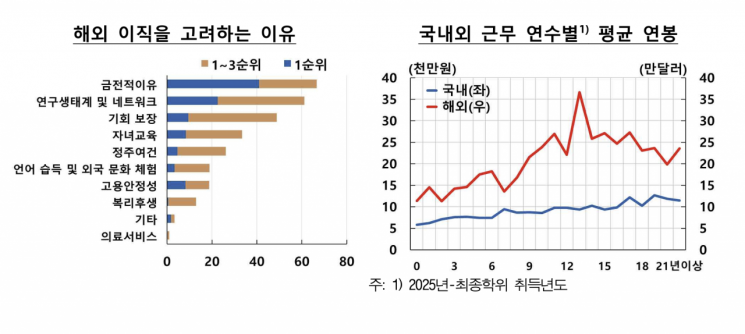
The main reason cited for considering overseas employment was monetary factors, such as salary levels. Although there are differences in average salaries between Korea and abroad depending on years of experience, on average, overseas salaries are nearly twice as high as those in Korea. In particular, the gap in compensation structures and early career opportunities between Korea and other countries is a major factor driving younger professionals to prefer working abroad. Non-monetary factors, such as research ecosystem and networks (61.1%) and guaranteed career opportunities (48.8%), also accounted for a significant proportion.
Job satisfaction levels also showed a significant gap between Korea and abroad in terms of the research ecosystem, networks, and working conditions. When asked about the most urgent tasks for advancing science and technology, respondents prioritized improving the research environment (39.4%) over bold monetary compensation (28.8%).
An empirical analysis (using a logit model) of the factors influencing overseas employment showed that if income satisfaction improved from "average" to "satisfied," the probability of moving abroad decreased by 4.0 percentage points. Improvements in job security (-5.4 percentage points) and promotion opportunities (-3.6 percentage points) also reduced the likelihood of moving abroad. By degree, for those with a master's degree, promotion opportunities and research environment were the main factors reducing the intention to move abroad, while for those with a doctorate, job security and children's education were relatively more important. By field, for those in new growth sectors such as bio and IT, research environment and children's education had a greater impact, whereas in other fields, job security was the overwhelmingly dominant factor.
Director Choi emphasized that, in order to prevent the outflow of STEM talent, it is necessary to: ▲ innovate the monetary compensation (incentive) system to secure outstanding talent; ▲ expand and strengthen the effectiveness of R&D investment; and ▲ expand the innovation ecosystem by strengthening the foundation for technology startups and utilizing strategic technologies such as aerospace and defense.
Director Choi stated, "There is a need to transition to a flexible wage and compensation system based on performance. This is not just a task for the STEM field, but a direction that must be pursued in the long term to strengthen talent competitiveness and the foundation for sustainable growth in our entire economy." He analyzed that, to this end, the government should provide tax incentives, such as strengthening the effectiveness of tax credits for human capital investment and income tax reductions for key personnel.
He also diagnosed that, to ensure that master's level research personnel can grow stably in Korea, it is necessary to strengthen R&D capabilities by establishing predictable career tracks, enhancing exchanges with overseas research institutions and researchers, and improving access to advanced infrastructure. Director Choi added, "It is also important to provide institutional support to create a 'talent circulation' structure, in which experienced and capable scholars return to the domestic ecosystem, by establishing organizational structures and incentive systems that can flexibly accommodate personnel with overseas experience, as well as introducing concurrent positions and extending retirement age."
Director Choi stressed, "The government should expand opportunities for failed entrepreneurs to try again, and promote the realization of investment returns by strengthening exit mechanisms such as mergers and acquisitions (M&A) and initial public offerings (IPOs). The government should also act as an early adopter in advanced industries to promote technology validation and market formation." He explained that, in strategic technology fields related to national security, such as aerospace and defense, it is possible to both protect national security assets and enhance private innovation and industrial impact by establishing open and commercialization pathways under thorough institutional safeguards and technology protection systems.
© The Asia Business Daily(www.asiae.co.kr). All rights reserved.



















