Damage Concentrated in Yeongnam Region Including North Gyeongsang, South Gyeongsang, and Ulsan
Pine wilt disease, often referred to as the "AIDS of pine trees," is rapidly spreading, particularly in the Yeongnam region.
According to data recently submitted by the Korea Forest Service to Assemblyman Eo Gigu, Chair of the National Assembly's Agriculture, Food, Rural Affairs, Oceans, and Fisheries Committee from the Democratic Party of Korea, approximately 4.13 million trees have been affected by pine wilt disease from 2020 to May 2025. Notably, in this year alone, 1,486,338 trees, accounting for 35% of the total cases, have been infected. By region, the damage has been concentrated in the Yeongnam area, with around 1.86 million trees in North Gyeongsang Province, about 900,000 in South Gyeongsang Province, and approximately 350,000 in Ulsan.
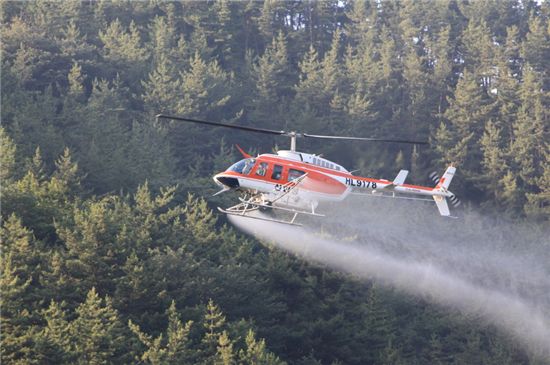 A forestry helicopter conducting aerial pest control for pine wilt disease
The speed of the spread is also alarming. Over the past five years, the number of pine wilt disease cases has increased by about 4.8 times (from 300,000 to 1.48 million). Regionally, Daegu saw a 24-fold increase (from 3,136 to 75,758), South Chungcheong Province a 16-fold increase (from 326 to 5,331), and Gwangju a 12-fold increase (from 280 to 3,432).
Control Budget Doubled, but Damage Quadrupled
Accordingly, while the budget for controlling pine wilt disease has doubled, the damage has instead quadrupled.
According to data received by Assemblyman Cho Kyungtae of the People Power Party, a member of the National Assembly's Agriculture, Food, Rural Affairs, Oceans, and Fisheries Committee, from the Korea Forest Service, the budget for pine wilt disease control increased from 50.4 billion won in 2022 to 100.8 billion won in 2025. However, during the same period, the number of pine trees affected by the disease surged nearly fourfold, from 380,000 to 1.49 million. The financial burden of control measures has also soared. The annual control costs, tallied from May each year to April of the following year, were 76.1 billion won in 2021, 68 billion won in 2022, 120.5 billion won in 2023, 120.7 billion won in 2024, and 205.1 billion won in 2025, with a total of approximately 590.3 billion won in state and local government funds invested over the past five years.
Regarding this, Assemblyman Cho stated, "In Korea, we are limited to post-infection spot treatments, only removing infected trees, and the control period runs from September to the following May, making it impossible to respond swiftly." He emphasized, "An immediate government-wide task force under the Prime Minister dedicated to pine wilt disease crisis response must be established, and a proactive control system should be introduced."
Pine wilt disease is a pest that invades pine trees, Korean red pines, and Korean nut pines, blocking the pathways for water and nutrients and causing the trees to die. There is no cure, and once infected, the trees inevitably wither and die. Currently, the best response is to cut down all infected trees or treat them by injection to prevent further spread.
© The Asia Business Daily(www.asiae.co.kr). All rights reserved.
















