Xi Jinping's Call for Multilateralism Adds Upward Pressure
Reduced Expectations for U.S. Rate Cuts Lead to Slight Decline
Despite the U.S.-China summit, the lack of clear conflict resolution has led international gold prices to remain in a wait-and-see mode.
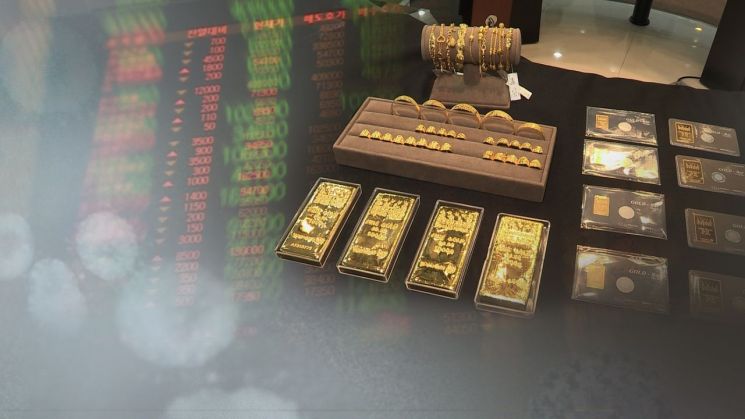
According to major foreign news outlets, as of 4:22 p.m. Eastern Time on October 31, spot gold was trading at $3,997.79 per ounce, down 0.7% from the previous session.
Gold prices, which have risen by nearly 60% so far this year, have been undergoing a correction phase, declining since October 20.
However, the downward pressure that had been driven by optimism over recent U.S.-China trade negotiations has significantly eased. On October 22, gold futures for December delivery on the COMEX, a metals exchange under the Chicago Mercantile Exchange Group (CME), fell 5.7% from the previous session, marking the largest drop in the past 12 years.
The recent downward pressure on gold prices is largely attributed to Federal Reserve Chair Jerome Powell's cautious stance on cutting the benchmark interest rate.
Chair Powell took a hawkish position the previous day regarding the prospect of a rate cut in December, stating that it was "not a foregone conclusion." Since gold is a safe asset that does not yield interest, its investment appeal increases relative to the dollar when the benchmark rate is lowered, which can drive up its price. In other words, the Federal Reserve's dampening of market expectations for further rate cuts has intensified the downward pressure on gold prices.
On the other hand, lingering uncertainties that were not fully resolved by the U.S.-China summit continue to serve as a driving force supporting gold prices. At the summit held in Busan on October 30, the United States and China achieved some results, such as a 10 percentage point reduction in U.S. tariffs on Chinese goods and a one-year suspension of China's rare earth export controls, but market concerns persist.
Chinese President Xi Jinping was seen as targeting the United States when he emphasized the "multilateral trading system" at the Asia-Pacific Economic Cooperation (APEC) summit held the day after the U.S.-China summit.
There are also concerns that China's economic influence, highlighted during the summit, has further increased uncertainty in U.S.-China relations.
Bloomberg News commented, "This U.S.-China summit has bought both countries time to reduce their strategic dependence on each other," adding, "While extreme situations may be avoided for several months, the stability in bilateral relations may only last during that period."
Nevertheless, experts believe that the correction phase for gold prices will continue for the time being. Gold prices are still up more than 50% so far this year.
Robert Rennie, an analyst at Westpac Bank, stated, "The correction trend is being reinforced by hawkish rate cut signals, the truce in the U.S.-China trade war, and large-scale outflows from gold exchange-traded funds (ETFs)," adding, "Gold prices could fall to $3,750 per ounce."
© The Asia Business Daily(www.asiae.co.kr). All rights reserved.

















