[Hyundai Motor, Over the Mobility] (38)
Hyundai Family’s Three Generations Defy the “Three-Generation Curse”
Leadership Transformation Aligned with the Spirit of the Times
Chung Ju-yung: Pioneer Leadership Rooted in Community
Chung Mongkoo: St
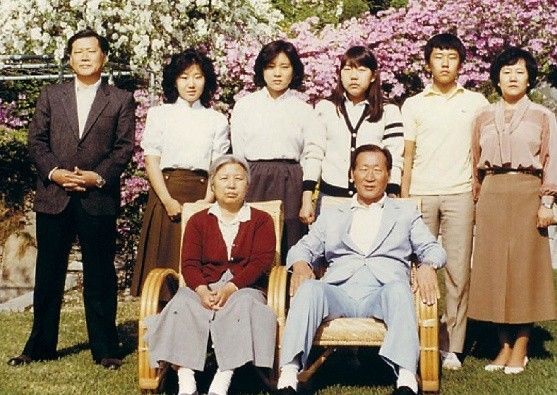 The Hyundai family is taking a family photo at their home in Cheongun-dong. (From the back row left) Honorary Chairman Chung Mongkoo, Advisor Chung Sungyi of Innocean, President Chung Myung of Hyundai Commercial, Advisor Chung Yooni of Haevichi Hotel & Resort, Chairman Chung Euisun, and Honorary Chairman Chung's spouse Mrs. Lee Junghwa. (From the front row left) The late Mrs. Byun Joongsuk, and the late Founder Chairman Chung Ju-yung of Asan. Courtesy of Asan Chung Ju-yung.com
The proverb "Wealth does not last three generations" is universally recognized across cultures and eras. In China, there's the saying "Fu bu san dai," in Japan, "The third generation ruins the family," and in English-speaking countries, "Shirtsleeves to shirtsleeves in three generations." All these expressions share the same insight: as generations pass, the pioneering spirit of the founder fades, and inherited wealth and authority can actually weaken a leader's motivation and crisis management abilities. This concern is a global phenomenon.
However, there is a notable exception to the "third-generation curse" in Korean corporate history: Hyundai Motor Group. The three-generation management, spanning Chung Ju-yung, Chung Mong-koo, and Chung Euisun, has not only ensured survival but also achieved expansion in asset scale, business domains, and global stature. In particular, the three generations of leadership within the Hyundai family have evolved in line with the demands of their respective eras.
The era of Chung Ju-yung, who had to lay the foundation for postwar industry, was defined by "pioneering" and "challenge." To revive the Korean economy, which had no industrial base, a strong drive to turn the impossible into possible was essential. During Chung Mong-koo's era, Hyundai made a full-scale debut in overseas markets, and global quality competition intensified. He emphasized craftsmanship and relentless leadership, building Hyundai into a company that could stand shoulder to shoulder with brands from advanced economies. Bold overseas investments also paid off during this period.
The current era of Chung Euisun centers on "connection" and "communication." To transform from a car manufacturer into a mobility solutions provider, integrative leadership that weaves together the wisdom of all members is required. Now, with its sights set on becoming number one in the world, Hyundai must accelerate innovation and foster open innovation by collaborating with external partners to create new ecosystems. This series will examine the structural evolution of Hyundai Motor Group's leadership by exploring the management philosophies, organizational practices, and contemporary challenges faced by its three leaders.
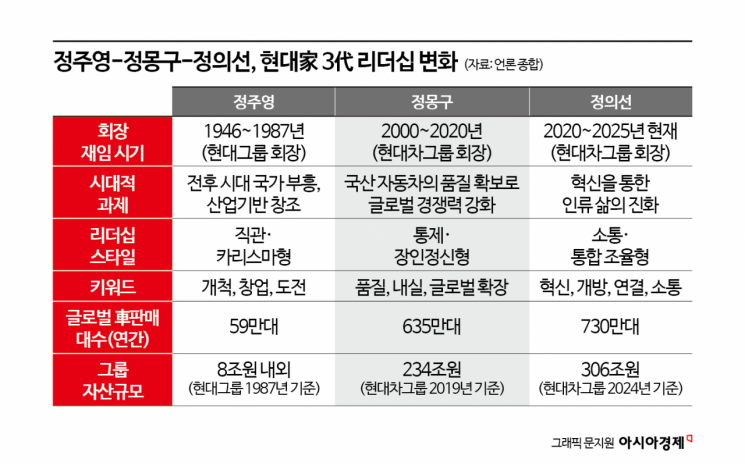
Chung Ju-yung: The Pioneer’s Execution and Community Leadership
The entrepreneurial spirit of the late founder Chung Ju-yung can be summed up as "leadership through challenge"-the drive to pioneer new realities. Postwar Korea lacked both capital and technology. His oft-cited phrase, "Have you tried?" was a message of encouragement, urging Koreans to take on challenges despite having nothing. He prioritized action over calculation and preferred to confront problems head-on rather than waiting for perfect preparation.
The famous story of persuading a British bank to grant a loan with nothing but a photo of a shipyard model, at a time when there was not a single dollar of foreign currency available, is legendary. Thanks to his creative thinking, Hyundai Heavy Industries, with no prior shipbuilding experience, completed a project in 2 years and 3 months-a task that typically took other companies over five years. Breaking free from the conventional wisdom of building a shipyard before constructing ships, he instructed that both be built simultaneously. He once said, "Textbook thinking is a trap of fixed ideas, and that's what makes us fools."
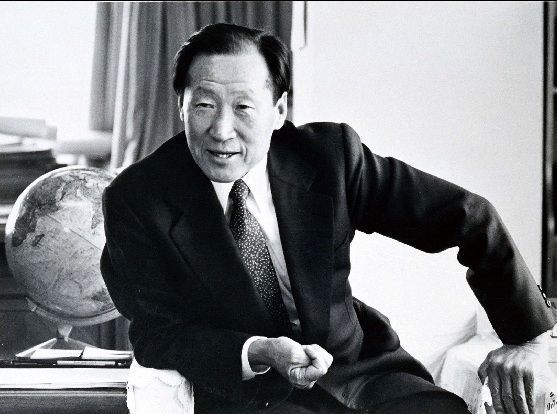
Why is Chung Ju-yung regarded as the most respected businessperson among Koreans? It is because his "rags-to-riches" story transcended individual success to become a symbol of hope for an entire era. He demonstrated that anyone could create opportunities through perseverance and execution, even in the harshest conditions. This mirrors the trajectory of the Korean economy, which grew from an industrial wasteland. Kim Ki-chan, Professor Emeritus at Catholic University, noted, "The difference between an entrepreneur and a businessperson lies in the ability to spot new opportunities. Chung Ju-yung was a daring entrepreneur who found opportunities in markets everyone else thought impossible, such as Middle East construction and shipbuilding."
While Chung’s leadership began with the drive of a pioneer, its roots were always in "people" and "community." Having grown up in a poor farming family and moved to Seoul as a young man, he had little interest in family lineage beyond being part of the Hadong Chung clan. But when Hyundai Group rose to become Korea’s top conglomerate, various branches of the Hadong Chung clan claimed him as their own. He laughed it off, saying, "If we’re all Chungs, we’re one family-why make a fuss about it?" He even set aside a lounge in the Gwanghwamun Hyundai Marine & Fire Insurance building for all clan members and hired staff to manage family events. This anecdote is more than a feel-good story; it illustrates his approach to people. When selecting talent, he cared little for background-anyone with the will to work and a sense of responsibility was welcomed as "family."
For him, "family" was a concept broader than blood ties. Workers in the same industry and citizens living in the same era were all part of a "community that must live together." This mindset was reflected in his management philosophy. Chung saw building industries as equivalent to building the nation. The same applied to the automotive industry. In his memoirs, he wrote, "Cars are moving national flags. Thanks to the image of a country that can independently produce and export cars, other products are also highly valued overseas. If car production becomes 100% localized, our entire machinery industry can advance."
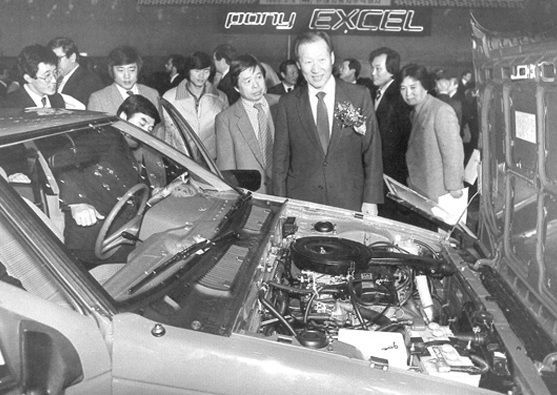 Chairman Chung Ju-yung, the late founder of Asan Group, attending the 1985 Pony Excel new car launch event (center in photo). Provided by AsanJunguyoung.com. Photo by Chung Ju-yung
Chung Mong-koo: Quality Management and Thinking Outside the Box
The founder’s ambition to revive the national economy through automobiles was inherited by his eldest son, Chung Mong-koo. Within the group, he was known as the most hands-on leader with deep knowledge of automobiles. His leadership style perfectly matched the period when the Korean auto industry was transitioning from "pioneering" to "precision and sophistication."
His meticulous attention to detail and aversion to losing were reflected in his management style. Shin Dalseok, former executive director of the Korea Automobile Industry Cooperative and a high school classmate, recalled, "He hated losing, whether in academics or sports, even as a student. This fierce competitiveness later became evident when Hyundai entered quality competition in the global market."
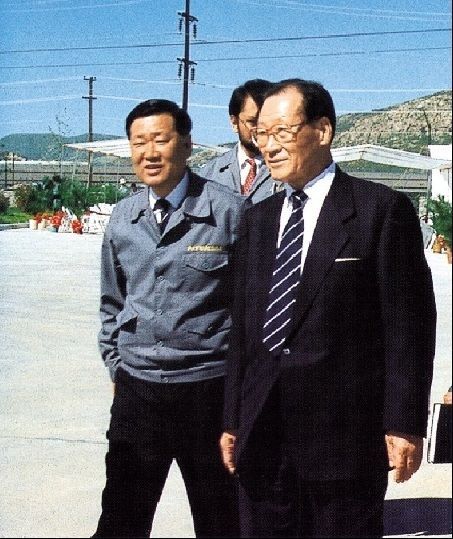 1991 Asan Chung Ju-yung, former chairman (right in the photo), and Chung Mong-koo, honorary chairman. Provided by AsanChungJuyoung.com
Upon taking office, Chung Mong-koo made quality innovation his top priority. The first competitor he targeted was Toyota. He set up a quality control room in the most prominent spot on the first floor of the Yangjae headquarters and framed the improvement tasks identified by J.D. Power, a U.S. new car quality research firm, for all to see. This was a kind of "quality declaration" visible to everyone. The quality control room operated 24 hours a day, and all employees were required to review consumer complaint reports. Executives who failed to read these reports faced reprimands from the chairman.
For Chung Mong-koo, a mistake in quality meant a loss of trust. The organization was always on edge. At a time when Hyundai was rated poorly for quality in global markets, an obsession with craftsmanship and quality was exactly what was needed.
He was not afraid to take bold risks when necessary. A prime example is the "10-year/100,000-mile" free warranty policy introduced in the U.S. market. Internally, there was significant opposition due to concerns about massive recall costs. But he insisted, "Then let’s just make cars that don’t break down for over 10 years." His conviction was that there could be no compromise on quality. This bold decision awakened the organization and marked the beginning of a culture that prioritized quality above all else. Five years after the quality management declaration, in 2004, Hyundai surpassed Toyota in the J.D. Power rankings. This was the moment Hyundai began to shed its "value for money" image and be recognized as a trustworthy quality brand for the first time.
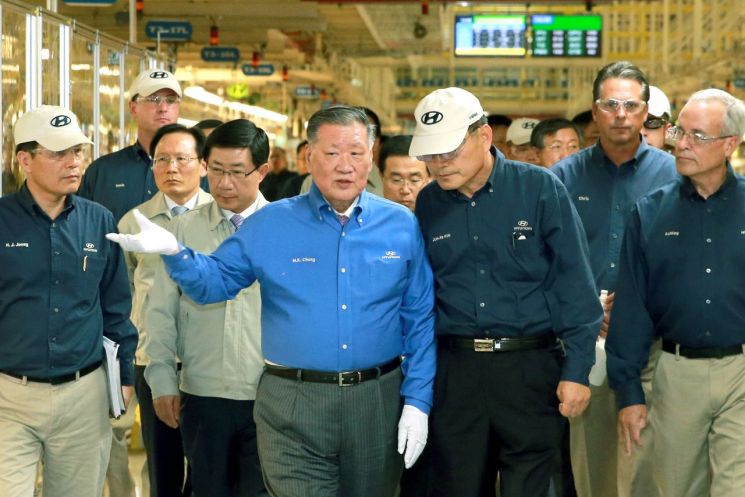 Jung Monggu, Honorary Chairman, inspecting Hyundai Motor's Alabama plant in the United States in 2014 (center in the photo). Provided by Hyundai Motor Group. Photo by Hyundai Motor Group
Another core aspect of Chung Mong-koo’s leadership was "thinking outside the box." When other companies hesitated, he moved in the opposite direction. A representative example is the acquisition of Kia Motors during the 1997 Asian financial crisis. With the domestic economy in recession and consumer sentiment frozen, many saw taking on Kia as a risky move. But his perspective was different. He believed that adding the Kia brand would allow Hyundai Motor Group to dominate the domestic market and provide greater momentum for overseas expansion. After rigorous restructuring, Kia returned to normalcy within a year, and Hyundai Motor Group quickly became Korea’s largest automotive group.
The same applied to overseas expansion targeting the BRICS nations (Brazil, Russia, India, China). After the collapse of the Soviet Union, Russia in the 1990s was a market that most multinational companies avoided due to political and economic instability. He insisted, "You have to enter early during tough times to seize opportunities," and pushed ahead with exports and local plant construction. As a result, Hyundai later captured a 20% market share in Russia, ranking second among automotive brands. Although the company recently withdrew due to the Russia-Ukraine war and other political issues, Russia remains a symbolic stage in Hyundai’s global expansion history.
Chung Euisun: Leadership Through Communication... Connecting the Future Mobility Ecosystem
Chung Euisun’s leadership is defined by communication and connection. He was the first to tackle the deeply entrenched military-style hierarchy within the organization. After he became Executive Vice Chairman, a series of changes followed: casual dress codes, flexible working hours, streamlined reporting, and a horizontal job title system.
The initial response was one of caution. New employees would check the mood in other departments, wondering, "Can we really come to work in jeans?" This illustrates just how deeply hierarchy and discipline were rooted in Hyundai’s organizational culture. Today, casual dress is no longer an issue at Hyundai. Face-to-face reporting has decreased, and email reports have become the norm. As reporting lines were simplified, decision-making became noticeably faster. Professor Kim explained, "When exchanging opinions with Chairman Chung via email, he never takes more than a day to respond. The leader’s prompt feedback sets the pace for the entire organization."
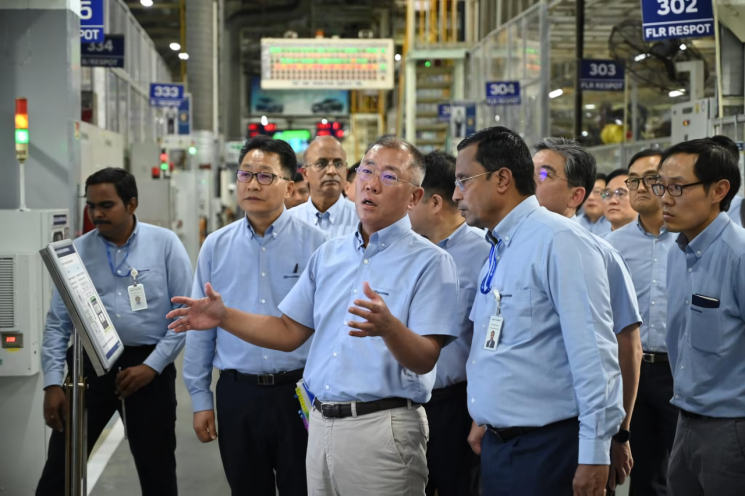 Jung Eui-sun, Chairman of Hyundai Motor Group, conducting an on-site inspection during his visit to the Indian factory in 2023 (center in the photo). Provided by Hyundai Motor Group.
Chung Euisun’s "connection" extends beyond the organization to the outside world. He is not just an owner, but a "business diplomat" who coordinates the global technology and industrial ecosystem. He interacts directly with global automotive leaders such as Mary Barra, Chairman of General Motors, and Akio Toyoda, Chairman of Toyota. His open leadership style even involves collaborating with competitors. Just five years ago, it would have been unimaginable for top-tier rivals to meet and discuss supply chain ecosystems. A recent "chimaek" (chicken and beer) gathering with Jensen Huang, CEO of Nvidia, and Lee Jae-yong, Chairman of Samsung Electronics, is a case in point. In Korea’s business community, this is seen as a dramatic change, especially given the historical rivalry between Samsung and Hyundai in the automotive sector.
Those who have observed Chairman Chung up close describe him as "humble." But this humility is not about self-effacement; it is an openness to the possibility of being wrong. He often seeks advice from elders who worked with previous chairmen, asking, "What would my grandfather have done?" Even when working with the honorary chairman, he never accompanied his father on official overseas trips, preferring to let his father take the spotlight. For him, his father was more than a predecessor-he was an object of respect and reverence.
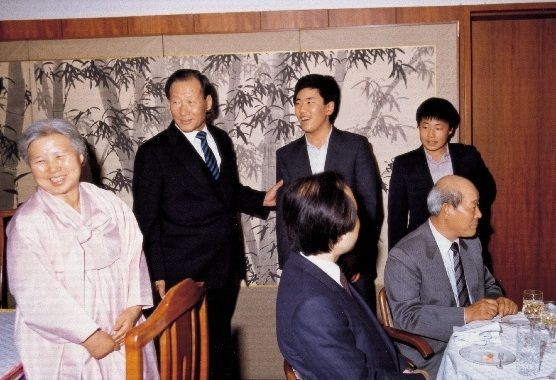 The Hyundai family enjoying a joyful moment together. (From left in the photo) The late Mrs. Byeon Jungseok, Asan Chung Ju-yung, former chairman, and grandson Chung Euisun, chairman, Jeong Ilseon, president of Hyundai BNG Steel. Courtesy of Asan Chung Juyoung.com
There was only one occasion when he strongly asserted his own will to his father: the independent launch of the premium brand Genesis. At the time, Honorary Chairman Chung Mong-koo was cautious about the premium strategy, which required massive investment and a long-term commitment. There was a risk that, if not executed well, both brands would be damaged by being perceived as "expensive Hyundais." However, Chairman Chung Euisun persuaded his father, saying, "We already have the technology and quality. Looking ten years ahead, it’s time for us to pursue an upscale strategy."
Chairman Chung’s vision is firmly fixed on the future. He sensed that the era of technology and quality was giving way to an era of branding. For Hyundai to shed its "value for money" image and compete on the global stage, it needed to add design, storytelling, and emotional appeal. He recruited global design talents like Luc Donckerwolke and redefined the brand philosophy. Genesis emphasized a uniquely Korean aesthetic-space, restraint, and quiet confidence. There was debate over whether Genesis should remain a high-end line within Hyundai or become an independent brand, but Chairman Chung chose independence to provide a differentiated customer experience. Launched in 2015, Genesis has since received top ratings in the North American J.D. Power premium segment and achieved cumulative global sales of 1 million units in just eight years. It is now recognized as the first Korean brand to establish itself in the global premium market.
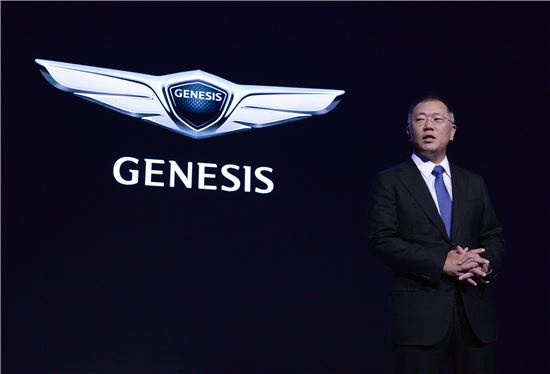 Jung Eui-sun, then Vice Chairman of Hyundai Motor Group, announced the launch of the Genesis brand at the Genesis brand declaration ceremony in November 2015. Provided by Hyundai Motor Group
© The Asia Business Daily(www.asiae.co.kr). All rights reserved.
!["I'd Rather Live as a Glamorous Fake Than as a Poor Real Me"...A Grotesque Success Story Shaking the Korean Psyche [Slate]](https://cwcontent.asiae.co.kr/asiaresize/183/2026021902243444107_1771435474.jpg)


















