October Exports Rise 3.6% to $59.57 Billion
Five Consecutive Months of Export Growth
Semiconductor Exports Hit Record High for October
Exports reached record highs last month, marking five consecutive months of growth. Despite a reduced number of working days due to the Chuseok holiday, strong exports of semiconductors and ships drove the overall increase in exports.
According to the Ministry of Trade, Industry and Energy on November 1, export volume in October was tallied at 59.57 billion dollars, up 3.6% from the same month last year.
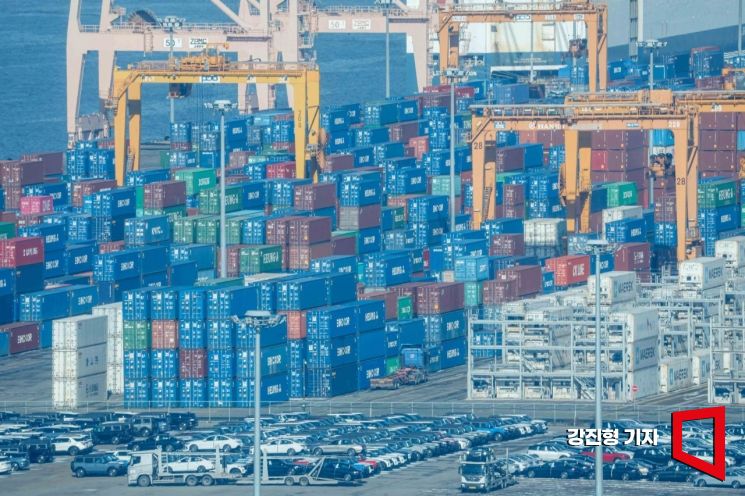
A Ministry official explained, "Despite the number of working days in October decreasing by two to 20 days due to the Chuseok holiday, exports in October set a new record for the month, continuing five consecutive months of positive growth since June. Average daily exports also reached a record high for the entire period, rising 14.0% to 2.98 billion dollars."
In October, exports increased for four out of the fifteen major export items. Due to the reduction in working days, most items-including those outside the top fifteen-showed a negative trend. In particular, items subject to U.S. tariffs recorded a double-digit decline rate.
Semiconductor exports rose 25.4% to 15.73 billion dollars. Strong demand for high-capacity, high-value-added memory such as server-centric high-bandwidth memory (HBM) and double data rate (DDR)5 led to an increase in fixed memory prices, resulting in eight consecutive months of growth and the highest October performance on record. Computer exports (980 million dollars) also increased by 1.7%, ending three months of decline and returning to positive growth.
Ship exports, including marine plants (2.47 billion dollars), reached 4.69 billion dollars, recording a triple-digit growth rate (131.2%) and marking eight consecutive months of increase. Petroleum product exports rose 12.7% to 3.83 billion dollars, marking two consecutive months of growth, as export volume increased year-on-year despite international product prices remaining steady.
By region, exports increased in two out of the nine major export regions. Notably, exports to the United States fell 16.2% to 8.71 billion dollars, the only double-digit decline among the top nine regions, as key items such as automobiles, auto parts, steel, and general machinery weakened due to tariff impacts.
Exports to China decreased 5.1% to 11.55 billion dollars, but remained above 11 billion dollars for the second consecutive month. Exports to ASEAN countries fell 6.5% to 9.4 billion dollars, as most items except semiconductors declined due to fewer working days.
Exports to Central and South America surged 99.0% to 4.71 billion dollars, setting a new all-time record, thanks to large-scale marine plant exports. Exports to the Commonwealth of Independent States (CIS) increased 34.4% to 1.34 billion dollars, marking eight consecutive months of growth.
Imports in October declined 1.5% to 53.52 billion dollars. While energy imports (10.14 billion dollars, -9.0%) decreased, non-energy imports (43.38 billion dollars) rose 0.4%.
Last month, the trade balance posted a surplus of 6.06 billion dollars, up 2.89 billion dollars. The cumulative surplus from January to October reached 56.43 billion dollars, surpassing last year's total surplus of 51.84 billion dollars.
Minister of Trade, Industry and Energy Kim Jeonggwan stated, "Despite the reduction in working days due to the Chuseok holiday in October, semiconductors and ships led overall export growth, resulting in five consecutive months of positive growth since June. Semiconductor exports exceeded 15 billion dollars for three consecutive months, driven by robust demand from downstream industries such as artificial intelligence (AI) servers and rising fixed prices, while ship exports also posted a triple-digit growth rate thanks to 2.5 billion dollars in marine plant exports."
He added, "On October 29, Korea and the United States reached an agreement on the details of tariff negotiations, ensuring that major Korean export items such as automobiles, semiconductors, and pharmaceuticals will not face unfavorable tariffs compared to competitors in the U.S. market. The government will ensure that the Korea-U.S. financial package, which supports the revival of manufacturing and industrial competitiveness in both countries, provides new growth opportunities for Korean companies by thoroughly implementing follow-up measures."
© The Asia Business Daily(www.asiae.co.kr). All rights reserved.
![Clutching a Stolen Dior Bag, Saying "I Hate Being Poor but Real"... The Grotesque Con of a "Human Knockoff" [Slate]](https://cwcontent.asiae.co.kr/asiaresize/183/2026021902243444107_1771435474.jpg)










