Court: "Substantial Land Development Profits Distributed to Private Operators"
Heavy sentences were handed down in the first trial to private business operators implicated in the Daejang-dong development corruption scandal. This comes nearly four years after they were indicted at the end of 2021.
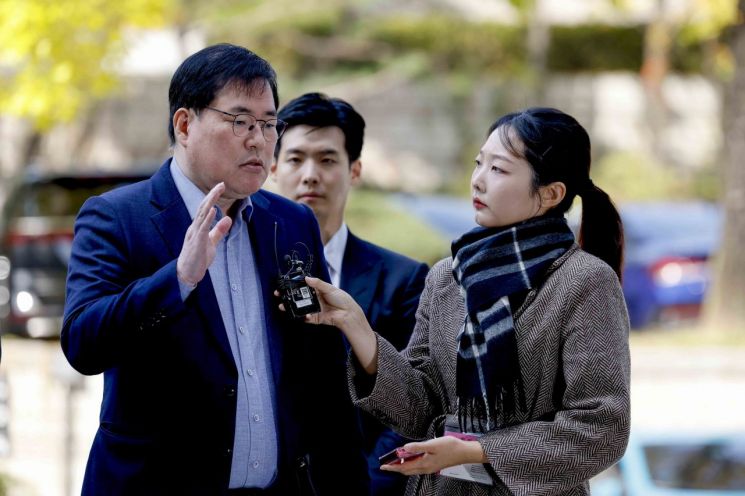 Former Planning Director Yoo Donggyu of Seongnam Urban Development Corporation, who was indicted on allegations of corruption in the Daejang-dong development project, is attending the first trial sentencing hearing held at the Seoul Central District Court in Seocho-gu, Seoul on the 31st and is stating his position. Photo by Yonhap News
On the 31st, the 22nd Criminal Division of the Seoul Central District Court (Presiding Judge Cho Hyungwoo) found all the private business operators and Yoo Donggyu, former Planning Director of Seongnam Urban Development Corporation, guilty on charges including breach of trust under the Act on the Aggravated Punishment of Specific Economic Crimes, and ordered their immediate detention in court.
Yoo Donggyu was sentenced to eight years in prison, a fine of 400 million won, and forfeiture of 810 million won. Kim Manbae, the major shareholder of Hwacheon Daeyu Asset Management, was sentenced to eight years in prison and forfeiture of 42.8 billion won. Attorney Nam Wook and accountant Jung Younghak received four and five years in prison, respectively. Attorney Jung Minyong, who served as the head of the Investment Business Team at the corporation’s Strategic Business Office, was sentenced to six years in prison, a fine of 3.8 billion won, and forfeiture of 3.722 billion won.
The prosecution had sought seven years for Yoo Donggyu and five years for attorney Jung Minyong, but the sentences handed down were even heavier. However, the charge of aggravated breach of trust under the Act on the Aggravated Punishment of Specific Economic Crimes was not recognized due to the unspecified amount of loss, and only the lesser charge of occupational breach of trust under the Criminal Act was upheld.
The court found that the defendants formed collusive relationships during the establishment of the corporation and the process of deciding on the expropriation method, and were essentially pre-designated as project operators, receiving preferential treatment. The court stated, "This case is a series of corrupt crimes committed in collusion, based on relationships formed over an extended period through the provision of money and valuables." The court further explained, "By forming collusive relationships and pre-designating project operators, the requirements of the private business operators were reflected in the project proposal guidelines, enabling them to be selected as preferred negotiation partners. This act significantly undermined the fairness and integrity of the project operator selection process and public trust, making it highly blameworthy from a societal perspective."
The court also pointed out, "The defendants conspired to set a fixed profit policy that amounted to less than half of the expected profits, proceeded with the public tender process accordingly, and ignored demands for profit sharing in case of increased business profits, thereby allowing the business agreement to be concluded as is. This resulted in a risk of substantial land development profits, which should have gone to local residents and the public, being distributed to private business operators, and this risk was realized in the actual distribution of profits." The court criticized the fact that no substantial damages have been recovered and no measures have been taken for restitution.
The court assessed that Yoo Donggyu, while at the corporation and serving as the de facto head of the development project, colluded with private business operators to commit illegal acts. Regarding the private operators, the court determined the sentences based on their individual roles: attorney Nam Wook as the de facto leader, accountant Jung Younghak as the architect of the profit structure, Kim Manbae, a former journalist recruited for lobbying in the project designed and promoted by Nam and Jung, and attorney Jung Minyong, who joined the corporation on Nam’s recommendation and conspired with the group as an insider.
Yoo Donggyu was found to have effectively pre-designated the private business operators as project operators for the Daejang-dong development, reflected their demands in the project proposal guidelines, and exerted influence to ensure their selection as preferred negotiation partners. The court stated, "Even during the business plan review process, the scoring was skewed in favor of the private operators, allowing the consortium led by them, Seongnam Eui Tteul, to be selected as the preferred negotiation partner. The private operators thus secured a favorable position for selection."
The court further noted, "Ultimately, the Daejang-dong development project’s public tender process was a series of actions by Yoo Donggyu and Jung Minyong to ensure the private operators were selected as preferred negotiation partners, accommodating their requests and providing favors. This was a violation of their duty to select preferred negotiation partners through a fair public tender process, betraying the trust placed in them by the corporation."
In the Daejang-dong project, the corporation was allocated only fixed profits, while all remaining development profits were structured to go to the private operators, resulting in losses for the corporation. The court pointed out, "The private operators fully anticipated that the expected development profits, excluding the cost of converting District 1 into a park, would exceed 400 billion won. Nevertheless, they manipulated the appearance to make it seem as if the corporation would receive half of the total profits by understating the development profits."
The corporation received only 182.2 billion won as fixed profits from the Daejang-dong development, but the court found that it suffered financial losses by not receiving the much larger actual profits. However, the court applied only the charge of occupational breach of trust under the Criminal Act, not the aggravated breach of trust under the special law as indicted by the prosecution. With the general law applied instead of the special law, the level of punishment was reduced. The court explained, "The amount of loss for aggravated breach of trust under the special law must be strictly proven. It was impossible to accurately calculate the amount that would have been gained from the project at the time, so only occupational breach of trust is recognized, and aggravated breach of trust under the special law is not."
The reasons for sentencing the five individuals varied according to their roles. Regarding Yoo Donggyu, the court stated, "He formed collusive relationships with private business operators through the exchange of money and valuables, causing a risk of significant financial loss to the corporation. As the de facto head of the Daejang-dong development project, he approved and carried out the arrangements made with the private operators, leading the breach of trust."
The court also recognized that Yoo Donggyu received a bribe of 310 million won from attorney Nam Wook. However, the court acknowledged that during the investigation, he admitted to the crime, providing clues for uncovering the facts, and mainly acted as an intermediary between the private operators and the senior management of Seongnam City in making key decisions.
Regarding Kim Manbae, the court noted that he was not involved in the early stages of the development project led by Nam Wook and Jung Younghak, but "as the largest private shareholder (49%) and de facto representative, he actively participated in the breach of trust, made final decisions, and obtained the greatest economic benefit from the profit distribution."
Attorney Nam Wook was recognized as having led the Daejang-dong development from the outset until around the end of 2014, when he handed over the initiative to Kim Manbae. "As the representative of the private operators, he provided large sums of money and other financial benefits to Yoo Donggyu and others, forming collusive relationships and contributing significantly to the pre-designation of private operators as project implementers." Nam Wook was reported to have brought in Kim Manbae to take over his role and handle external affairs after he was detained during the project. However, the court found his involvement in the breach of trust to be relatively minor.
Regarding accountant Jung Younghak, the court stated, "Along with Nam Wook, he played a central role in the private sector from the early stages of the Daejang-dong development, handling PF loan financing, consortium formation, business plan drafting, and profit estimation, all of which were key to the breach of trust." However, the court recognized as a mitigating factor that he provided the so-called "Jung Younghak recordings" during the investigation.
As for attorney Jung Minyong, the court stated, "Despite being aware of the risk of causing losses to the corporation, he uncritically accepted the private operators’ requests without objective or rational review." The fact that he received a bribe of 3.722 billion won from attorney Nam Wook and falsified related documents was also taken into account in sentencing.
All defendants were found not guilty of violating the Public Officials Conflict of Interest Prevention Act in relation to the Seopangyo Tunnel project. The prosecution argued that information about the tunnel’s planned location and the likelihood of its eventual construction constituted a secret under the Act, but the court ruled otherwise. Additionally, the court found that Kim Manbae’s payment of 500 million won to Yoo Donggyu and the promise of an additional 42.8 billion won were merely the prearranged distribution of financial benefits resulting from their joint breach of trust, and therefore could not be punished as additional bribery.
They were indicted between October and December 2021 on charges including drafting project proposal guidelines in favor of Hwacheon Daeyu, ensuring the Seongnam Eui Tteul consortium (which included Hwacheon Daeyu) was selected as the preferred negotiation partner, thereby obtaining 788.6 billion won in illicit gains and causing 489.5 billion won in damages to the corporation.
© The Asia Business Daily(www.asiae.co.kr). All rights reserved.

















