No Korean Companies Among 1-Trillion-Token Processors
Absent from Top 10 in Website Traffic
"Need to Grow into Creative Adopters and Producers"
As the third anniversary of ChatGPT’s launch approaches and collaboration between artificial intelligence (AI) and humans becomes commonplace, South Korea, which ranks second in the world for paid ChatGPT users, has not made it into the top 10 countries in terms of user traffic. While users in Korea have shown a high level of interest in ChatGPT, critics point out that this has not translated into active utilization, such as developing services based on the platform.
According to the IT industry on November 3, as ChatGPT nears its third year of service, its global monthly active users (MAU) are estimated to reach 1 billion. Sam Altman, CEO of OpenAI, announced at the developer event "DevDay 2025" held on October 6 (local time) that ChatGPT’s global weekly active users (WAU) have reached 800 million.
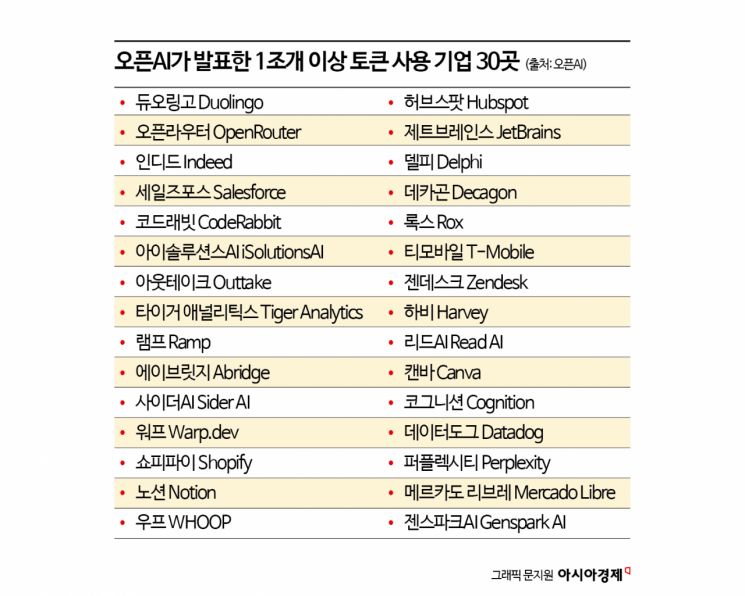
On the same day, OpenAI also revealed a list of 30 companies that have processed more than 1 trillion tokens through its application programming interface (API). When applications or services are built using ChatGPT’s features, the API is used to access these functions, and the more data is generated or analyzed, the greater the token processing volume.
Among the 30 companies announced by OpenAI, 13 were global corporations such as Salesforce, Shopify, and T-Mobile, while the rest were classified as startups. However, there were no Korean companies on the list.
As of August, South Korea was also absent from the top 10 countries with the highest ChatGPT website traffic, according to market research firm SimilarWeb. The top three were the United States, India, and Brazil, while Korea ranked lower than Japan (6th) and the Philippines (9th). Although Korea ranks second only to the United States in the number of paid ChatGPT users and there is a nationwide AI boom, the relatively low user traffic and limited API utilization indicate that there is still a long way to go.
Kang Sujin, CEO of The Prompt Company, commented, "While interest in AI is high in Korea, this interest has not translated into practical utilization. It is time to grow beyond being simple users and become creative adopters and producers." Lee Chanhee, co-founder of the AI meeting recording and summarization service 'Carrot', pointed out, "Services developed in Korea are tailored to the domestic market, which results in limitations in market size and user base. The domestic business sector is also largely confined to AI consulting and character chat, and there is a lack of diversity in the startup investment ecosystem."
Kim Jaepil, senior researcher at the Virtual Convergence Research Institute at Sogang University, stated, "Currently, Korea’s AI boom is heavily focused on 'consumer experience' and 'internal productivity,' and there are not yet many large-scale API businesses built on top of this. However, if Korean corporations and local partner structures open up in the future, Korean companies could also make the list."
© The Asia Business Daily(www.asiae.co.kr). All rights reserved.

















