Once Employed 40,000 Workers at a U.S. Warship Shipyard
The Key Player in Shipbuilding: Once Produced One Ship Every 1.5 Days
Rapid Decline After the Cold War... Acquired by Hanwha
U.S. President Donald Trump announced on October 30 that he has approved South Korea's construction of nuclear-powered submarines, drawing attention by stating, "They will be built at the Philadelphia shipyard." The Philadelphia shipyard is a private shipyard located in Philadelphia, the largest city in Pennsylvania, which was acquired by Hanwha Group last year. While it currently focuses on building commercial vessels, it was once a massive shipyard that repaired and built more than 1,200 U.S. Navy warships.
The Key Player in U.S. Naval Shipbuilding: Once Produced One Ship Every 1.5 Days
The official name of the shipyard mentioned by President Trump is Hanwha Philly Shipyard. It is located on League Island near the Delaware River, between Philadelphia and New Jersey. Since the early 2000s, the shipyard has been building various commercial vessels, such as liquefied natural gas (LNG) carriers and icebreakers, and also provides ship maintenance services.
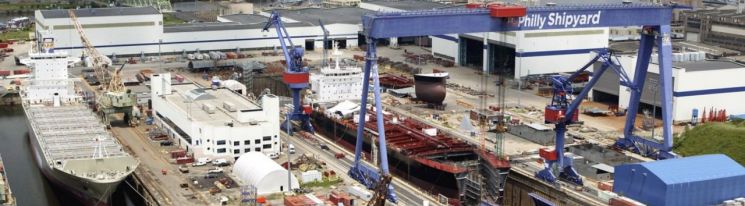
Although the shipyard now primarily builds commercial ships, it was once known as the "heart of the U.S. Navy." During World War II, the Philly Shipyard repaired more than 1,200 U.S. Navy vessels and simultaneously built over 50 warships. In his speech at the Asia-Pacific Economic Cooperation (APEC) CEO Summit on October 29, President Trump remarked, "The United States was once a country that built one ship a day." In fact, at the height of World War II, U.S. shipyards, including the Philly Shipyard, launched the 14,000-ton Liberty ships at an average rate of one every 1.5 days.
Lost Its Glory After the Cold War... Acquired by Hanwha Last Year for 100 Million Dollars
Throughout the 1940s, the Philly Shipyard employed 40,000 workers, but after the war, the workforce gradually shrank to about 14,000. To make matters worse, the end of the Cold War led to a further decline in work for the shipyard. In 1991, the U.S. federal government convened the Base Realignment and Closure (BRAC) Commission and decided to close the Philly Shipyard.
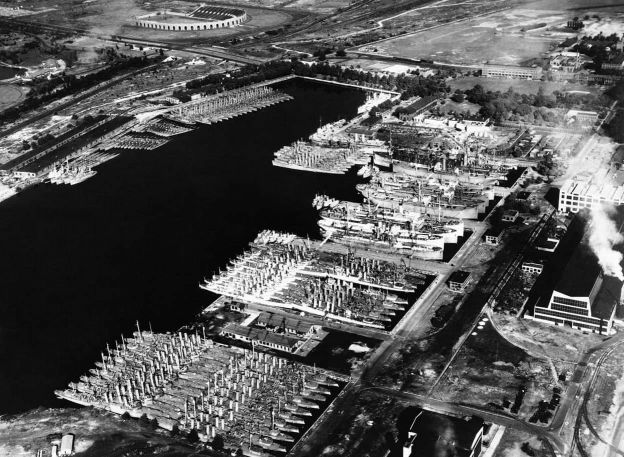 Warships built at the Piri Shipyard during World War II are docked. Screenshot from the online community Reddit
At that time, local authorities, including the city of Philadelphia and the state of Pennsylvania, opposed the federal government's closure decision and even filed lawsuits, but ultimately failed. The military shipbuilding facilities at the Philly Shipyard closed in 1995, resulting in 7,000 workers being laid off. Afterward, the city of Philadelphia operated the remaining shipyard facilities in cooperation with private companies. In 2005, Norway's Aker Group acquired the shipyard and focused on commercial shipbuilding. On June 20 last year, Hanwha Group acquired the Philly Shipyard from Aker for 100 million dollars (approximately 143 billion won).
Will It Reemerge as a Facility for South Korean Nuclear-Powered Submarine Production?
Once sprawling across the entire League Island, the Philly Shipyard has now been reduced to a smaller facility with two docks and a 660-ton gantry crane for cargo handling. However, Hanwha Group is making significant facility investments, and with the possibility of building South Korean nuclear-powered submarines in the future, the shipyard has a new opportunity to reestablish itself as a military shipbuilding facility.
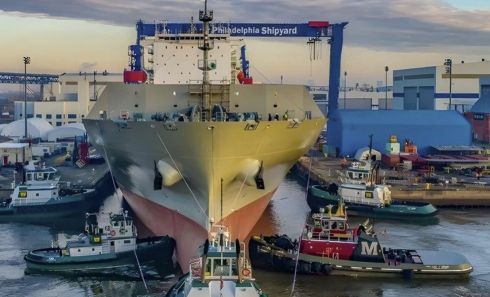 Hanwha Group plans to invest 5 billion dollars (approximately 7.15 trillion won) in the Philippines shipyard. Hanwha Group
Previously, President Trump stated at the APEC CEO Summit press conference that "Hanwha Group will invest 5 billion dollars (approximately 7.15 trillion won) in Philadelphia, USA." In fact, Hanwha Group announced the same investment plan this August, explaining, "We plan to expand our annual shipbuilding capacity from the current 1 to 1.5 ships to up to 20 ships by securing additional docks and quay walls, and establishing new production bases." This would mean more than a tenfold increase in shipbuilding capacity.
This investment is expected to accelerate further, as it aligns with the South Korean government's security-driven demand for nuclear-powered submarines. During the recent South Korea-U.S. summit, President Lee Jaemyung emphasized to President Trump, "We ask for your decision to allow us to receive fuel for nuclear-powered submarines. If you permit fuel supply, we will be able to build several submarines equipped with conventional weapons using our technology, which will help defend the waters around the Korean Peninsula and reduce the burden on U.S. forces."
© The Asia Business Daily(www.asiae.co.kr). All rights reserved.
![Clutching a Stolen Dior Bag, Saying "I Hate Being Poor but Real"... The Grotesque Con of a "Human Knockoff" [Slate]](https://cwcontent.asiae.co.kr/asiaresize/183/2026021902243444107_1771435474.jpg)


















