LH President's Resignation Processed After Audit
HUG Announces Recruitment for New President
Personnel Appointments Stalled by Vacant First Vice Minister Post
Six Out of 29 Agencies See Heads Step Down
First Vice Minister Appointment N
As soon as the National Assembly audit ended, the appointment process for heads of agencies under the Ministry of Land, Infrastructure and Transport began to accelerate. The resignation letter of Lee Hanjun, President of Korea Land and Housing Corporation (LH), which had been sitting in a drawer for over two months, was finally approved by the government the day after the National Assembly Land, Infrastructure and Transport Committee's audit concluded. On the same day, the Korea Housing & Urban Guarantee Corporation (HUG) launched an open recruitment process for its new president. It appears that the appointments for key agencies under the Ministry, which had been on hold, are now being set in motion one after another. However, the position of First Vice Minister of the Ministry of Land, Infrastructure and Transport remains vacant, so it is expected to take more time before the overall personnel structure is fully established.
LH President's Resignation Approved Immediately After Audit Ends
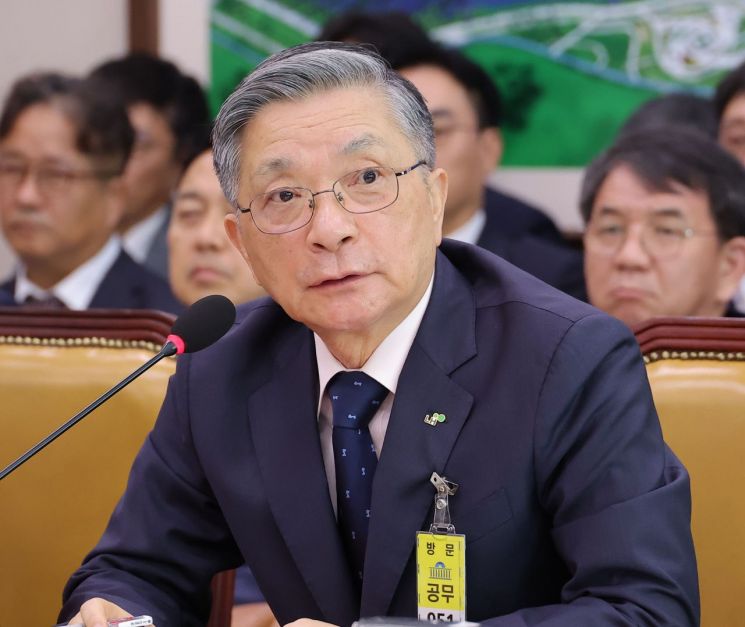 Lee Hanjun, President of Korea Land and Housing Corporation (LH), is responding to a lawmaker's question during the National Assembly Land, Infrastructure and Transport Committee's audit on the 14th. President Lee announced his resignation in August, but it was not accepted, and he eventually appeared at the audit to face intense criticism from opposition lawmakers. In his farewell speech on the 31st, he said, "As I conclude this heavy journey, I intend to serve those in need in new fields and fulfill my role for national development." Yonhap News
On the 31st, LH announced that President Lee Hanjun's dismissal was approved by the government the previous day. President Lee had submitted his resignation in August, but it was not accepted, requiring him to attend the National Assembly audit. He was only dismissed after the audit ended. Some interpret this as the government trying to avoid responsibility that might arise during the audit and the implementation of housing policies. In his farewell speech, President Lee stated, "I have come this far with the original intention of working tirelessly to earn the trust and love of the public for LH. Now, as I conclude this heavy journey, I intend to serve those in need in new fields and fulfill my role for national development."
With the resignation now accepted, LH can begin the process of selecting a successor. An LH official said, "We plan to immediately initiate administrative procedures such as forming the executive recommendation committee." Choi Kyungho, Director of the Housing Neutrality Research Institute, commented, "The conditions for development sites and the population structure have changed significantly compared to past development periods. It is important to have leadership that understands the direction of the LH Reform Committee and is equipped with the expertise to implement housing policies in line with changing times."
HUG Begins President Recruitment Process... "About Three Months Required"
HUG also began its official recruitment process for a new president by posting a job announcement on the 30th, immediately after the audit concluded. The application period runs until November 7. The final candidates will be selected through vetting by the executive recommendation committee and review by the Ministry of Economy and Finance's Public Institutions Management Committee, narrowing down to two or three candidates. The Ministry of Land, Infrastructure and Transport will then finalize the appointment through a general meeting of shareholders. The Ministry holds an 89% stake in HUG. The entire process, including presidential appointment, typically takes about three months. Former President Yoo Byungtae resigned in July, leaving a year on his term, after receiving a "poor" rating for two consecutive years in public institution management evaluations.
Among the 29 agencies under the Ministry of Land, Infrastructure and Transport, the presidents of six have submitted their resignations. SR is awaiting acceptance of its president's resignation, while LH, Korea Airports Corporation, Korea Railroad Corporation (KORAIL), HUG, and Jeju Free International City Development Center (JDC) are currently operating under acting presidents. Korea Real Estate Board and Korea Infrastructure Safety and Technology Corporation continue to be led by acting presidents after their terms expired.
An official from one of the Ministry's affiliated agencies said, "The selection of the Vice Minister is the priority, and appointments for key agency heads like LH need to be completed before appointments at our agency can resume. There is unlikely to be any progress for the time being." He explained that if appointments for agency heads proceed before the selection of the Vice Minister-who assists the Minister and oversees policy and administration-it could inevitably cause practical confusion and delays.
Analysis of Past First Vice Ministers... Directors of Planning and Housing Are the Fast Track
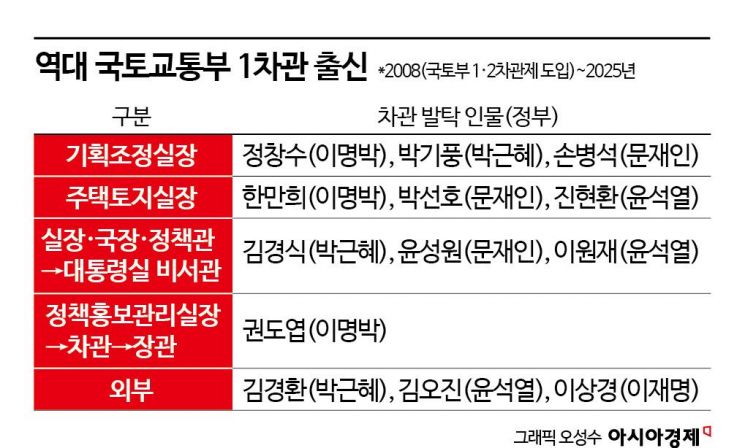
Most previous First Vice Ministers have been promoted internally within the Ministry. An analysis of the 13 First Vice Ministers over the 17 years since the introduction of the dual vice minister system in 2008 shows that 10 were promoted from within. Six of them previously served as Director General for Planning and Coordination (three persons) or Director General for Housing and Land (three persons), while three had experience as Secretary for Land, Infrastructure and Transport at the Presidential Office.
The Director General for Planning and Coordination oversees the Ministry's budget, personnel, and organization, making it a prime candidate pool for vice minister appointments. Former First Vice Ministers Chung Changsoo (Lee Myungbak administration), Park Gipung (Park Geunhye administration), and Son Byungseok (Moon Jaein administration) all held this position.
Han Manhee (Lee Myungbak administration), Park Sunho (Moon Jaein administration), and Jin Hyunhwan (Yoon Sukyeol administration) previously served as Director General for Housing and Land. Since the First Vice Minister is responsible for housing, urban, and land policies, the Director General for Housing and Land is considered well-suited for the role in terms of work continuity.
Serving as Presidential Secretary Leads to Fast-Track Promotion
Some have become vice ministers without serving as directors general. Yoon Sungwon (Moon Jaein administration) and Lee Wonjae (Yoon Sukyeol administration) were at the director level (Grade 2, Director General), but were promoted to the Presidential Office (Grade 1), recognized for their policy coordination abilities, and subsequently appointed as vice ministers. Kim Kyungsik (Park Geunhye administration) became vice minister after serving as Director General for Construction and Water Resources Policy and as Secretary at the Presidential Office.
It is rare for an external figure to be appointed as First Vice Minister. In the past 17 years, this has happened only three times, including Lee Sangkyung. Kim Kyunghwan (Park Geunhye administration) was the first professor to become vice minister, having served as a professor of economics at Sogang University and as President of the Korea Research Institute for Human Settlements. Kim Ojin (Yoon Sukyeol administration) became vice minister after serving as an aide and party official for a conservative party and as a secretary at the Presidential Office, but stepped down after six months to run in the general election.
There have also been cases of "one-top promotions" from vice minister to minister. Former Minister Kwon Dooyeop (Lee Myungbak administration) was appointed as First Vice Minister at the launch of the Ministry of Land, Transport and Maritime Affairs in 2008, served for about 2 years and 5 months, and was reappointed as Minister in 2011. He was an expert in housing and urban affairs, having served as Director General for Land Policy, Director General for Housing Policy, and Director General for Policy Promotion and Management at the predecessor Ministry of Construction and Transportation, as well as President of Korea Expressway Corporation.
With the Ministry facing increased policy burdens after the October 15 measures, there is a growing opinion that the Vice Minister position should be filled by a policy expert to complement the political nature of the Minister. Professor Lim Jaeman of Sejong University said, "Minister Kim Yoonduk has extensive experience with the National Assembly Land, Infrastructure and Transport Committee, which is a strength in setting the overall policy direction. At times like this, it is necessary for the Vice Minister to be a professional figure who can design detailed policies and oversee field implementation." Professor Lim added, "If a candidate's practical sense and expertise are verified, it is not necessary to strictly adhere to the tradition of internal promotion."
A senior government official said, "Someone who has experienced the relationship between market trends and policy firsthand can drive policy implementation more effectively. Being in the field often reveals moments when the policy direction envisioned in one's mind does not match actual market trends. Experiencing such trial and error helps predict market responses and enhance policy effectiveness."
A Ministry of Land, Infrastructure and Transport official said, "The appointment of the Vice Minister is ultimately decided by the President. Unlike the appointment of public institution heads, there is no legally prescribed process, so it is difficult to predict the timing of the appointment."
© The Asia Business Daily(www.asiae.co.kr). All rights reserved.
![Clutching a Stolen Dior Bag, Saying "I Hate Being Poor but Real"... The Grotesque Con of a "Human Knockoff" [Slate]](https://cwcontent.asiae.co.kr/asiaresize/183/2026021902243444107_1771435474.jpg)

















