Hyundai Executive Speaks with Korean Reporters at Japan Mobility Show
New Nexo to Launch in Japan in First Half of Next Year
"Market Conditions Are Favorable"
Hyundai Motor Company has decided to expand the sales regions for its hydrogen electric vehicles to include Japan, Europe, and North America. Although demand remains limited due to a lack of charging infrastructure, this move is part of the company's strategy to secure a leading position in the global eco-friendly vehicle market.
Jung Yuseok, Head of Domestic Business Division at Hyundai Motor Company, met with reporters at the Japan Mobility Show 2025 on the 29th and said, "After completing local certification procedures, we plan to begin selling the new Nexo in Europe and North America within the first half of next year. We are also considering additional regions, including the Asia-Pacific and Australia, particularly where hydrogen vehicle infrastructure is in place."
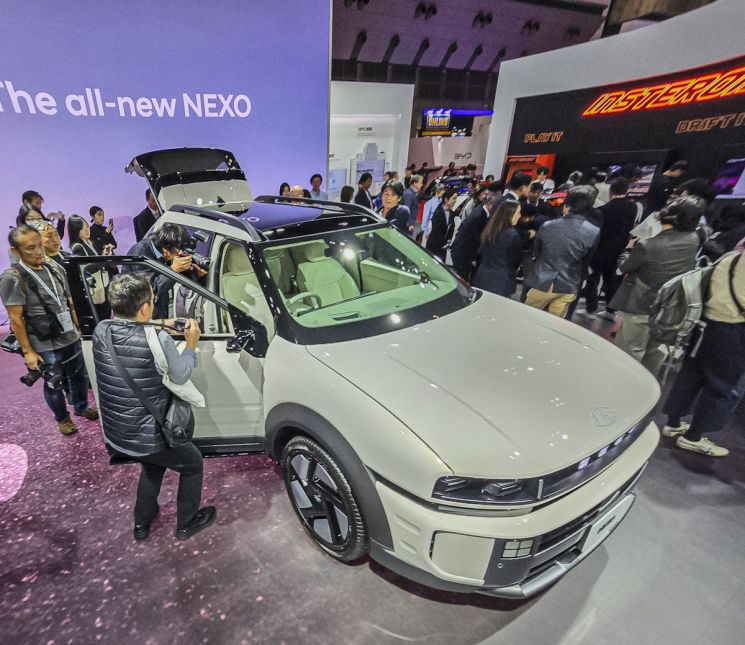 Hyundai's new Nexo displayed at the Japan Mobility Show 2025. It was unveiled in Japan for the first time as a hydrogen electric vehicle. Local sales will begin in the first half of next year. Provided by the Korea Automobile Journalists Association
At this event, Hyundai unveiled the new Nexo in Japan for the first time. This is the second-generation model, released seven years after the first-generation debuted in 2018, and was introduced in Korea this past April. The company also announced plans to begin sales in Japan starting next year. After re-entering the Japanese market in 2022, Hyundai currently sells only battery electric vehicles there, such as the Kona SUV, Ioniq 5, Ioniq 5 N, and Inster (known as Casper Electric in Korea). With the addition of a hydrogen electric vehicle, the company is expanding its lineup.
Japan has been relatively slow in transitioning to electrified vehicles. However, it is one of the few countries where hydrogen passenger cars are sold. Toshiyuki Shimegi, Head of Hyundai Motor Japan Corporation, stated, "We want to demonstrate to the Japanese market that Hyundai is forward-looking for all powertrains."
There are still few manufacturers producing mass-market hydrogen electric vehicles. For passenger cars, the main players are Hyundai, Toyota (Mirai), and Honda (CR-V e:FCEV). BMW has developed a prototype, the iX5 Hydrogen, which is currently in pilot operation. Some Chinese companies are producing commercial vehicles such as buses and trucks.
According to data from market research firm SNE Research, global hydrogen vehicle sales peaked at around 20,704 units in 2022, then declined to 14,451 units the following year and 12,866 units last year, showing a steady decrease. In the first half of this year, only about 4,102 units were sold, a 27% drop compared to the same period last year. Hyundai's hydrogen electric vehicle exports have also been declining since reaching 1,118 units in 2021. This is mainly because charging infrastructure is lacking, and both hydrogen vehicles and hydrogen fuel itself remain expensive, making it difficult to achieve price competitiveness.
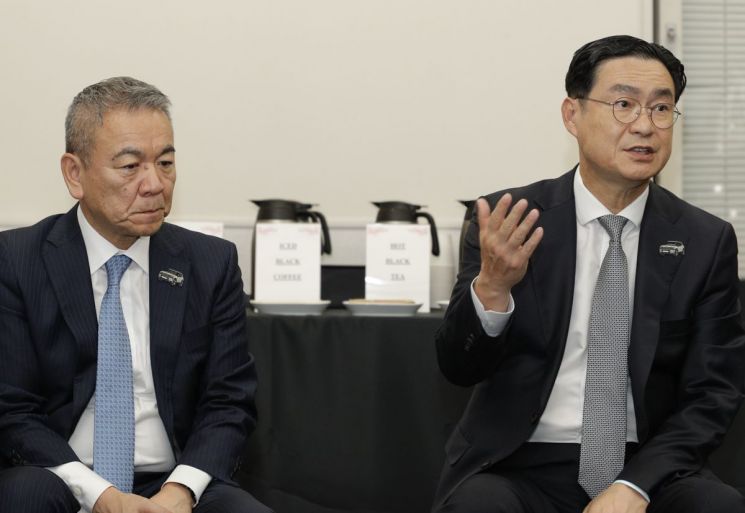 Jung Yuseok, Head of Domestic Business Division at Hyundai Motor Company (right), and Toshiyuki Shimegi, Head of Hyundai Motor Japan Corporation, met with the Korean press and answered questions at Tokyo Big Sight, where Japan Mobility Show 2025 was held on the 29th. Provided by Korea Automobile Journalists Association
Nevertheless, the industry expects the market to grow in the mid- to long-term in line with the global decarbonization trend. As carbon emission regulations become increasingly strict, it will be difficult to meet targets with battery electric vehicles alone. Shimegi added, "The price of hydrogen in Japan is relatively high at about 2,400 yen per kilogram, and safety inspections for hydrogen charging tanks take a long time, limiting business operations to about 15 days a month. However, Tokyo is considering subsidies for hydrogen electric vehicles and hydrogen itself, and there is a high possibility that regulations on hydrogen charging station operations will be relaxed. Therefore, we expect the business environment to become more favorable in the future."
Jung also stated, "The first-generation Nexo was sold in limited quantities in Europe after 2018. The main reason was the fragmented charging infrastructure. However, based on our past sales experience and the fact that consumers have become more familiar with hydrogen vehicles, we plan to sell about 11,000 units domestically this year."
© The Asia Business Daily(www.asiae.co.kr). All rights reserved.
![Clutching a Stolen Dior Bag, Saying "I Hate Being Poor but Real"... The Grotesque Con of a "Human Knockoff" [Slate]](https://cwcontent.asiae.co.kr/asiaresize/183/2026021902243444107_1771435474.jpg)

















