Wendy Cutler: "Structural Issues Remain... China May Play the Rare Earths Card Again"
Scott Kennedy: "U.S. Steps Back... Xi Secures Space to Expand Leadership"
U.S. President Donald Trump and Chinese President Xi Jinping reached an agreement to ease trade tensions during their summit on the 30th. However, American experts have assessed that while the two countries managed to patch up surface-level conflicts and avoid escalation, they have only achieved a "temporary truce" without addressing the fundamental issues underlying the U.S.-China trade imbalance.
Above all, this summit is seen as a moment where China significantly boosted its bargaining power against the United States by leveraging the rare earth card. Experts have warned that China could use such practical means of retaliation to pressure the U.S. at any time, and that the trade war between the two countries could reignite.
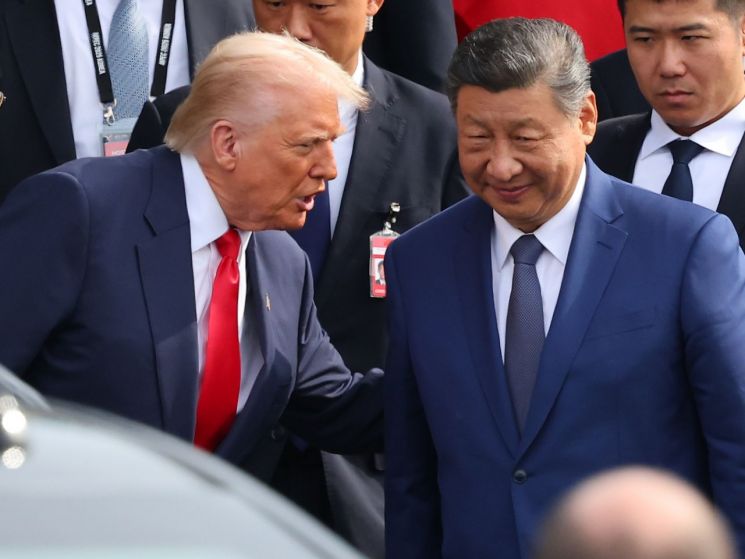 U.S. President Donald Trump and Chinese President Xi Jinping are seen leaving the meeting room while conversing after concluding the U.S.-China summit at Naraemaru Protocol Office, Busan Gimhae Air Base on the 30th. Photo by Yonhap News
Wendy Cutler, Vice President of the Asia Society Policy Institute (ASPI), stated in a press release that "the long-awaited meeting between President Trump and President Xi was an important step in stabilizing relations by de-escalating a series of recent tensions between the two countries." However, she pointed out, "The agreements announced at this summit do little to address the fundamental structural issues driving economic tensions between the two nations, such as China's excess production capacity, excessive subsidies, and unfair trade practices," adding, "This truce may not last long."
Nicholas Burns, former U.S. Ambassador to China, said in a CNBC interview that "the truce between the U.S. and China is not a comprehensive agreement," diagnosing that "we remain in a precarious ceasefire amid a simmering trade war."
Robert Lighthizer, former U.S. Trade Representative who led trade negotiations with China during the first Trump administration, also predicted in a Bloomberg TV interview conducted before the summit that this truce would not last. He stated, "Rather than complete decoupling, we will see strategic decoupling," and anticipated, "This will last only a few months-at most a year-after which we will have to revisit and reconsider these issues."
There have also been growing observations that the U.S.-China summit and the trade war truce have only served to increase China's confidence and negotiating leverage.
Scott Kennedy, Senior Adviser and Trustee Chair in Chinese Business and Economics at the Center for Strategic and International Studies (CSIS), told Bloomberg that "although China made some concessions, the key dynamic is that China forced the U.S. to back down from a series of sanctions." He analyzed, "President Xi has completely mastered how to handle President Trump," adding, "President Xi has created a safer space for expanding China's economic system and global leadership."
Vice President Cutler noted that, unlike the U.S.-centric trade agreements the United States has concluded with other countries, this negotiation showed that China can play the same game as the United States.
She emphasized, "Unlike the Phase One trade deal signed during the first Trump administration, this time China adopted a much tougher negotiating stance," pointing out, "Especially regarding tariff reductions and easing shipping costs, China insisted on receiving something in return for every concession it made." She continued, "While the suspension of China's rare earth export controls is welcome news, it is highly likely that China will continue to use this as a tool to pressure the U.S. in the future." She expressed concern that "as a result, U.S. tariff threats will lose credibility and become much more costly to implement."
Earlier, President Trump and President Xi held a summit at Busan Gimhae Air Base on the 30th, where the United States agreed to reduce tariffs on Chinese imports of fentanyl from the current 20% to 10%, while China agreed to suspend rare earth export control measures for one year and resume imports of U.S. soybeans. Tensions between the two countries had reached a peak ahead of the summit, as China announced plans to strengthen rare earth export controls and the U.S. responded by signaling it would impose an additional 100% tariff on Chinese goods starting in November. Rare earth elements are key materials for advanced industries such as semiconductors and electric vehicle batteries, and with China accounting for 70% of global supply, such export controls were seen as targeting a critical vulnerability for the United States. As a result, China's "weaponization" of rare earths is viewed as having served as a powerful bargaining chip in trade negotiations with the U.S.
© The Asia Business Daily(www.asiae.co.kr). All rights reserved.

















