Korea Disease Control and Prevention Agency Publishes "2023 Statistical Yearbook of Rare Disease Patients"
Expanded Scope of Incidence Statistics by Gender and Age Group
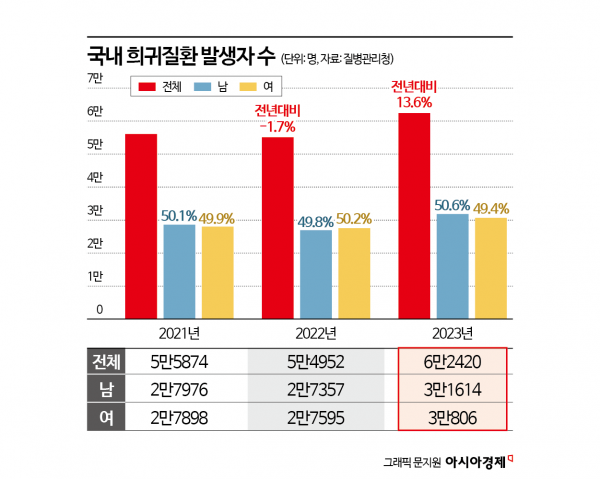
With the addition of 42 diseases, including hereditary kidney disease characterized by multiple cysts in both kidneys and idiopathic nonspecific interstitial pneumonia, to the list of nationally managed rare diseases, the number of newly diagnosed rare disease patients in 2023 exceeded 62,000.
Rare diseases are defined as those affecting fewer than 20,000 patients or those whose prevalence is unknown due to diagnostic challenges.
According to the "Annual Statistics Report on Rare Disease Patients" released by the Korea Disease Control and Prevention Agency on October 31, the number of new rare disease cases in 2023 reached 62,420, an increase of 7,468 from the previous year. This increase is attributed to the designation of 42 diseases, such as "autosomal dominant polycystic kidney disease (4,830 cases)" and "idiopathic nonspecific interstitial pneumonia (313 cases)," as nationally managed rare diseases.
Among the new cases, 2,510 (4.0%) were classified as ultra-rare diseases, 113 (0.2%) as other chromosomal abnormality diseases, and the remaining 59,797 (95.8%) as other rare diseases. By gender, there were 31,614 male patients (50.6%) and 30,806 female patients (49.4%).
Of the new patients, 3.4% (2,093) died in the same year. By age group, those aged 80 or older accounted for 16.7% of all deaths, those aged 70-79 for 7.3%, and those aged 60-69 for 3.1%.
Among the new patients, the total number of individuals who received medical care was 60,050. The average total medical expense per person, including an out-of-pocket payment of 680,000 won, was approximately 6.52 million won. In addition, 56,004 patients (93%) were covered by national health insurance, while 4,046 (7%) were medical aid beneficiaries.
Among rare diseases, the single disease with the highest medical expense burden was Gaucher disease, with a total medical cost reaching 310 million won, including an out-of-pocket payment of 31.84 million won. Morquio syndrome (total medical cost of 240 million won, out-of-pocket payment of 24.56 million won) and type II mucopolysaccharidosis (total medical cost of 210 million won, out-of-pocket payment of 21.32 million won) also each had total medical costs exceeding 200 million won.
The Annual Statistics Report on Rare Disease Patients is a nationally approved statistical resource containing information on the incidence, mortality, and healthcare utilization of rare diseases in Korea. It has been published annually since 2020 to systematically collect, analyze, and provide rare disease-related information, laying the foundation for evidence-based policy development and promoting related research.
Starting with this year's report, the Korea Disease Control and Prevention Agency has expanded the scope of information provided by easing the criteria for disclosing disease-specific statistics by gender, age group, and region. Previously, detailed statistics by disease were only disclosed for diseases with more than 200 cases, but going forward, data by gender, age group, and region will be released for all diseases. However, in consultation with patient and expert groups, information on diseases with only one to three cases will be masked to protect personal information and ensure safer data provision.
Im Seungkwan, Commissioner of the Korea Disease Control and Prevention Agency, emphasized, "Producing accurate statistics is the first step toward implementing tailored policies for rare diseases," adding, "We will continue to strengthen the national management system for rare diseases to bring about meaningful changes in the lives of rare disease patients and their families."
© The Asia Business Daily(www.asiae.co.kr). All rights reserved.

















