Redevelopment Industry Also Calls for Easing Rental Housing Ratio
"The Appropriate Ratio May Differ From When the Real Estate Market Was Stable"
Seoul Mayor Oh Sehoon announced that he would propose to the government a plan to lower the mandatory ratio of rental housing required in redevelopment and reconstruction projects.
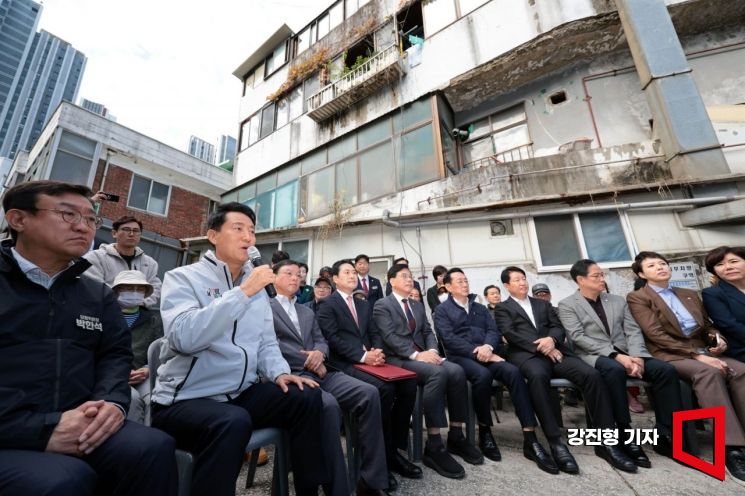 Seoul Mayor Oh Sehoon is holding a meeting with residents after visiting the Sangye 5 Redevelopment Promotion Zone in Nowon-gu, Seoul on October 24, 2025. Photo by Kang Jinhyung
At a briefing on the 2026 budget proposal held at Seoul City Hall on October 30, Mayor Oh said, "During a recent visit to the Garibong-dong redevelopment site, an association official earnestly asked if the ratio of rental housing could be reduced due to low profitability," adding, "At this morning's meeting, I said we should respond flexibly."
He continued, "The ratio of rental housing set in the past, when the economy was strong and real estate prices were stable, may be different from what is needed now," and added, "We have set a general direction for Seoul to do what it can to reassure citizens, and to request changes from the Ministry of Land, Infrastructure and Transport or seek legal amendments if necessary."
Under the current Urban and Residential Environment Improvement Act, the mandatory ratio of rental housing is set at 50-70% for redevelopment and 30-50% for reconstruction. Seoul has been applying a 50% mandatory ratio through municipal ordinances.
Choi Jinseok, Director of Housing at Seoul Metropolitan Government, explained, "If raising the floor area ratio, applying business feasibility adjustment coefficients, and shortening the permit period are external support measures for redevelopment projects, then the rental housing ratio is an internal factor," adding, "Since this is an issue that has been raised by the redevelopment industry, we are considering whether it should be discussed."
When asked whether the October 15 real estate measures by the government have led to a decrease in real estate transactions in Seoul and made it difficult to secure local tax revenues, Mayor Oh responded, "The acquisition tax, which forms the backbone of local taxes, is bound to decrease. I am concerned."
However, he explained, "Even if transactions have dropped by 80%, acquisition tax does not decrease by the same proportion. There are various forms in which home ownership changes, such as inheritance and gifts, and there are buffer zones," adding, "It is true that there is some impact, but it is not a drastic decrease, so we have prepared the budget very conservatively on that basis."
Regarding the October 15 measures, Mayor Oh criticized, "It does not promote housing supply at all, but rather puts people in a position where they cannot buy or sell homes and are forced to consider expensive monthly rentals."
He added, "Regardless of the government's direction, our top priority will be to collaborate as much as possible to ease citizens' concerns, promote supply, and stabilize the real estate market downward."
© The Asia Business Daily(www.asiae.co.kr). All rights reserved.
![An "Human Knockoff" Clutching a Stolen Dior Bag... A Bizarre Con That Shakes Your Sanity [Slate]](https://cwcontent.asiae.co.kr/asiaresize/183/2026021902243444107_1771435474.jpg)
















