Bank of Korea "Issue Note: AI Proliferation and Youth Employment Contraction"
Employment Trends by Age Group Since the Launch of ChatGPT
Youth Job Losses Driven by High AI-Exposure Sectors
Sharpest Decline for People in Their 20s... Jobs for Thos
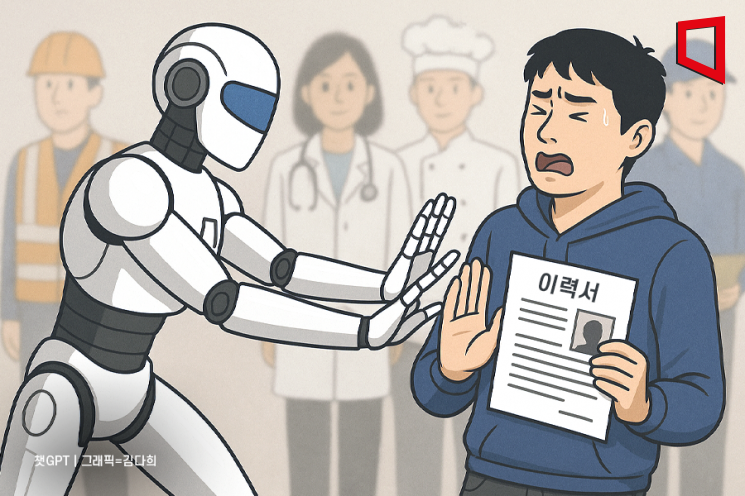
As artificial intelligence (AI) technology is rapidly introduced and spreading in South Korea, a study by the Bank of Korea has found that young people in their 20s are being hit the hardest. Over the past three years, 200,000 jobs for young people have disappeared in occupations with high exposure to AI technology. This is interpreted as a result of companies reducing new hiring and replacing work with AI. In contrast, for those in their 50s, whose jobs require social skills such as collaboration and organizational management, employment actually increased even in occupations with high AI exposure.
Job Losses Among People in Their 20s Concentrated in High AI Exposure Sectors...While Employment for Those in Their 50s Increased
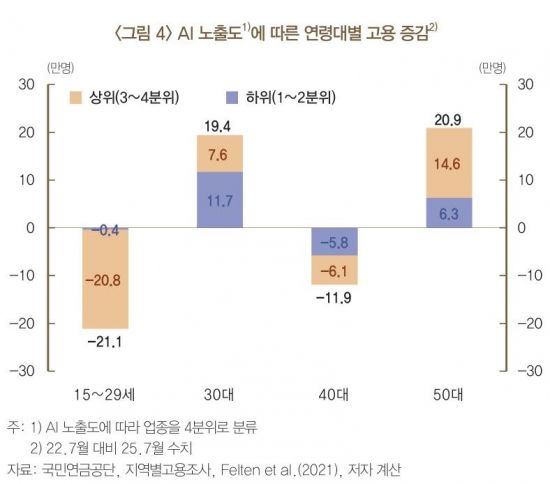
According to the "BOK Issue Note: AI Proliferation and Youth Employment Issues" report released by the Bank of Korea on the 30th, over the past three years since the launch of ChatGPT (July 2022 to July 2025), jobs for young people (aged 15-29) in occupations with high exposure to AI technology, such as computer programming, decreased by 208,000, the largest impact among all age groups. This accounts for 98.6% of the total decline in jobs for young people (a decrease of 211,000).
In contrast, employment for people in their 50s increased, with job growth even in occupations highly exposed to AI technology. Over the past three years, 209,000 jobs were added, with 146,000 (70%) of these in high AI exposure sectors. The Bank of Korea derived these results using the number of National Pension subscribers, the largest employment administrative statistic in South Korea, covering about 16 million people.
Oh Samil, head of the Employment Research Team at the Bank of Korea’s Economic Research Department, who led the study, said, "While the decline in youth employment is partly due to a shrinking population, since the launch of ChatGPT, it has become clear that the decrease is being driven by high AI exposure sectors." He added, "In contrast, the largest increase in employment occurred among people in their 50s, and we confirmed that jobs are increasing even in industries highly exposed to AI technology." This indicates that, similar to the United States, the South Korean labor market is experiencing a seniority-biased technological change in the early stages of AI adoption, with employment for juniors decreasing and employment for seniors increasing.
By sector, youth employment in computer programming, system integration, and management-including software development-fell by 11.2%. In publishing, it dropped by 20.4%, and in information services such as web server hosting, it declined by 23.8%. In professional services such as law and accounting, youth employment decreased by 8.8%.
The Lower the Seniority, the More Routine Work...Youth Employment Declines More Where AI Complements Work
This seniority bias occurs because those with lower seniority generally handle more routine knowledge work. Oh explained, "A strong hypothesis for the decline in youth employment at the early stage of AI adoption is the difference in work tasks. Most junior employees, who are generally young, perform work according to manuals or instructions from above and have little experience, so much of their work relies on knowledge learned from books, making it easier to be replaced by AI." In contrast, seniors with more experience are tasked with work that requires contextual understanding, collaboration, organizational management, and interpersonal skills-implicit knowledge and social skills that AI currently finds difficult to replace. As a result, they are more likely to use AI as a complementary tool rather than be replaced by it.
For this reason, it was found that even among young people, those with mid-to-high educational backgrounds, such as graduates of four-year universities or those with master's degrees, are more likely to be replaced by AI. The reduction in working hours due to AI utilization was highest for those with master's degrees (7.6%) and four-year university graduates (5.0%). In contrast, the rates were lower for those with doctorates (3.7%), two- to three-year college or technical college graduates (3.4%), and high school graduates (0.8%). Oh predicted, "In the long term, jobs held by juniors with mid-to-high educational backgrounds may have a higher likelihood of being replaced."
However, even among sectors with high exposure to AI technology, those with high complementarity experienced a relatively smaller decline in youth employment. Sectors with low complementarity saw an average decrease of 15%, while those with high complementarity saw a decrease of only 9 percentage points. In sectors such as healthcare, educational services, and air transportation, which are highly exposed to AI, youth employment did not decrease due to high complementarity. Complementarity refers to the degree of human resistance to new technology, meaning jobs where AI use results in significant errors or requires judgment, making them less likely to be replaced.
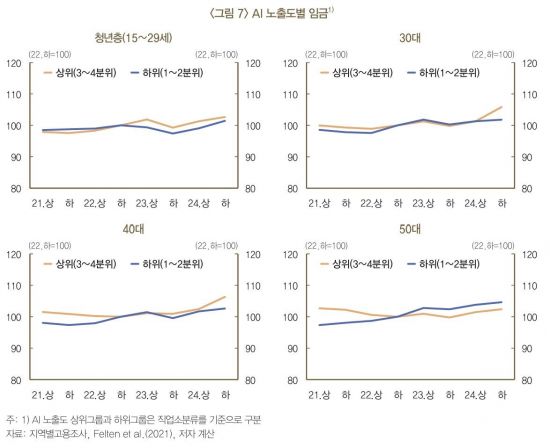
The impact of AI proliferation on wages was not as clear as on employment. The Bank of Korea interpreted this as employment adjustments occurring before wage adjustments due to wage rigidity, which makes it difficult to adjust wages in the short term. Oh stated, "It is possible that wage increases for the young people who were hired offset the decline. However, fundamentally, a decrease in the labor force acts as downward pressure on wages. Although the data does not show a difference, if the trend continues, wage disparities are likely to emerge."
"Uncertain Whether Youth Employment Contraction Will Continue...Could Even Benefit"
The Bank of Korea noted that it is uncertain whether the contraction in youth employment seen in the early stages of AI proliferation will continue in the future.
The Bank of Korea pointed out that, in the long term, companies are more likely to seek change by training talent who can collaborate with AI and redesigning job roles, rather than simply reducing new hires. If youth employment is reduced, the future talent pipeline will also deteriorate, so it is likely that companies will seek sustainable strategies. In addition, if AI leads to increased productivity and, in the medium to long term, acts as a factor expanding labor demand, the benefits could be centered on young people.
Oh concluded, "Since the proliferation of AI will have a significant long-term impact not only on corporate talent development but also on youth career development paths and income inequality, it is important to monitor future trends. Various policy responses should also be discussed, such as strengthening support for startups where AI can be used as a complementary tool, so that young people can seek new industrial opportunities during the AI proliferation period."
© The Asia Business Daily(www.asiae.co.kr). All rights reserved.














