ADD has been conducting joint research and development with domestic shipbuilders for several years
Nuclear-powered submarine program expected to accelerate after research concludes this year
With the pathway now open for South Korea’s military to possess nuclear-powered submarines, the defense industry is expected to become increasingly active. In particular, attention is focused on Hanwha Ocean, as U.S. President Donald Trump has identified the Philadelphia Shipyard owned by Hanwha as a potential site for building nuclear submarines, raising expectations that Hanwha Ocean could benefit significantly.
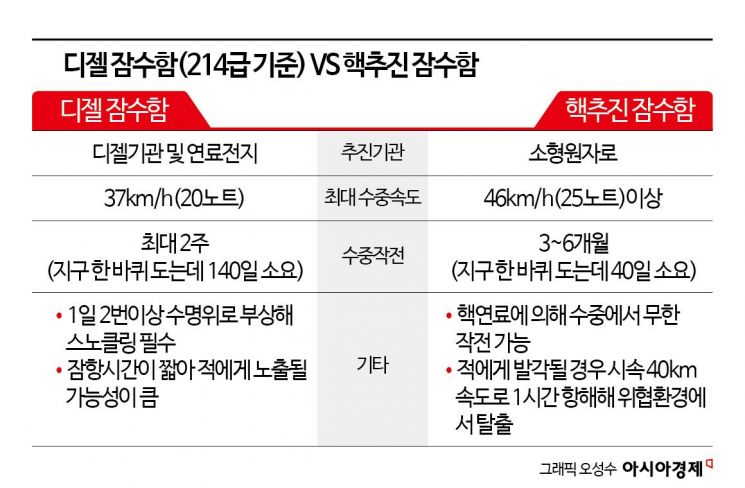
On October 30, industry insiders and experts analyzed that if Hanwha Ocean constructs nuclear-powered submarines at the Philadelphia Shipyard, it could achieve two goals simultaneously: the revival of the declining U.S. shipbuilding industry and the acquisition of nuclear-powered submarines by South Korea. Experts believe that, since South Korea possesses world-class nuclear technology, it could accomplish the construction of nuclear-powered submarines within a few years, provided it receives formal approval from the United States. Furthermore, with the development of small modular reactors (SMRs), the understanding of miniaturization technology for reactors has improved, and the development period is expected to be significantly shorter than in the past.
The Agency for Defense Development (ADD) has reportedly been conducting research projects related to nuclear-powered submarines in collaboration with domestic shipbuilders for several years. The research results are expected to be finalized as early as the end of this year. As a result, the next-generation submarine acquisition project planned by the South Korean military, known as “Jangbogo-III Batch-III,” is highly likely to involve nuclear-powered submarines rather than conventional ones.
The military estimates that the construction cost for each nuclear-powered submarine will exceed 2 trillion won. For comparison, the U.S. Virginia-class nuclear-powered submarine costs about 3.6 trillion won, the latest British Astute-class attack submarine costs about 2 trillion won, and the French Barracuda-class (Suffren-class), which is considered a model for South Korea’s nuclear-powered submarine, is around 1.6 trillion won. An official from the shipbuilding industry stated, “Based on the research results, we expect to design large submarines of 4,000 to 5,000 tons or more and proceed with the development of small nuclear reactors as the power source.”
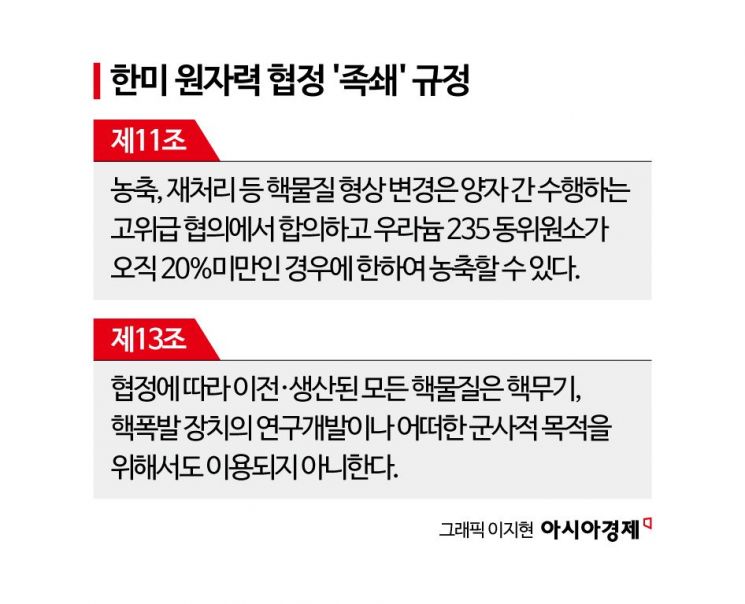
However, to build nuclear-powered submarines, the South Korea-U.S. Nuclear Agreement must be amended. Article 11 of the agreement stipulates that “any alteration of nuclear material forms, such as enrichment or reprocessing, must be agreed upon in high-level bilateral consultations, and enrichment is permitted only if the uranium-235 isotope is less than 20%.” Article 13 further states that “all nuclear materials transferred or produced under the agreement shall not be used for research, development, or any military purpose related to nuclear weapons or nuclear explosive devices.” As a result, there are strict restrictions that make it difficult to introduce nuclear-powered submarines using even low-enriched uranium (less than 20%), let alone highly enriched uranium.
Instead of amending the nuclear agreement, another approach would be to receive the fuel used in nuclear-powered submarines as a complete unit. While American nuclear-powered submarines use uranium enriched to 80-90% as fuel, it is believed that in South Korea, nuclear-powered submarines could be operated with low-enriched uranium below 20%. In fact, France has already deployed nuclear-powered submarines using low-enriched uranium in actual operations.
© The Asia Business Daily(www.asiae.co.kr). All rights reserved.
![Clutching a Stolen Dior Bag, Saying "I Hate Being Poor but Real"... The Grotesque Con of a "Human Knockoff" [Slate]](https://cwcontent.asiae.co.kr/asiaresize/183/2026021902243444107_1771435474.jpg)

















