Assemblyman Jeong Euho and Education Concern-Free Society
Analysis of First Semester Mathematics and English Internal Assessments at 16 High Schools Nationwide
In Mathematics, 2 Out of 10 Questions Are High-Difficulty Problems
It has been revealed that many so-called "killer questions" (high-difficulty questions) are being included in high school internal assessment exams, which are graded on a relative scale, under the pretext of ensuring discrimination among students. If questions that deviate from the official curriculum continue to appear on school exams, dependence on private education is expected to intensify even further. There are growing calls to reform the internal assessment system, which encourages excessive pre-learning, and to improve the direction of the College Scholastic Ability Test (CSAT) so that it aligns with the high school curriculum.
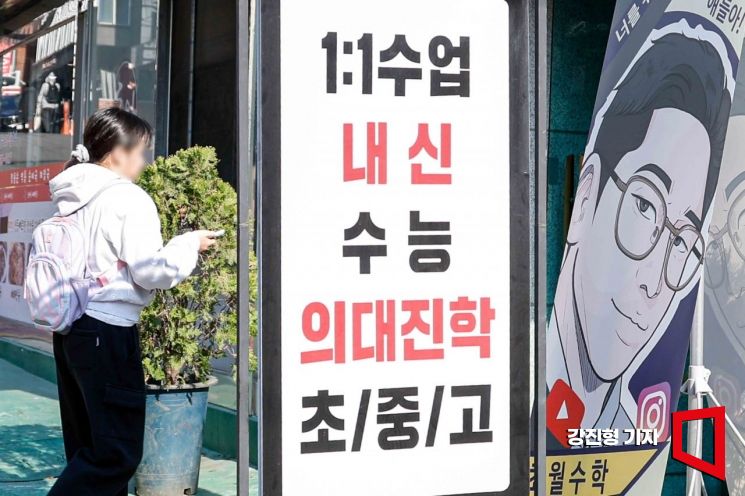 On the 20th, an elementary school student is entering an academy in the Daechi-dong academy district of Gangnam-gu, Seoul. Photo by Kang Jinhyung
On October 29, Assemblyman Jeong Euho of the Democratic Party of Korea and the group Education Concern-Free Society held a press conference at the National Assembly Communication Center, announcing the results of their analysis of this year's first semester mathematics and English internal assessment questions for first-year students at 16 high schools nationwide.
The analysis found that all 16 high schools included questions in mathematics exams that were determined to be outside the official curriculum. Out of a total of 370 mathematics questions across these 16 schools, 68 questions (18.4%) were found to be non-compliant with the curriculum.
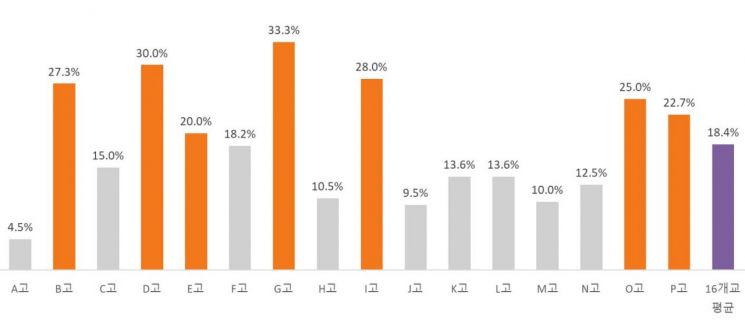 Proportion of non-compliant curriculum questions in mathematics midterm exams (first semester) among first-year students at 16 high schools nationwide in the first semester of 2025. Jeong Euho, Member of the National Assembly · Education Concern-Free Society
The proportion of non-compliant questions was particularly high in districts with intense private education activity.
The average proportion for four schools in Gangnam-gu and Seocho-gu was 17.7%, while the average for four schools in Guro-gu and Geumcheon-gu-districts without such intense private education activity-was 11.8%, a difference of 6 percentage points.
Among eight schools with high rates of admission to medical schools and Seoul National University, the average was 25.2%. For eight autonomous and special-purpose high schools, the average was 20.8%, both higher than the overall average. In contrast, the proportion at three general high schools without any special characteristics was 11.1%.
In the case of English, while the 16 high schools use textbooks at the level of U.S. 8th grade, their internal assessment exams are set at the level of U.S. 12th grade.
The highest average level of the eight types of "Common English I" textbooks adopted by the 16 schools was equivalent to U.S. 8th grade, but the highest average level of the midterm exams was equivalent to U.S. 12th grade, making the internal assessment exams about four grade levels higher than the textbooks.
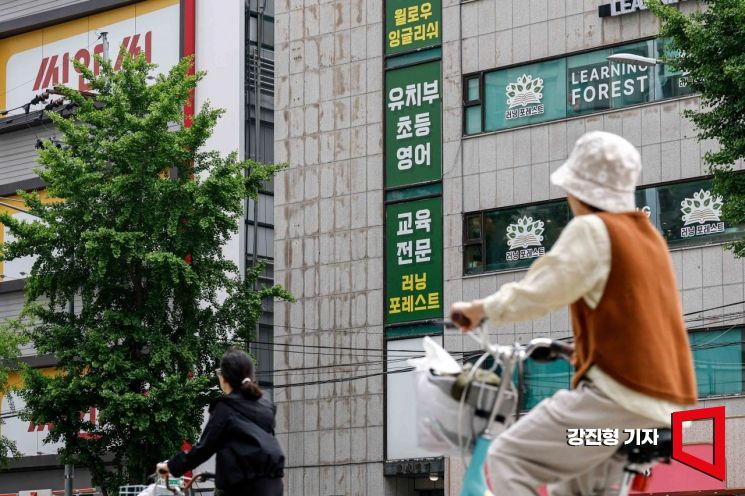 On the 23rd, the exterior wall of an English academy located in the Hagwon district of Mokdong, Yangcheon-gu, Seoul, is promoting English education for kindergarten and elementary students. Photo by Kang Jin-hyung
At some schools, the gap between the level of the textbook and the internal assessment exam reached as much as 6.76 grade levels.
At School B, the highest level of the textbook was equivalent to U.S. 7th grade (7.21), but the highest level of the internal assessment exam was at the level of a college sophomore (13.97).
The average level for four schools in the private education hotbeds of Gangnam-gu and Seocho-gu was 8.89, while the average for schools outside these districts was 7.63. The highest level was also higher in the four schools in the private education districts (12.18) compared to the four schools in Guro-gu and Geumcheon-gu (11.63), a difference of 0.55 grade levels.
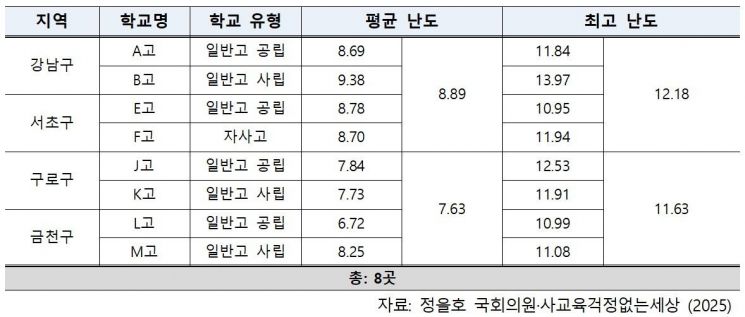
By type of high school, the average level of the internal assessment exams was as follows: foreign language high schools (9.06), autonomous private high schools (8.94), general private high schools (8.73), and general public high schools (8.01), in descending order of difficulty.
However, when comparing the highest level of difficulty, general private high schools had the highest, even surpassing special-purpose and autonomous high schools in terms of English exam difficulty.
The average level of internal assessment exams at the eight schools with the highest admission rates to medical schools and Seoul National University was 9.10, which was 0.84 grade levels higher than the average of the other eight schools (8.26). The highest level was 12.02, slightly higher than the average of the other eight schools (11.90).
Assemblyman Jeong and Education Concern-Free Society stated, "This situation reflects the fact that both internal assessments and the CSAT are graded on a relative scale, and that questions outside the curriculum, known as 'killer questions,' continue to appear on the CSAT." They pointed out, "If questions that exceed the scope and level of the curriculum continue to appear in internal assessments, students will inevitably have to rely on private education, and public trust in the education system will plummet."
They went on to emphasize, "A comprehensive reform of the internal assessment system is urgently needed. The internal assessment in high schools should be converted to an absolute grading system, and the direction of CSAT questions should be urgently revamped to align with the high school curriculum."
© The Asia Business Daily(www.asiae.co.kr). All rights reserved.
![Clutching a Stolen Dior Bag, Saying "I Hate Being Poor but Real"... The Grotesque Con of a "Human Knockoff" [Slate]](https://cwcontent.asiae.co.kr/asiaresize/183/2026021902243444107_1771435474.jpg)













