Five Anticancer Drug Research Projects Presented at AACR
Hanmi Pharmaceutical, the core business subsidiary of Hanmi Science, unveiled a range of next-generation modality research achievements at a world-renowned cancer conference, including the first public presentation of its new pipeline, the "EP300 Selective Degrader." In addition to new drugs for metabolic diseases such as obesity, the company is expanding its research into next-generation modalities that aim to transform the paradigm of existing cancer treatments. This is seen as a move to secure future growth engines that will further enhance Hanmi's global competitiveness in innovative drug development.
According to industry sources on October 29, Hanmi Pharmaceutical announced that it presented five preclinical research results in poster format at the international cancer conference "AACR-NCI-EORTC 2025," held in Boston, USA, from October 22 to 26 (local time). The research covered the EP300 Selective Degrader, SOS1-KRAS Interaction Inhibitor (code name HM101207), STING mRNA anticancer drug, p53-mRNA anticancer drug, and YAP/TAZ-TEAD Inhibitor.
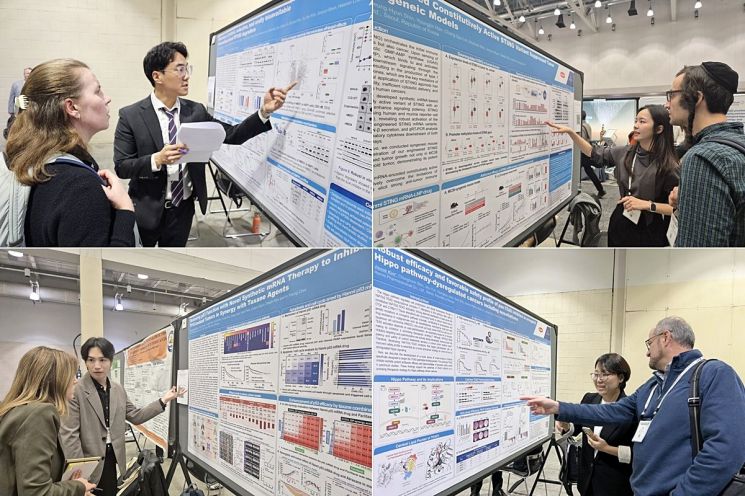 Researchers at Hanmi Pharmaceutical R&D Center are explaining to attendees the poster containing research on innovative anticancer drugs at the international cancer conference "AACR-NCI-EORTC 2025," held in Boston, USA, from October 22 to 26 (local time). Hanmi Pharmaceutical
The EP300 Selective Degrader, which drew particular attention during the conference, is an anticancer drug developed using Hanmi's new modality, the "Targeted Protein Degradation (TPD)" platform technology. It works on the principle of "synthetic lethality," selectively killing cancer cells that depend on the EP300 protein or have mutations in the CBP gene.
EP300 and CBP proteins are transcriptional co-activators with histone acetyltransferase activity. While they function complementarily in normal cells, cancer cells with CBP mutations are known to rely on EP300. Moreover, due to the high structural similarity between the two proteins, developing drugs that selectively target EP300 has been challenging.
At this conference, Hanmi Pharmaceutical presented results showing that the EP300 Selective Degrader demonstrated antitumor activity in EP300-dependent cell lines and CBP-mutant cell lines. Furthermore, in a prostate cancer xenograft animal model, it proved superior in tumor suppression compared to existing first-line therapies and EP300/CBP dual inhibitors.
The research findings attracted significant attention, as they suggested that the EP300 Selective Degrader, with its excellent metabolic stability and oral availability, could offer a new treatment option for EP300-dependent cancers and CBP-mutant cancers.
In another presentation, Hanmi Pharmaceutical disclosed results confirming the superior antitumor efficacy of "SOS1-KRAS Interaction Inhibitor (HM101207)," which was previously highlighted as a promising candidate for global anticancer combination therapy strategies at the international RAS-targeted drug development conference in September.
HM101207 is a novel inhibitor (SOS1-panKRAS Modulator) that blocks the binding between the "SOS1" protein, which plays a key role in the signal transduction cascade, and KRAS, in order to prevent the activation of the lethal "KRAS mutation" among cancer-causing gene mutations.
By inhibiting the interaction between SOS1 protein and various KRAS mutations, HM101207 reduces signal activation and suppresses cancer growth. It is also expected to overcome resistance that develops after administration of already approved KRAS G12C inhibitors, RTK inhibitors, or MAPK pathway inhibitors.
Notably, HM101207 demonstrated strong anticancer synergy in combination therapies with various RAS-off inhibitors. Compared to other competing SOS1 inhibitors currently in development, HM101207 offers superior target specificity and minimizes drug-drug interactions, making it a promising candidate for global anticancer combination therapy strategies.
Hanmi Pharmaceutical also presented research achievements on immuno-oncology drugs based on the "mRNA platform," a next-generation modality, demonstrating the potential to lead a paradigm shift in drug development.
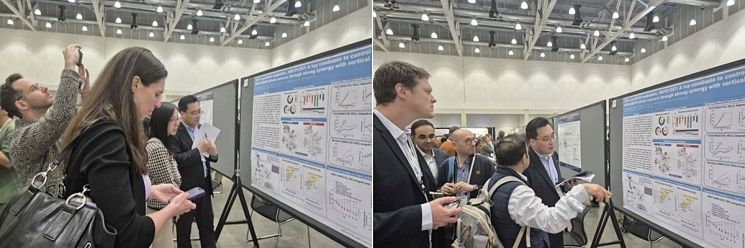 Senior Researcher Seunghyun Jung, Director at Hanmi Pharmaceutical R&D Center, is explaining to attendees the research content of the poster on 'SOS1-KRAS Interaction Inhibitor' (HM101207), a promising candidate for global anticancer combination therapy strategies. Hanmi Pharmaceutical
The STING mRNA anticancer drug is a therapy that directly expresses the STING (Stimulator of IFN Genes) protein to induce a powerful anticancer immune response. By fundamentally reconstructing the starting point of the immune response, it proposes a new "reboot" strategy to combat tumors.
Generally, immuno-oncology drugs have focused on restoring T-cell function through immune checkpoint inhibitors. Existing STING agonists have been limited by metabolic instability, reduced efficiency of cytoplasmic delivery, and decreased STING expression in actual tumor tissues, which restricts their therapeutic efficacy.
At this conference, Hanmi Pharmaceutical presented results showing that monotherapy with STING mRNA significantly suppressed tumor growth and demonstrated a favorable safety profile in colorectal and lung cancer animal models. Hanmi's STING mRNA anticancer drug is expected to show high synergy when used in combination with various anticancer agents.
Another mRNA platform-based drug, the p53 mRNA anticancer drug, is a therapy that induces apoptosis of cancer cells by restoring normal expression of the representative tumor suppressor gene p53 protein within the cell. At this conference, results were presented showing effective suppression of cancer cell growth in orthotopic animal models of lung and ovarian cancers.
In particular, the p53 mRNA anticancer drug demonstrated excellent synergy when combined with taxane-based chemotherapies, and antitumor activity was confirmed in lung and ovarian cancer animal models when combined with Abraxane. Furthermore, the p53 mRNA anticancer drug showed efficacy in paclitaxel-resistant cell lines, suggesting the potential to overcome resistance.
Hanmi's YAP/TAZ-TEAD Inhibitor regulates the excessively activated YAP/TAZ-TEAD signaling in Hippo pathway-mutated cancers by targeting the palmitate-binding pocket (PBP), which plays a key role in stabilizing TEAD.
At this conference, Hanmi's YAP/TAZ-TEAD Inhibitor was reported to exhibit strong growth-inhibitory activity in Hippo pathway-mutated mesothelioma cell lines and to significantly reduce the expression of YAP/TAZ-TEAD target genes in a dose-dependent manner.
In a mesothelioma xenograft mouse model, the antitumor efficacy and target gene suppression ability of Hanmi's inhibitor were confirmed, and it demonstrated superior safety compared to competing drugs in nephrotoxicity indicators such as proteinuria.
Choi Inyoung, Executive Vice President and Head of the R&D Center, stated, "The core foundation of Hanmi's new drug development is its anticancer pipeline, which is expanding its innovative scope into various modality areas such as Targeted Protein Degradation (TPD), messenger RNA (mRNA), cell and gene therapies (CGT), antibody-drug conjugates (ADC), and single-domain antibodies (sdAb). We will maximize the potential of next-generation modalities to create a powerful driving force for our global innovative drug engine."
© The Asia Business Daily(www.asiae.co.kr). All rights reserved.


















