
Gwangju Institute of Science and Technology (GIST) announced on October 29 that Professor Seungjun Kim's research team from the Department of AI Convergence has developed a vehicle VR platform called 'AttraCar,' which can precisely synchronize virtual reality (VR) content with heating/cooling, airflow, and seat motion feedback using only the systems already built into the vehicle.
AttraCar is characterized by its ability to provide multisensory stimulation without the need for additional wearable or external devices, reducing motion sickness for passengers and enhancing immersion and presence.
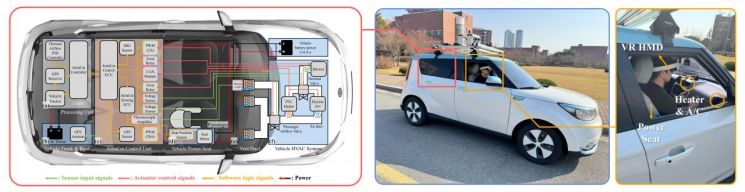
The research team integrated this platform into the vehicle system without any modifications to the car and validated its effectiveness in real on-road driving environments. Through this, they have demonstrated a foundation for delivering a safe and reliable in-vehicle VR user experience even during driving.
To first determine whether in-vehicle systems could be used as multisensory feedback devices, the team experimentally identified the 'perceptual thresholds' for airflow intensity, temperature (heating/cooling), and seat motion.
As a result, users were found to clearly perceive changes at approximately 0.34 m/s for airflow intensity, about 1.75 mm/s for seat motion, around 7.2°C for heating, and about 4.4°C for cooling. Based on this data, the team designed stimulus intensities for different scenarios and applied them to actual driving situations.
Next, the research team conducted an experiment comparing user responses under six different conditions, combining airflow (none/room temperature/hot air) and seat motion (none/present) in real driving environments. The results showed that when both airflow and seat motion stimuli were provided together, motion sickness (SSQ) significantly decreased, while presence (IPQ) and haptic experience (HX) were notably enhanced. In particular, the 'hot air + seat motion' condition demonstrated the greatest interaction effect.
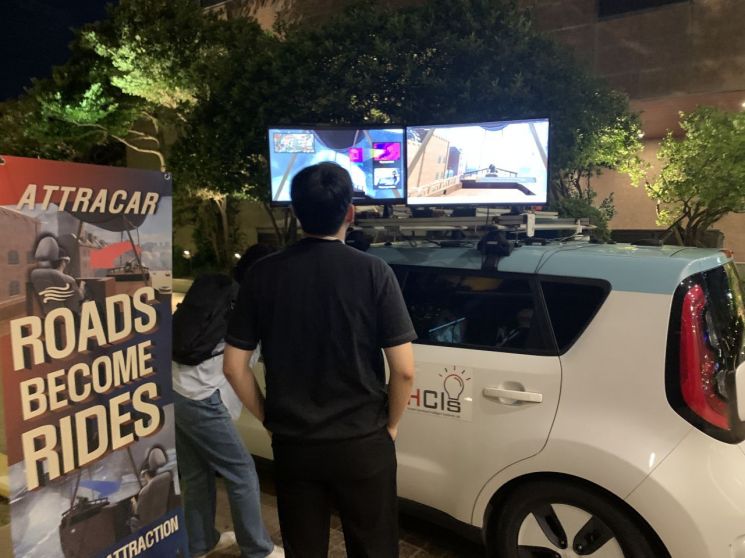 Professor Seungjun Kim's research team from the Department of AI Convergence at Gwangju Institute of Science and Technology is demonstrating the 'AttraCar' demo and explaining the research at ACM UIST 2025. Provided by Gwangju Institute of Science and Technology.
The study evaluated users' perceived responses using three indicators: motion sickness (SSQ, Simulator Sickness Questionnaire), presence (IPQ, Igroup Presence Questionnaire), and haptic experience (HX, Haptic Experience). SSQ is a survey tool that quantitatively measures the degree of motion sickness experienced in simulators or virtual environments; IPQ assesses the user's sense of immersion and presence within an environment; and HX reflects the user's tactile experience of haptic stimuli. By using these three assessments, the study comprehensively analyzed how various stimuli in a driving environment affect user immersion and comfort.
The 'AttraCar' platform also demonstrated commercial viability in terms of technical completeness. The average latency from the input of airflow and seat motion signals to the system's response was only about 60ms (0.06 seconds), and the time to reach the target temperature for heating and cooling was measured at approximately 4.3 seconds and 3.6 seconds, respectively, allowing for natural synchronization with on-screen events. In addition, the system was integrated while maintaining the existing vehicle control methods, meeting safety standards and operating stably in actual vehicles.
Professor Seungjun Kim stated, "With only the systems already built into the vehicle, we can provide passengers with multisensory feedback, making immersive and vivid VR experiences possible inside the car. This study systematically demonstrates the potential applications of in-vehicle VR technology and its effectiveness in enhancing user experience."
This research, supervised by Professor Seungjun Kim of GIST's Department of AI Convergence and led by doctoral student Dohyun Yeo as first author, was supported by the National Research Foundation of Korea's Mid-Career Researcher Program, the International Cooperation Hub Project for Outstanding Overseas Research Institutions, and the Institute for Information & Communications Technology Planning & Evaluation (IITP) University ICT Research Center (ITRC) support program.
© The Asia Business Daily(www.asiae.co.kr). All rights reserved.
![Clutching a Stolen Dior Bag, Saying "I Hate Being Poor but Real"... The Grotesque Con of a "Human Knockoff" [Slate]](https://cwcontent.asiae.co.kr/asiaresize/183/2026021902243444107_1771435474.jpg)













