A study has found that risks associated with climate change impact sales in urban commercial districts. Based on this, the possibility has also been raised that artificial intelligence (AI) can predict the future of urban small business ecosystems.
KAIST announced on the 29th that its Urban AI Lab and the Senseable City Lab at the Massachusetts Institute of Technology (MIT) recently unveiled the results of their joint research in the field of "Urban AI" at the "Smart Life Week 2025" exhibition held at COEX in Seoul.
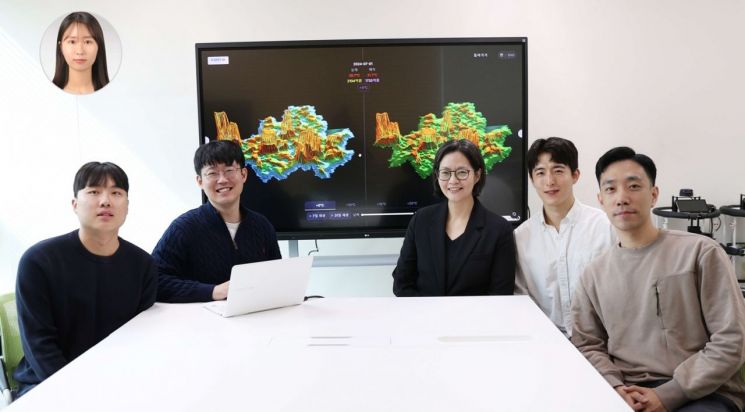 (From left) Jang Gunhee, Integrated Master's and PhD Program, Kim Namwoo, Postdoctoral Researcher, Yoon Yoonjin, Professor, Yoon Seokwoo, Researcher, Park Youngjun, Postdoctoral Researcher, (Top) Noh Junyoung, Master's Program. Provided by KAIST
KAIST and MIT have been conducting the "Urban AI Joint Research Program," which analyzes major urban issues using AI, such as "Urban Heat and Sales," "Healing Nature, Seoul," and "Data Sonification."
"Urban Heat and Sales" is a study that analyzes the impact of climate change on urban commercial districts and small business ecosystems using AI. The two institutions used an AI model trained on more than 300 million data points, including sales figures for 96 business types across 426 administrative districts in Seoul and weather data, to quantify the effects of climate factors such as temperature and humidity on sales by business type.
In addition, they visualized 40,896 "Urban Heat Resilience" indicators, which score the level of adaptation and recovery to climate change by region and business type, making it possible to distinguish commercial districts with high climate resilience and to grasp the resilience of each area at a glance.
For example, in the convenience store sector, 64.7% of the 426 administrative districts were classified as "climate-neutral areas," which are relatively stable in the face of climate change, while the remaining 35.3% were categorized as "climate-sensitive areas," which are more affected by climate change.
This suggests that even within the same business category, such as convenience stores, the impact of climate factors varies by region, implying that this data can be used as a reference when establishing future location strategies from the perspective of urban resilience.
KAIST and MIT also provided visitors at the exhibition with the opportunity to experience a system where they could select a region and business type on a map of Seoul and see AI-generated, real-time visual predictions of sales changes under future climate change scenarios.
This predictive model is a proprietary technology developed by KAIST, and there are plans to expand collaboration with other major cities around the world, such as Boston and London.
Above all, this research is expected to provide new directions for establishing small business opening strategies and formulating city-specific climate risk response policies in the future.
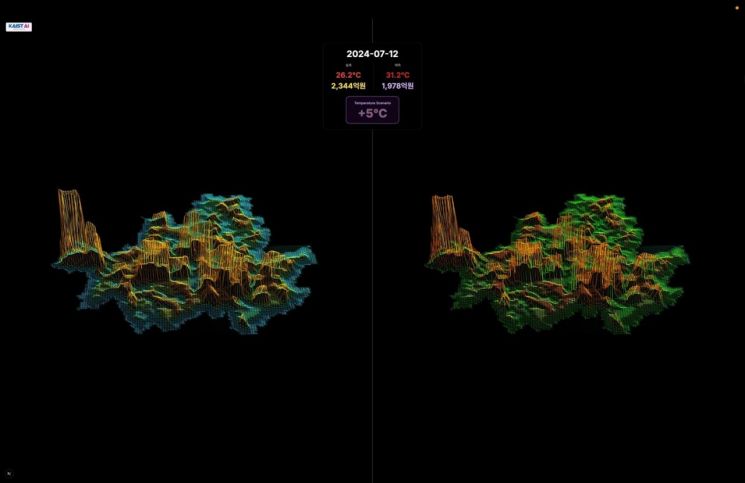 An image visualizing existing sales data from 426 districts in Seoul as a 3D mesh structure. Height and color represent sales. The left side shows the sales distribution in Seoul under actual temperature conditions, while the right side visualizes the predicted sales changes by artificial intelligence when the temperature rises by 5 degrees. Provided by KAIST
"Healing Nature, Seoul" is the Seoul expansion of MIT's global project "Feeling Nature." The core of the project is to train AI to estimate the "psychological green," or the psychological experience of greenery as actually felt by Seoul citizens, by combining urban environmental data such as street views, maps, and satellite images with citizen survey data.
The AI model, after a series of processes, went beyond simply calculating the area of green parks and proposed a new direction for urban design that reflects the "emotional resilience" and "well-being" that green environments provide to citizens. This research can serve as scientific evidence for future green space policies in Seoul and for region-specific urban design.
"Data Sonification" is the world's first AI technology that interprets over 300 million data points and expresses them as musical elements. Using data such as temperature, humidity, and sales, the technology audibly represents information, with higher sales corresponding to higher pitches and lower sales to lower pitches. This provides a new sensory experience of "hearing (understanding)" urban data through sound rather than sight.
This technology is a representative example of "Barrier-Free AI" that enables intuitive understanding of data even for those with limited access to visual information, such as the visually impaired and children, making it an inclusive AI technology for all.
Yoon Yoonjin, Director of the Urban AI Lab, said, "This exhibition is meaningful in that it demonstrates AI's potential to evolve beyond calculating the city to understanding and empathizing with people and the urban environment. We aim to help create a more inclusive and sustainable urban future by enabling citizens to co-create and experience data, and by collaborating with cities around the world."
This achievement is the result of a global collaborative research project in the AI field jointly conducted by the KAIST Urban AI Lab and the MIT Senseable City Lab, with support from the Seoul AI Foundation.
© The Asia Business Daily(www.asiae.co.kr). All rights reserved.
!["The Woman Who Threw Herself into the Water Clutching a Stolen Dior Bag"...A Grotesque Success Story That Shakes the Korean Psyche [Slate]](https://cwcontent.asiae.co.kr/asiaresize/183/2026021902243444107_1771435474.jpg)

















