Zamenix Completes Half of Clinical Trials
with 232 Patients Enrolled
Loensurgical announced on October 28 that the clinical trials for its self-developed artificial intelligence (AI)-based kidney stone surgery robot, Zamenix, are progressing smoothly as part of the innovative medical technology program.
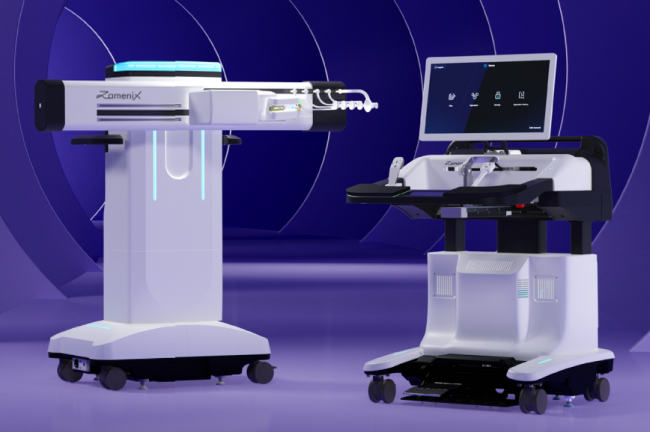
Zamenix, the world's first AI-based kidney stone surgery robot, is a device equipped with an ultra-miniature endoscope that removes stones by passing through the ureter without any incisions. It features AI-based respiratory compensation, stone size determination, and path reproduction functions, which enable safe fragmentation and extraction of stones from the body. Zamenix was designated as the 17th innovative medical device in 2021.
The innovative medical technology program supports the creation of clinical evidence and improves access to advanced medical technologies by providing temporary health insurance listing for technologies recognized for their safety and potential. The program primarily targets innovative treatment methods such as AI diagnostics and robotic surgery.
Loensurgical is conducting a randomized controlled clinical trial for innovative medical technology, verifying the safety and efficacy of kidney stone removal by comparing flexible endoscopic surgery, known as retrograde intrarenal surgery, with the Zamenix procedure. The clinical results are expected to be used as evidence for new medical technology assessments and insurance registration reviews, supporting the adoption of Zamenix in clinical settings and its expansion as a standard treatment.
This clinical trial, currently underway in the urology departments of Samsung Medical Center, Yeungnam University Medical Center, Kyungpook National University Hospital, Yangsan Pusan National University Hospital, and Korea University Anam Hospital, has so far enrolled 126 out of a total of 232 participants, achieving a 50% progress rate. No serious adverse effects have been reported in the clinical results to date.
Lee Seungsoo, Professor of Urology at Yangsan Pusan National University Hospital, stated, "So far, no serious adverse effects have been reported in the innovative medical technology clinical trials, so Zamenix is considered a safe treatment. I hope that patients with refractory kidney stones will benefit greatly from this clinical opportunity."
Zamenix was designated as the 17th innovative medical device by the Ministry of Food and Drug Safety in December 2021 and received manufacturing approval in October 2022. In August 2023, it was selected as an innovative medical technology by the National Evidence-based Healthcare Collaborating Agency (NECA), making it available for non-reimbursed use for three years starting in 2024. After the completion of the clinical research, it can be used for treatment purposes within hospitals. Based on three years of clinical evidence, the decision for insurance coverage will be made through the new medical technology assessment by the Health Insurance Review and Assessment Service.
© The Asia Business Daily(www.asiae.co.kr). All rights reserved.

















