Highest Growth Rate in Six Quarters
Domestic Demand Contributes 1.1 Percentage Points
Dual Recovery in Public and Private Sectors
The government has indicated the possibility of raising its annual growth rate forecast from the previous 0.9% to the 1% range. Analysts attribute this to a balanced recovery in both domestic demand and exports, driven by improved consumer sentiment, government fiscal spending, and strong semiconductor exports.
At a recent economic briefing on October 28, the Ministry of Economy and Finance stated, "Facility investment maintained a high growth rate from the third quarter of last year but showed an adjustment in the first quarter of this year. In the second quarter, it slowed due to internal and external uncertainties, but in the third quarter, as the semiconductor industry improved, there was a significant turnaround, especially in machinery, returning to positive growth."
According to the "Advance Estimate of Real Gross Domestic Product (GDP) for the Third Quarter of 2025" released by the Bank of Korea on the same day, real GDP grew by 1.2% compared to the previous quarter. This is the highest level since the first quarter of last year (1.2%), surpassing the Bank of Korea's August growth forecast of 1.1%.
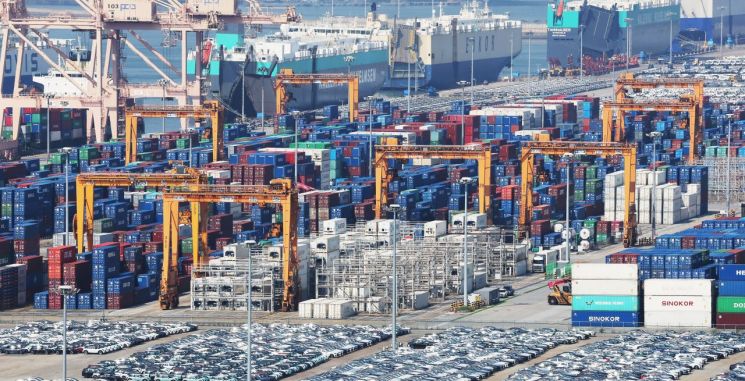 'Trump Tariffs' See 1.4% Decline in September Exports to the U.S.
(Pyeongtaek=Yonhap News) Reporter Hong Giwon = Despite the impact of U.S.-imposed tariffs, South Korea's exports in September rose 12.7% compared to the same period last year, reaching an all-time high, driven by strong performance in the two main export sectors: semiconductors and automobiles.
Exports of semiconductors, the largest export item, set a new record, boosting South Korea's overall export performance. Automobile exports, which are significantly affected by U.S. tariffs, found new markets in Europe and other regions, diversifying export destinations and achieving the highest September export record ever.
September automobile exports to the U.S. amounted to $1.91 billion, down 2.3% due to the 25% high tariff rate. Meanwhile, exports to the EU increased by 54% year-on-year to $700 million, and exports to the Commonwealth of Independent States (CIS) surged 77.5% to $610 million.
Photo by Hong Giwon on October 1, 2025, showing containers stacked at Pyeongtaek Port, Gyeonggi Province.
xanadu@yna.co.kr (End)
Domestic Demand Drives Growth... Private Consumption Up 1.3%
By sector, domestic demand led the growth. In the third quarter, domestic demand contributed 1.1 percentage points (P) to the growth rate, while net exports (exports minus imports) contributed 0.1 percentage points. The contribution from domestic demand more than doubled compared to the second quarter (0.4%P).
During the same period, private consumption rose by 1.3%, marking the largest increase in three years since the third quarter of 2022. The consumer sentiment index exceeded the long-term average (100) for six consecutive months for the first time in three years and five months, indicating clear improvement. The issuance of consumption coupons and a bullish stock market also stimulated spending.
Facility investment increased by 2.4%, mainly driven by machinery such as semiconductor manufacturing equipment. Construction investment fell by 0.1% due to sluggish building construction, marking a sixth consecutive quarter of contraction. However, the decline was significantly reduced, and the sector is considered to have almost emerged from its slump.
Exports grew by 1.5%, led by strong performances in semiconductors and automobiles. In particular, semiconductor exports increased by 26.5% compared to the same period last year. The expansion of artificial intelligence (AI) investment has led to a surge in demand for high-bandwidth memory (HBM), and combined with server replacement demand, the "semiconductor supercycle" continues.
Automobile exports also rose sharply, especially to the European Union (EU, up 46.7%) and the Commonwealth of Independent States (CIS, up 57.7%), resulting in an 11.5% year-on-year increase. However, exports to the United States fell by 9.1% due to the impact of tariffs. Imports increased by 1.3%, mainly in machinery, equipment, and automobiles. The increase in import volume is interpreted as a reflection of the recovery in domestic demand.
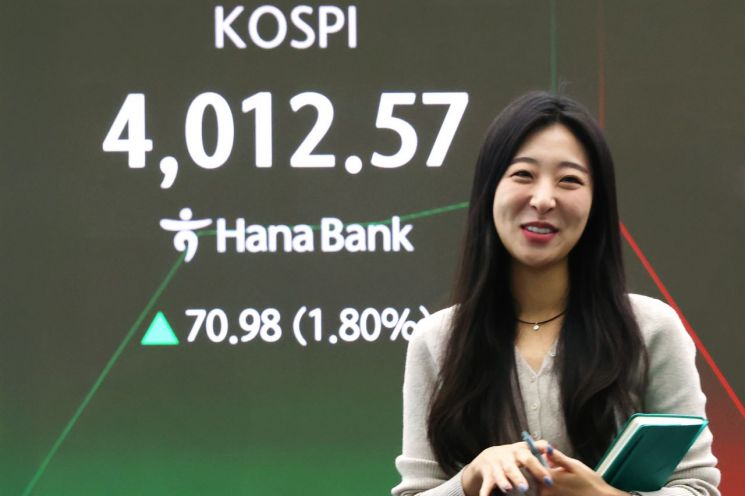 Kospi Surpasses 4,000 for the First Time
(Seoul=Yonhap News) Reporter Jin Yeonsu = On the 27th, when the Kospi surpassed the 4,000 mark for the first time in history, an employee was working in the dealing room of Hana Bank in Jung-gu, Seoul. On this day, the Kospi started at 3,999.79, up 58.20 points (1.48%) from the previous session, and increased its gains to break through the 4,000 mark for the first time ever. 2025.10.27 jin90@yna.co.kr (End)
Kospi Surpasses 4,000... Accelerating Shift of Funds from Real Estate to Stocks
Alongside economic recovery, the stock market is also booming. Following the launch of the new administration, investment sentiment improved due to amendments to the Commercial Act and the introduction of the "one-strike out" rule for unfair trading, enabling the Kospi index to surpass the 4,000 mark for the first time in history.
As of October 24, compared to the end of May, the Kospi had risen by 46.1%, far outpacing the United States (14.9%), Europe (5.7%), and Japan (29.9%). Since June, foreign investors have made net purchases of approximately 20 trillion won, with more than 12 trillion won concentrated since September.
Currently, the Kospi price-to-book ratio (PBR) stands at 1.3 times, and the price-to-earnings ratio (PER) is 18.4 times, still low compared to major countries. Leading global investment banks continue to highlight the valuation appeal of the Korean stock market, raising target prices or recommending "buy the dip" strategies.
The government has analyzed that the trend of funds shifting from real estate to productive sectors is strengthening. Kim Jaehoon, Director General for Economic Policy at the Ministry of Economy and Finance, commented on the fourth-quarter outlook, stating, "The improvement trend is evident not only in private consumption but also in construction investment, which has largely emerged from its slump. Facility investment is also showing a positive trend, and exports are performing well, so we currently expect this positive momentum to continue into the fourth quarter."
© The Asia Business Daily(www.asiae.co.kr). All rights reserved.


















