Keynote Speech at the 'AI Frontier International Symposium' on the 27th
Explaining the Training of the 'World Model'
On the 27th, Professor Yann LeCun stated, "Existing large language models (LLMs) will become obsolete within five years," and emphasized, "Text-based learning alone cannot achieve human-level artificial intelligence (AI); understanding the world through sensory input is essential."
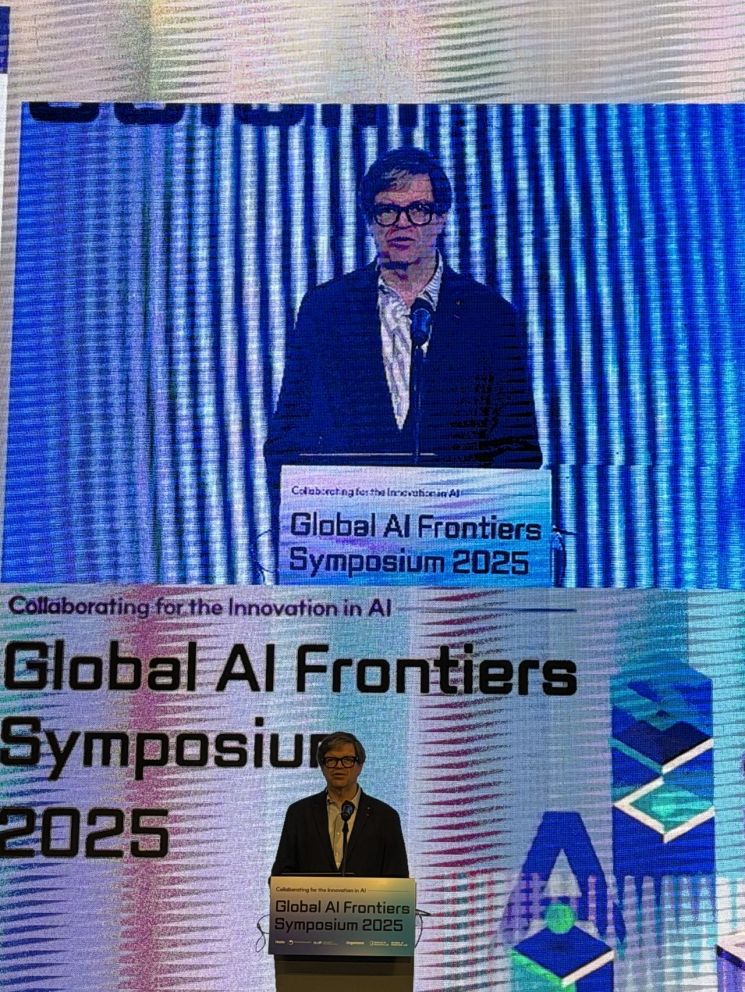 Professor Yann LeCun is delivering the keynote speech at the "AI Frontier International Symposium" held on the 27th in Yongsan, Seoul. Photo by Kim Bokyung
He made these remarks during his keynote speech at the "AI Frontier International Symposium" held at Dragon City in Yongsan, Seoul, on the same day. Professor Yann LeCun is one of the "four leading scholars in AI" and co-director of the Global AI Frontier Lab in New York, United States.
He began by saying, "Several more revolutions are needed to create truly intelligent machines," and went on to explain the "World Model" concept he has long advocated.
The World Model is similar to the way a baby, just a few months old, forms concepts by observing the world. According to Professor LeCun, to reach human-level intelligence, AI must be equipped with the ability to understand the physical world through various senses, such as vision, hearing, and touch, just like a baby.
The World Model is also a concept that predicts the next state (t+1) based on the current point in time (t). Predicting t+1 enables AI to learn and simulate physical laws, causality, and environmental changes. The goal is not simply to memorize data, but to create AI that understands and predicts how the world works.
He remarked, "Current AI architectures are extremely poor. Today's AI systems are not even comparable to the intelligence of humans or animals," and added, "In terms of understanding the physical world, they are not even as smart as a house cat."
He also noted that human intelligence is not general but specialized, which is why he does not favor the term "artificial general intelligence (AGI)." He stressed, "What we should aim for is advanced intelligence capable of understanding the world and performing physical reasoning."
He proposed the concept of JEPA (Joint Embedding Predictive Architecture), explaining that it is impossible to predict the future precisely at the pixel level, and that prediction should be carried out in an abstract representation space.
He said, "JEPA transforms both the input and the prediction target into their own encoders and performs prediction within that representation space. The model is built at a level where abstraction allows for predictability," adding, "This is the essence of intelligence."
He explained that for AI to think like humans and animals, its architecture must: ▲ observe the current state, ▲ combine it with short-term memory to simulate multiple action sequences through a world model, and ▲ select actions that satisfy its goals.
Professor Yann LeCun predicted, "We will focus on areas that existing LLMs cannot solve, such as understanding the physical world, reasoning, and planning," and added, "JEPA-style architectures will become the mainstream."
© The Asia Business Daily(www.asiae.co.kr). All rights reserved.

















