Bank of Korea Releases Financial Institution Lending Attitude Survey Results
Non-bank Lenders Also Maintain Tightened Loan Screening Standards
It is expected to remain difficult to obtain household loans from banks in the fourth quarter of this year.
 A customer is receiving consultation at a commercial bank in Euljiro, Jung-gu, Seoul. Photo by Jo Yongjun jun21@
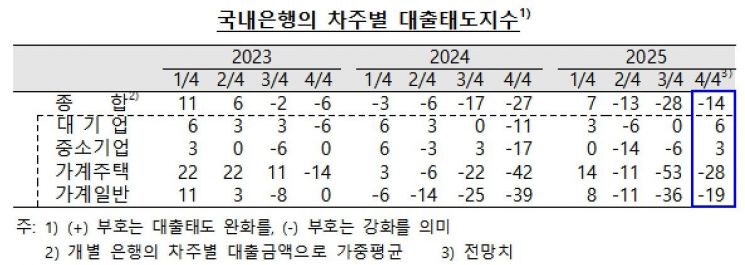
According to the results of the "Financial Institution Lending Attitude Survey" conducted by the Bank of Korea on loan officers at financial institutions, the composite index for banks' lending attitudes in the fourth quarter stood at -14, marking a negative value for the third consecutive quarter. A negative index indicates that more financial institutions responded that they would tighten lending standards rather than ease them.
By borrower type, the lending attitude index for corporate loans shifted to a majority expecting easing for both large corporations and small and medium-sized enterprises. The index for large corporations improved from 0 in the third quarter to 6, while for small and medium-sized enterprises, it rose from -6 to 3. This means that more banks responded they would ease lending requirements compared to the previous quarter.
In contrast, more respondents said they would maintain strict standards for household loans. The index for household mortgage loans was -28, and for general household loans, it was -19. Although the degree of tightening was less than the previous quarter's -53 and -36, respectively, more banks still indicated they would tighten rather than ease lending standards.
A Bank of Korea official stated, "Due to the impact of the June 27 measures and subsequent policies, lending attitudes for household loans, including both mortgage and credit loans, are expected to tighten." The government, through the June 27 and October 15 measures, has reduced the total household loan targets for banks in the second half of the year, set limits on mortgage loans, and raised the stress interest rate.
Loan demand in the fourth quarter is also expected to decrease, especially for housing-related loans. The composite index for loan demand at domestic banks was -5, maintaining a declining outlook following the previous quarter's -6. This is attributed to the anticipated contraction in demand for household mortgage loans, which posted -31. Banks expect demand to decrease as the government continues its policy of managing household debt. On the other hand, demand for general household loans, such as credit loans (-6 to 0), is expected to increase slightly.
Corporate loan demand is projected to rise for both large corporations and small and medium-sized enterprises, driven by needs for operating funds and liquidity. The loan demand index was recorded at 11 for large corporations and 19 for small and medium-sized enterprises. Notably, the index for small and medium-sized enterprises showed a significant increase from the previous quarter's 8.
Domestic banks expect the credit risk for both corporations and households in the fourth quarter to decline compared to the previous quarter but to remain at a high level. The composite index for credit risk was 25, down from 28 in the previous quarter. The credit risk index for small and medium-sized enterprises was 28, lower than the previous quarter's 33, but concerns remained higher than for large corporations and households. The index for large corporations was 11 and for households 22, both unchanged from the previous quarter.
A Bank of Korea official commented, "Credit risk for corporations is expected to remain elevated, especially for small and medium-sized enterprises, due to ongoing uncertainty in domestic and global economic conditions and concerns over deteriorating profitability amid sluggish business performance. For households, concerns about worsening soundness may persist, particularly among vulnerable borrowers."
For non-bank financial institutions, all sectors except life insurance companies are expected to maintain a tightening stance on lending. Credit risk is also expected to remain high, especially for savings banks and mutual finance institutions. Loan demand is projected to decline slightly, mainly for corporate facility funds and housing funds.
The Bank of Korea official added, "With uncertainty in domestic and global economic conditions persisting, the tightening trend in lending attitudes will continue due to strengthened household debt management and high delinquency rates. Credit risk is also expected to remain high due to concerns over borrowers' declining debt repayment capacity."
Meanwhile, this survey was conducted from the 1st to the 15th of last month, targeting a total of 203 financial institutions, and examined trends over the past three months as well as prospects for the next three months. Domestic banks conducted an additional survey following the October 15 real estate measures.
© The Asia Business Daily(www.asiae.co.kr). All rights reserved.
![User Who Sold Erroneously Deposited Bitcoins to Repay Debt and Fund Entertainment... What Did the Supreme Court Decide in 2021? [Legal Issue Check]](https://cwcontent.asiae.co.kr/asiaresize/183/2026020910431234020_1770601391.png)
















