Seoul Asan Medical Center Develops "Surface Fluidic Microneedle Patch"
A team of Korean researchers has developed a technology that allows the delivery of large doses of medication using a single patch, eliminating the need for repeated injections for patients who experience discomfort from such treatments.
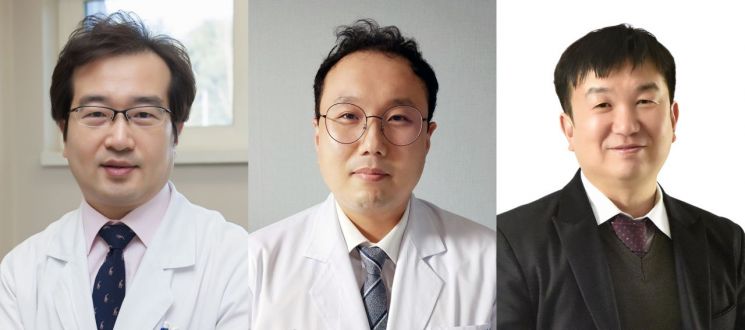 (From left) Professor Jaeyong Jeon, Department of Rehabilitation Medicine, Ulsan College of Medicine, Dr. Hwaryoung Cheon, Institute of Medical Engineering, and Professor Hyunsik Yoon, Seoul National University of Science and Technology. Seoul Asan Hospital
A joint research team led by Professor Jaeyong Jeon of the Department of Rehabilitation Medicine at Ulsan College of Medicine, Dr. Hwaryoung Cheon of the Institute of Medical Engineering, and Professor Hyunsik Yoon of Seoul National University of Science and Technology, has recently developed the "Surface Fluidic Microneedle Patch (SFMNP)," which can rapidly deliver large quantities of drugs without the need for injections.
When this patch was applied to a small animal model, the contrast agent reached the lymph nodes within 10 minutes, and the drug was delivered as successfully as with conventional syringes.
The results of this study were published in the world-renowned international journal "Advanced Functional Materials," which specializes in functional and nanomaterials. The paper was also selected as a cover article and highlighted as a hot topic by the European Chemical Society.
In the human body, bodily fluids flow from blood vessels to the interstitial space, then to lymphatic vessels and lymph nodes, and finally into veins. The interstitial space serves as a major pathway connecting lymphatic vessels to lymph nodes, and has recently become a key target for targeted drug delivery.
While syringes are commonly used to inject necessary medications, microneedles that can deliver drugs or contrast agents painlessly have drawn significant attention, especially for patients with chronic diseases or those requiring repeated monitoring, to improve their convenience.
However, existing microneedle technologies often have limitations such as low drug loading capacity, or the inability of the drug to quickly spread from the skin surface to the interstitial space. Attempts to overcome these shortcomings have resulted in more complex manufacturing processes or higher costs.
The research team developed the Surface Fluidic Microneedle Patch, which utilizes capillary action to allow high-capacity drugs to autonomously flow into the interstitial space beneath the skin. Capillary action refers to the ability of a liquid to spread on its own in very narrow spaces without external pressure.
To harness capillary action, the team designed the microneedle patch with a continuous structure that connects a large drug reservoir, 1mm-sized holes, and fine microneedles in a hierarchical manner, creating channels of varying sizes.
Specifically, the Surface Fluidic Microneedle Patch contains a large reservoir for storing drugs or contrast agents. The drug moves from the reservoir through 1mm holes into the patch. Capillary action allows the drug to spread through microchannels between the patch surface and the skin, reaching the microneedles autonomously.
The researchers first evaluated the efficacy of the microneedle patch through basic experiments, such as mechanical insertion and in vitro tests. They confirmed that the drug was drawn in by capillary action, and that the drug successfully reached the lymphatic capillaries through the approximately 0.2-0.3mm holes created by the microneedles, without any loss.
Furthermore, when the Surface Fluidic Microneedle Patch was applied to animal models to deliver a contrast agent for lymphangiography, the agent reached the interstitial space and lymph nodes within 10 minutes. The intensity of the fluorescent signal, used to confirm drug delivery, was nearly identical to that of conventional syringes, and the drug remained in the body for more than two hours.
The Surface Fluidic Microneedle Patch can be mass-produced through a simple process. Its patch form allows for single-use manufacturing, which reduces the risk of infection and greatly increases patient convenience.
Professor Jeon stated, "The Surface Fluidic Microneedle Patch we developed can provide superior efficiency and patient convenience compared to conventional injections for targeted drug delivery to the interstitial and lymphatic systems, such as contrast agents or anticancer drugs. In the future, we will continue our research to develop this as a next-generation drug delivery platform that can be expanded for disease diagnosis and monitoring of treatment responses, including conditions like lymphedema or lymph node metastasis of tumors."
Professor Yoon added, "The Surface Fluidic Microneedle Patch can be produced through a continuous mass-production process, which is expected to significantly accelerate commercialization."
© The Asia Business Daily(www.asiae.co.kr). All rights reserved.

















