Verifying High-Performance, Long-Duration Plasma Operation in a Tungsten Wall Environment
Application of AI-Based Control Technology
The Korea Superconducting Tokamak Advanced Research (KSTAR), known as the Korean artificial sun, has begun full-scale experiments aimed at operating future fusion reactors.
On October 27, the National Fusion Research Institute announced, "We have started the 2025 KSTAR plasma experiments with the goal of securing stable, long-duration operation technology for ultra-high temperature plasma."
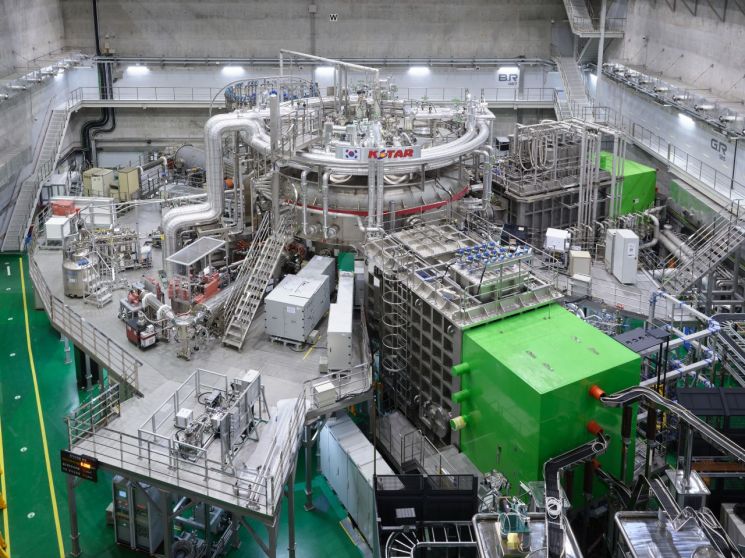
For fusion energy to become commercially viable, it is essential to develop operational technology that can stably maintain ultra-high temperature plasma, which reaches hundreds of millions of degrees, for extended periods. KSTAR has already succeeded in achieving the world’s longest high-performance plasma operation for over 100 seconds in this field. Starting this year, it has entered an experimental phase that simulates the environment of future fusion reactors.
The core focus of this experiment is to verify plasma operation technology in a tungsten wall environment. Since equipping KSTAR with the same tungsten divertor as the International Thermonuclear Experimental Reactor (ITER) in 2023, researchers have continued to study how to adapt to tungsten, a material highly resistant to heat but prone to frequent impurity generation.
This year, the focus goes beyond simple replication, with efforts concentrated on developing operational scenarios to realize stable, high-performance plasma even in a tungsten environment.
Controlling tungsten impurities is currently one of the most significant challenges in global fusion research. The institute plans to precisely analyze impurity behavior by combining various heating and fueling injection methods and to identify optimal operational conditions to suppress these impurities. In addition, they will comprehensively verify the interactions among key operational factors such as heating, current drive, and magnetic field control, aiming to achieve plasma that simultaneously meets the high-pressure, high-current, and stability requirements of future fusion reactors.
Notably, this year’s experiment newly applies AI and machine learning-based real-time control technology. This will enable the immediate detection and response to subtle changes in plasma, while also supporting research to elucidate complex physical phenomena such as fast ions.
Director Oh Youngkuk stated, "As global competition intensifies to accelerate the commercialization of fusion energy, KSTAR is speeding up the acquisition of core technologies that will be directly applicable to the operation of future fusion reactors. We will further strengthen our capabilities to realize fusion energy by actively utilizing international collaborative research and the latest technologies such as AI."
Meanwhile, this KSTAR plasma experiment will continue through December 2025. After about a month of equipment inspection, the next year’s experiment will begin immediately in February 2026. This is an unprecedented measure to conduct experiments for two consecutive years without halting device operation and is also part of preparations to replace the entire KSTAR inner wall with tungsten tiles. Through this, the institute plans to further enhance the precision and effectiveness of research by evolving KSTAR to operate under conditions similar to those of future fusion reactors.
© The Asia Business Daily(www.asiae.co.kr). All rights reserved.
![Clutching a Stolen Dior Bag, Saying "I Hate Being Poor but Real"... The Grotesque Con of a "Human Knockoff" [Slate]](https://cwcontent.asiae.co.kr/asiaresize/183/2026021902243444107_1771435474.jpg)
















