Market Cap Surges 60% in Three Years Under Lee Jae-yong
Major Orders Continue as Semiconductor Technology Rebounds
Challenges Remain in Foundry Yields and U.S. Plant Profitability
On October 27, Samsung Electronics, which holds the top spot in domestic market capitalization, saw its stock price surpass 100,000 won for the first time in history. Chairman Lee Jae-yong, who was appointed during a period of instability in the semiconductor and smartphone businesses, marks the third anniversary of his tenure on this day, having led Samsung Electronics to a remarkable new leap forward, including increasing its market capitalization by more than 60%.
According to the Korea Exchange on the 27th, as of 9:15 a.m., Samsung Electronics was trading at 101,000 won, up 2,200 won from the previous session. This is the first time Samsung’s stock price has exceeded 100,000 won. Although Chairman Lee marks his third anniversary in office today, he plans to continue his on-site management activities without issuing a separate message. When Chairman Lee took office, Samsung’s market capitalization was about 355.202 trillion won, and in the three years since, it has grown to 584.8602 trillion won as of the 24th.
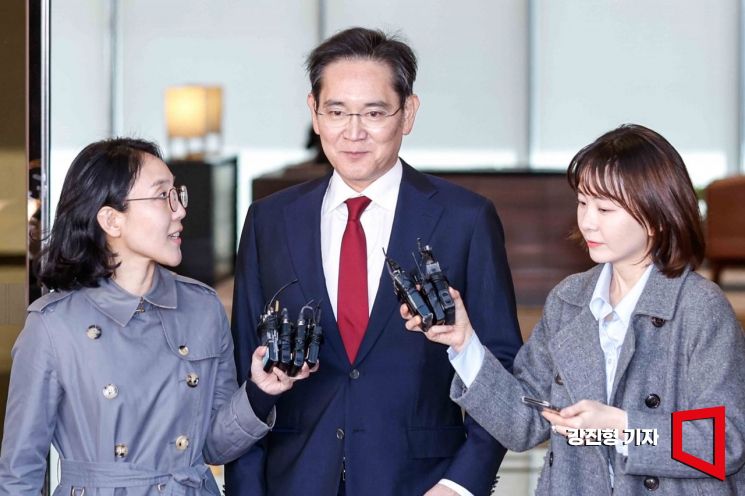 Samsung Electronics Chairman Lee Jae-yong is returning to Seoul through the Gimpo Airport Business Aviation Center in Gangseo-gu after meeting Chinese President Xi Jinping in March this year. Photo by Kang Jin-hyung
Chairman Lee stepped to the forefront of management in October 2022, when the company posted an "earnings shock" and a sense of crisis intensified, prompting calls for strong leadership. At the time, Samsung had fallen behind in artificial intelligence (AI) demand, but responded to Lee’s call for "technology the world has never seen" by focusing on restoring its technological edge. This year, the company secured a record-breaking semiconductor order worth 23 trillion won from Tesla, continuing its streak of unprecedented achievements. Samsung also succeeded in expanding shipments in the high-bandwidth memory (HBM) market, which had been dominated by SK Hynix, by diversifying customers for its HBM3E 12-layer products, and is expected to supply HBM4 to Nvidia. In addition, Samsung secured a contract this year to supply image sensors for Apple’s iPhones.
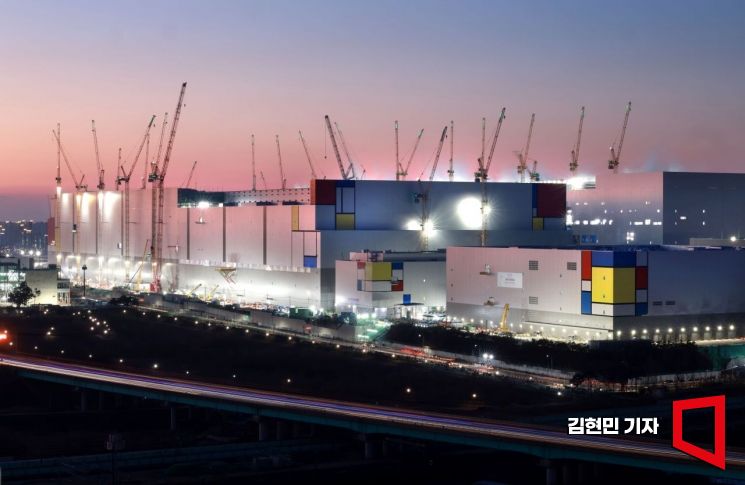
As competition in the global AI semiconductor market intensifies, Samsung Electronics faces internal challenges such as stabilizing foundry (semiconductor contract manufacturing) yields, expanding its design ecosystem, and strengthening technological capabilities. Ensuring profitability at the large-scale Pyeongtaek Campus and the Taylor plant in the United States, where significant investments have been made, will also be key turning points.
In addition, Samsung Electronics has continued to pursue mergers and acquisitions (M&A) of startups and specialized companies in advanced sectors such as AI, biotech, and audio in recent years. Through Harman, Samsung acquired the audio division of U.S.-based Masimo for about 500 billion won in May this year, and last year, Samsung Medison acquired Sonio, a French startup specializing in obstetric imaging analysis. This strategy is seen as an effort to proactively build a technological convergence ecosystem, beyond just hardware competitiveness.
Meanwhile, SK Hynix surpassed 500,000 won during intraday trading for the first time on the 21st, ushering in the "500,000 Hynix" era. The company continues to set new record highs, buoyed by a surge in demand for server and data center DRAM.
© The Asia Business Daily(www.asiae.co.kr). All rights reserved.


















