Installation of Electromagnetic Catapult... Construction of Fourth Carrier
Weaknesses Include Design Flaws and Insufficient Pilot Training
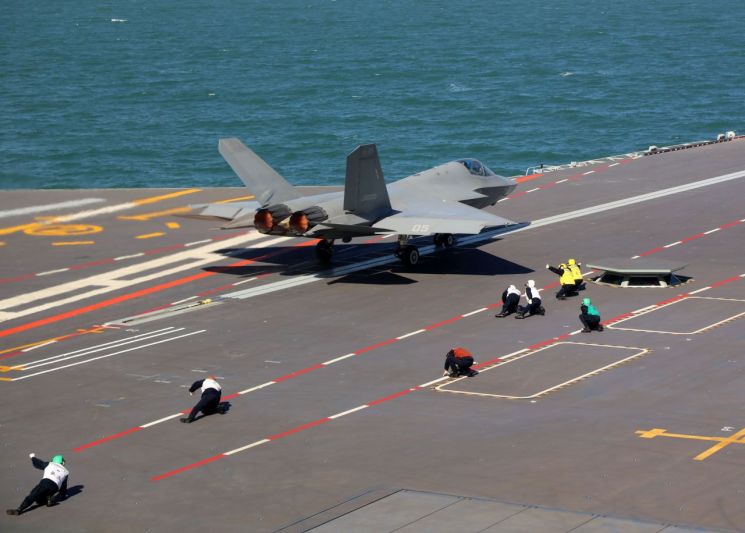 On the 22nd of last month (local time), a J-35 fighter jet conducted takeoff training using an electromagnetic catapult on the Fujian, China's third aircraft carrier. Photo by Xinhua News Agency
As China's new aircraft carriers are increasingly being equipped with the "electromagnetic aircraft launch system (EMALS)," a technology previously exclusive to the U.S. Navy, assessments of China's naval power are diverging both within and outside the United States.
There are predictions that China's fourth aircraft carrier, currently under construction, will be equipped with both an electromagnetic catapult and a nuclear propulsion engine, leading some to conclude that the technological gap with the United States has significantly narrowed. However, some experts still assess that Chinese aircraft carriers are only at about 60% of the capability of the aging U.S. carrier fleet. They argue that due to design flaws in the carriers and insufficient training of carrier-based aircraft pilots, China still faces significant challenges in matching the United States in actual operational capability.
Following the Fujian, the Sichuan is also equipped with an electromagnetic catapult... Rapid construction of the fourth carrier
According to the South China Morning Post (SCMP) in Hong Kong, the Chinese military began electromagnetic catapult takeoff training on the latest amphibious assault ship, the Sichuan, on October 20. The area around the Hudong-Zhonghua Shipyard pier in Shanghai, where the Sichuan is docked, was designated a restricted zone from October 20 to 29, and images circulated on Chinese social media showing the ship's electromagnetic catapults facing the sea.
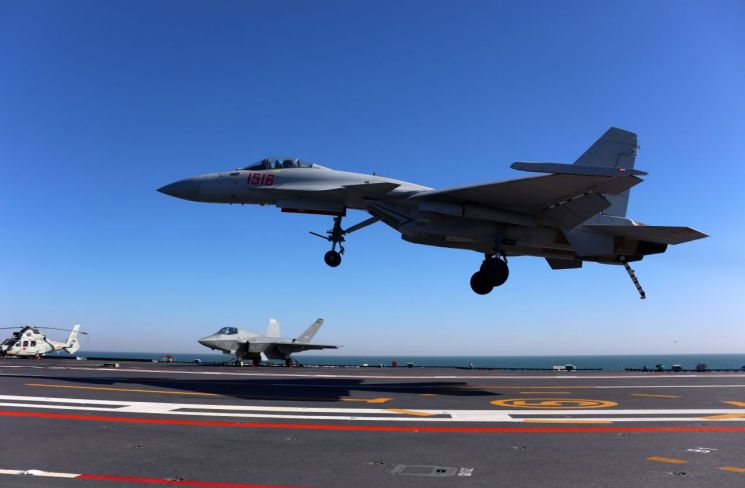
In September, the third Chinese aircraft carrier, the Fujian, which was launched earlier this year, was also equipped with an electromagnetic catapult, and footage was released of its carrier-based J-35 fighter jet conducting takeoff and landing training. As the Chinese military continues to install electromagnetic catapults on both large and small carriers and conduct training, there is growing consensus that China has successfully acquired a technology that was previously exclusive to the U.S. Navy.
An electromagnetic catapult is a device that assists fighter jets in taking off from aircraft carriers. There are electromagnetic and steam-powered versions, with the electromagnetic system widely regarded as vastly superior in terms of efficiency. Until now, this technology had only been deployed on U.S. carrier strike groups, and even Russia, the world's second-largest military power, has not been able to operate it.
With speculation that the Chinese military may equip its fourth aircraft carrier, currently under construction, with a nuclear propulsion engine in addition to the electromagnetic catapult, some analysts believe that China's carrier construction technology has caught up significantly with that of the United States. Quoting experts, Taiwan-based China Times reported, "China's fourth aircraft carrier, now under construction, is expected to be capable of carrying more than 90 carrier-based aircraft and to be equipped with a nuclear propulsion engine," adding, "Its capabilities could be on par with the U.S. Navy's latest Gerald R. Ford-class carriers."
"Only 60% of U.S. aging carrier capability"... Addressing design flaws and pilot training remains crucial
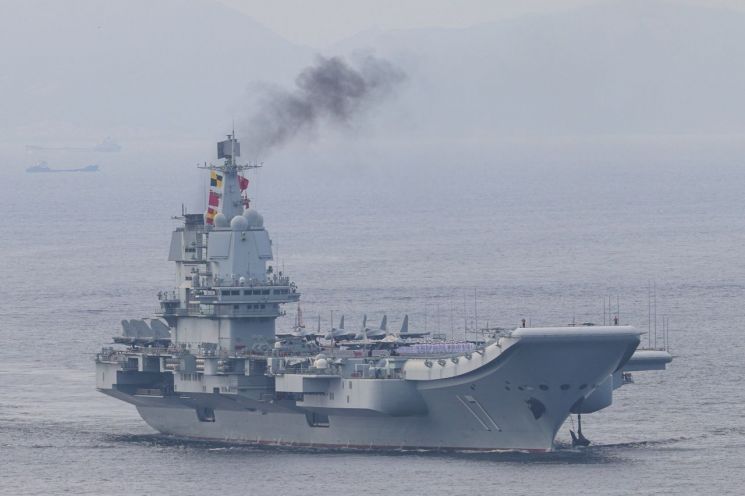
However, some argue that China's actual carrier operational capabilities still lag behind those of the U.S. Navy, and that China's naval power should not be overestimated. They point out that more training and real-world operational experience are needed to truly validate China's combat readiness.
Carl Schuster, a retired U.S. Navy captain who served on American aircraft carriers, told CNN, "The deck layout of the Fujian limits the ability to conduct takeoff and landing operations simultaneously. The landing area is so long that it is too close to the catapult launch area," adding, "Considering these design flaws, the operational capability of China's Fujian is likely only about 60% of that of the Nimitz-class carrier, which entered service in 1975."
Chronic shortages of carrier-based aircraft pilots and insufficient training are also cited as factors limiting China's carrier operational capabilities. In an effort to increase the number of carrier pilots, the Chinese government shortened the pilot training period from six years to three in 2022, but it is still reportedly unable to secure the minimum 200 pilots needed to operate three carriers. Although 4,500 trainees have been selected, training carrier-based pilots is far more difficult than training regular fighter pilots, and China continues to face challenges in developing the necessary expertise.
Keith Stewart, a former U.S. Air Force lieutenant colonel, stated, "You can build as many new carriers as you want, but the true operational capability of a carrier is forged by the pilots. China still seems to be in the process of figuring out what is not working in carrier operations, and this can only be learned through practice in all kinds of situations."
© The Asia Business Daily(www.asiae.co.kr). All rights reserved.



















