Travel Trend Focuses on High Efficiency and Ultra-Low Budgets
China's younger generations are drawing attention for adopting so-called "special forces-style" travel, which emphasizes high efficiency at minimal cost.
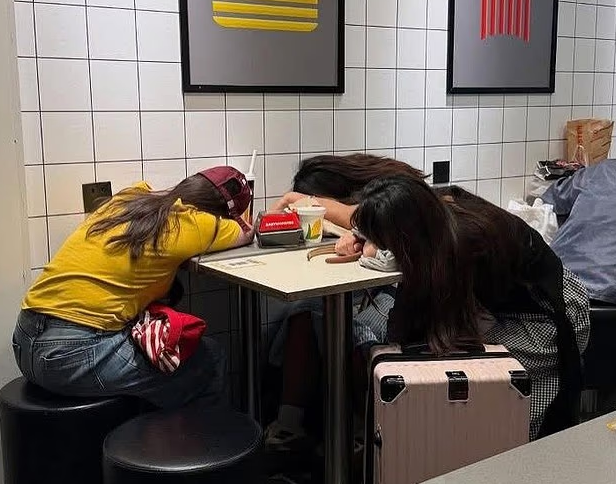 Among young generations in China, "special forces travel" is becoming popular. They pursue extreme efficiency and low cost, such as spending the night at a McDonald's that operates 24 hours to save on hotel accommodation fees. Instagram capture
According to the British Daily Mail and other foreign media on October 25, these outlets recently reported that a travel trend called "special forces travel" is spreading among Chinese Generation Z tourists. Australian ABC News explained, "Inspired by the efficiency, endurance, and intensity of the military, the goal is to visit as many tourist attractions as possible in a short time and at the lowest possible cost."
Walking, Convenience Stores, and Sleeping at McDonald's... Ultra-Low-Cost "Special Forces Travel" Trend in China
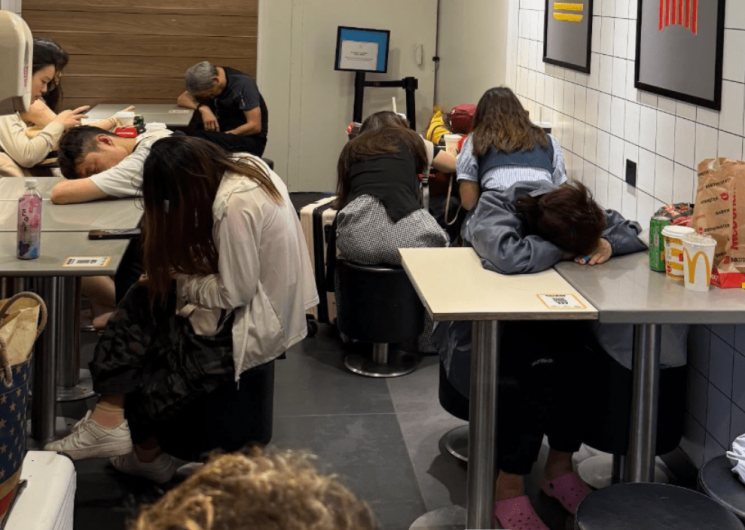 Among young people in China, "special forces travel" is becoming popular. They pursue extreme efficiency and low cost, such as spending the night at a McDonald's that operates 24 hours to save on hotel accommodation fees. Thread capture
On Chinese social media platforms, there is a flood of advice about how to travel "special forces-style." One of the most popular methods is spending the night at a McDonald's that operates 24 hours a day. Chinese tourist Chloe Kai said, "I visited Hong Kong for three days in May and spent about 100,000 won in total, with one night at McDonald's. Hotel prices in Hong Kong during the holiday season were too expensive, so I spent one night at McDonald's and another at a cheap hotel that cost about 43,000 won." Instead of dining at restaurants, they ate food from convenience stores and only visited free attractions such as Victoria Harbour and The Peak. To save on transportation costs, they walked most of the time.
Yuan Wenerhan and Pipitang, who live in Shanghai, also shared in an interview with ABC that "We arrived in Hong Kong on a night flight, showered at the airport, and started sightseeing from 6 a.m. We visited 14 destinations in 48 hours and spent about 340,000 won."
In May, photos of Chinese tourists spending the night at a 24-hour McDonald's in Hong Kong spread on social media. Some Hong Kong residents argued, "The influx of low-budget travelers has failed to boost the economy," "24-hour operations at fast-food restaurants like McDonald's should be stopped," and "It damages the city's dignity."
"Special Forces-Style" Travelers Drive Up Visitor Numbers but Reduce Tourism Revenue... "May Decrease Benefits in the Long Run"
Statistics show that despite an increase in visitors due to this "special forces-style" travel, related revenues have declined. According to the Hong Kong Tourism Board, 25.5 million tourists from mainland China visited Hong Kong between January and August this year. This is an 11% increase compared to the same period last year. However, data from the Hong Kong Census and Statistics Department shows that total retail sales during the same period were 245.1 billion Hong Kong dollars (about 45.4195 trillion won), a 1.9% decrease from the previous year.
Mimi Li, a professor of tourism at Hong Kong Polytechnic University, explained, "While the number of tourists has increased, issues of overtourism and overcrowding have emerged. Because of low-budget travelers, many tourists no longer stay overnight in Hong Kong, do not dine at local restaurants, and do not shop, thus contributing only minimal revenue to the economy." However, she added, "If young people visiting Hong Kong later gain more purchasing power, there could be long-term benefits."
"Young Chinese Suffer from 'Time Anxiety'... Want to Maximize Experiences Within Limited Budgets and Time"
Meanwhile, Mingming Cheng, head of the Social Media Research Lab at Curtin University, analyzed that the popularity of this "special forces-style" travel reflects the widespread social pressures among young Chinese. "Although their budgets and time are limited, they still want to experience as much as possible, which leads to 'time anxiety,'" he said.
However, experts advise that while this is a way for young people to travel in an era of high inflation, it is important to find a balance between the true meaning of travel and consideration for the destinations they visit.
© The Asia Business Daily(www.asiae.co.kr). All rights reserved.
![Clutching a Stolen Dior Bag, Saying "I Hate Being Poor but Real"... The Grotesque Con of a "Human Knockoff" [Slate]](https://cwcontent.asiae.co.kr/asiaresize/183/2026021902243444107_1771435474.jpg)












