Government Convenes Market Situation Review Meeting
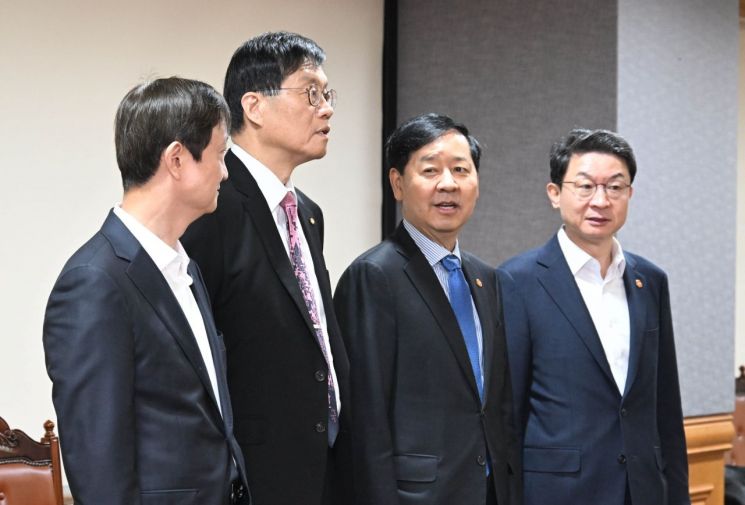 Koo Yoon-chul, Deputy Prime Minister and Minister of Economy and Finance, is taking a commemorative photo before the start of the Market Situation Review Meeting held on the 24th at the Korea Federation of Banks in Jung-gu, Seoul. From left to right are Lee Chan-jin, Financial Supervisory Service Governor; Lee Chang-yong, Bank of Korea Governor; Deputy Prime Minister Koo; and Lee Ok-won, Financial Services Commission Chairman. (Photo by Ministry of Economy and Finance)
Koo Yoon-chul, Deputy Prime Minister for Economy and Minister of Economy and Finance, stated on the 24th that, in response to the continued volatility in the foreign exchange market, "We will closely monitor external conditions, including the international financial market, around the clock and respond in a timely manner when necessary."
On this day, Deputy Prime Minister Koo presided over the Market Situation Review Meeting at the Korea Federation of Banks in Jung-gu, Seoul, where he reviewed recent trends in domestic and international financial and foreign exchange markets and discussed future response strategies. The meeting was attended by Lee Chang-yong, Governor of the Bank of Korea; Lee Ok-won, Chairman of the Financial Services Commission; and Lee Chan-jin, Commissioner of the Financial Supervisory Service.
The won-dollar exchange rate closed at 1,437.40 won in overnight trading the previous day, up 7.60 won, marking the highest level in six months during overnight trading. Although the Bank of Korea kept the base interest rate unchanged at 2.50% per annum, as the market had expected, growing concerns that the Korea-U.S. tariff negotiations would not be resolved soon pushed the exchange rate higher. The preference for safe-haven assets, reflected in the overnight decline of major U.S. stock indices, and net selling of stocks by foreign investors in the domestic stock market also contributed to upward pressure on the exchange rate.
The participants said, "Recently, global uncertainties have increased due to factors such as the U.S.-China trade conflict and fiscal and political risks in countries like France and Japan, leading to continued volatility in the foreign exchange market. Each institution will closely monitor external conditions, including the international financial market, around the clock, centering on the Market Situation Review Meeting, and will respond in a timely manner when necessary."
Additionally, as the real estate market has recently shown signs of overheating, the government will make every effort to expand housing supply by swiftly addressing supply constraints alongside demand management.
The participants further evaluated, "Recently, the effects of the supplementary budget and improved consumer sentiment have led to a turnaround in domestic demand, while exports have performed better than expected. As a result, the overall economy is showing signs of improvement. Policy effects such as the amendment of the Commercial Act and the introduction of a one-strike-out rule for unfair trading, as well as expectations for a recovery in the semiconductor industry, have attracted foreign investment, leading the KOSPI index to reach an all-time high. Overall, the domestic financial market is displaying stability."
© The Asia Business Daily(www.asiae.co.kr). All rights reserved.

















