NH Investment & Securities has forecast that the KOSPI, which surpassed the 3,900 mark intraday for the first time in history, will move within the 3,650-3,950 range next week. In particular, the company expects that uncertainties over Korea-US tariffs will act as a source of noise ahead of the Asia-Pacific Economic Cooperation (APEC) summit.
Na Jeonghwan, a researcher at NH Investment & Securities, stated in the "Weekly Investment Strategy on Friday" report released on Friday, the 25th, "This week, the KOSPI continued its upward trend on expectations of easing domestic and external risks," and presented a weekly forecast range of "3,650-3,950" for next week. The KOSPI surpassed the 3,900 mark intraday for the first time ever the previous day, but after a rollercoaster session, it closed at 3,845.56.
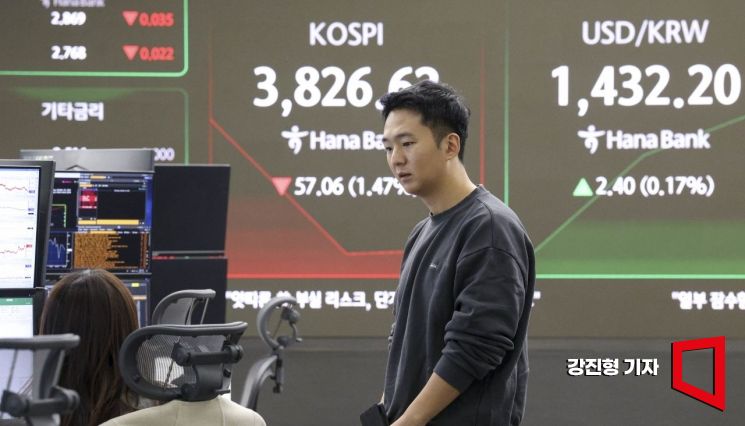 On the 23rd, the KOSPI index opened at 3832.38, down 51.30 points from the previous trading day, as dealers were working in the dealing room of Hana Bank in Jung-gu, Seoul. On the same day, the won-dollar exchange rate opened in the 1430 won range ahead of the Bank of Korea's interest rate decision. October 23, 2025. Photo by Kang Jinhyung
First, Na cited the expansion of global liquidity and strong Korean exports as factors that could drive the KOSPI higher next week, while pointing to reduced expectations of interest rate cuts and profit-taking as factors that could weigh on the index.
Regarding the upcoming Federal Open Market Committee (FOMC) meeting of the US Federal Reserve next week, he noted, "The interest rate futures market is currently pricing in a 98.9% probability of a 0.25 percentage point cut," and added, "Given Federal Reserve Chair Jerome Powell's comments expressing concerns about a slowdown in employment, the accommodative stance is likely to be maintained. Therefore, the favorable liquidity environment and expectations for continued foreign capital inflows remain valid." He also said, "Although the Korean won is currently weak, considering fundamental factors such as improvements in the trade balance, a rebound is possible. While foreign investors have turned to net selling, if an agreement is reached on tariff uncertainties and the won rebounds, net buying could resume."
He also highlighted the ongoing uncertainty surrounding Korea-US tariff negotiations ahead of the APEC summit, which will be held in Gyeongju from October 31 to November 1. Na stated, "Whether US President Donald Trump will accept South Korea's proposal to split investments in the US is a key issue," but added, "The US is in a position where it needs investment and cooperation from Korean companies in shipbuilding, nuclear power, and power equipment. Although the Korea-US negotiations may face difficulties and delays, ultimately, the negotiations are likely to proceed toward the US accepting the investment split proposal."
Accordingly, he recommended that "since the current market is characterized by a divergence between earnings and liquidity, it is reasonable to respond to short-term corrections by buying." He explained that while there has been some profit-taking following the recent rapid rise, export conditions remain favorable, with average daily exports in October up 9.7% year-on-year, and domestic investor deposits have surpassed 80 trillion won, indicating ample liquidity.
He identified semiconductors (Samsung Electronics), securities (Kiwoom Securities), holding companies (Doosan), artificial intelligence (AI) software (LG CNS), and automobiles (Hyundai Motor) as sectors of interest. He added, "Currently, expectations for a bull market in the domestic stock market are high, and in this environment of abundant liquidity, even stocks and sectors with weak annual returns can see strong net buying and price increases if there is any sign of earnings improvement. It is also worth revisiting sectors and stocks with poor annual returns and excessively undervalued valuations during a bull market."
© The Asia Business Daily(www.asiae.co.kr). All rights reserved.
!["The Woman Who Threw Herself into the Water Clutching a Stolen Dior Bag"...A Grotesque Success Story That Shakes the Korean Psyche [Slate]](https://cwcontent.asiae.co.kr/asiaresize/183/2026021902243444107_1771435474.jpg)
















