Extension of Capital Gains Tax Suspension Also a Variable
"Approach Needed from a Structural, Not Political, Perspective"
Just over a week after the government announced the '10·15 Real Estate Measures,' discussions about increasing property holding taxes have resurfaced. This comes as Kim Yongbeom, Chief Presidential Secretary for Policy, and Koo Yooncheol, Deputy Prime Minister and Minister of Economy and Finance, both emphasized the need to strengthen holding taxes. Although the Ministry of Economy and Finance clarified that Deputy Prime Minister Koo's remark, "The United States has a 1% holding tax," did not represent the official position, speculation is growing in the real estate market that the government may introduce tax reform as its next measure to curb demand.
The 'ability to pay' principle put forward by Deputy Prime Minister Koo suggests taxing in accordance with individuals' financial capacity. This is interpreted as a plan to increase holding taxes while lowering capital gains taxes, thereby achieving both tax fairness and greater market liquidity. Strengthening holding taxes could increase the tax burden for owners of multiple properties, thereby discouraging speculative demand aimed at short-term gains. However, it could also burden not only the wealthy but also retirees and genuine single-home owners, making controversy inevitable. There are concerns that if holding taxes rise sharply while income falls, households with limited cash flow could be hit with a so-called 'tax bomb.'
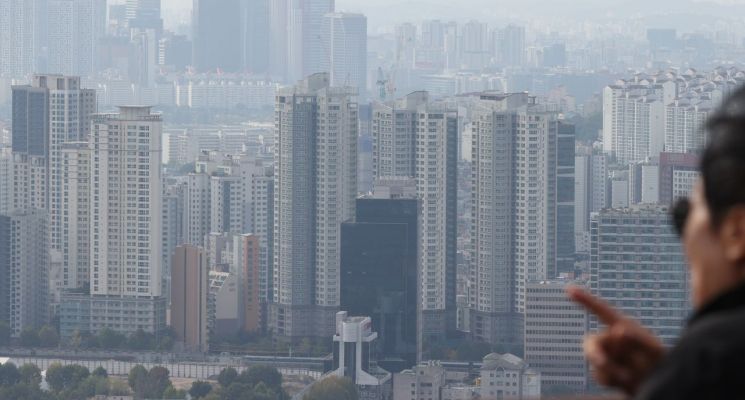
◆ Holding Tax: A Key Tool for Market Stability and the Center of Debate = The holding tax is an annual tax levied on property ownership, consisting of property tax and the comprehensive real estate tax. It is regarded as a key policy tool not only for raising tax revenue but also for curbing overheating in the real estate market and promoting tax fairness. Currently, the effective holding tax rate on housing in Korea is between 0.16% and 0.20% of the property value. For example, as of June this year, the officially assessed value of a mid- to high-floor 84-square-meter unit in 'Raemian One Bailey' in Banpo-dong, Seocho-gu, Seoul, was 3.749 billion won, with a holding tax of about 18.03 million won, which is 0.32% of the actual transaction price. For 'Mapo Raemian Prugio' in Ahyeon-dong, the assessed value was 1.318 billion won, and the holding tax was 2.31 million won (including 220,000 won in comprehensive real estate tax), equivalent to 0.19% of the actual transaction price.
Opinions are divided on the level of holding tax burden. Those who argue the tax is high compare holding tax revenue to the size of the economy, while those who argue it is low compare the tax rate to actual transaction prices. The Korea Institute of Local Finance believes that Korea's holding tax burden already exceeds the OECD average. According to a report published last year by Senior Researcher Shin Mijeong, as of 2022, Korea's property holding tax was 1.23% of GDP and 5.15% of total tax revenue, higher than the OECD averages of 0.97% and 3.75%, respectively. Shin explained, "Although the effective tax rate relative to private real estate assets is evaluated as low, this may be the result of domestic asset values being overestimated," and added, "With the realization of official prices and the strengthening of the comprehensive real estate tax, the tax burden has increased the most among OECD countries."
On the other hand, the Land+Liberty Institute argued in a report last month that Korea's effective holding tax rate is only half the OECD average. According to the institute, as of 2023, Korea's effective holding tax rate was 0.15%, ranking 20th out of 30 countries and lower than the OECD average of 0.33%. However, the report also noted, "It is difficult to conclude that raising the holding tax has led to stabilization of housing prices," analyzing that structural factors such as supply shortages, regional demand differences, and liquidity play a greater role in the market.
◆ 2.8-Fold Increase in Holding Tax Burden Under the Moon Administration... Concerns About Unintended Tax Effects = Strengthening the holding tax has also been implemented by previous administrations. In the final year of the Moon Jaein administration in 2021, 1.08756 trillion won was collected in holding taxes, a 2.8-fold increase from 393.92 billion won in 2016. The increase over five years amounted to about 700 billion won. At the time, the government raised both holding and capital gains taxes, but this ultimately led to a shortage of properties for sale and is seen as a factor that fueled the real estate price surge. There is also analysis that excessive tax tightening focused on the comprehensive real estate tax contributed to public discontent and the change of government. As a result, there are calls within the government to moderate the pace of tax tightening.
On the other hand, some argue that the current level of holding tax is insufficient to curb surging demand for high-priced apartments, a phenomenon known as the 'smart single property' trend. A government official stated, "The tax office does not want to make holding tax hikes the centerpiece of real estate policy, but under the current tax structure, capital inevitably flows into real estate," adding, "It is necessary to gradually normalize the fair market value ratio (the tax base), which is currently 60% of the officially assessed value." The need to strengthen holding taxes is also raised because real estate is seen as a key factor in deepening asset inequality. The current structure, which places a relatively low burden on high-value property ownership and concentrates benefits from property and comprehensive real estate taxes, is intensifying the concentration of wealth in Seoul and the metropolitan area.
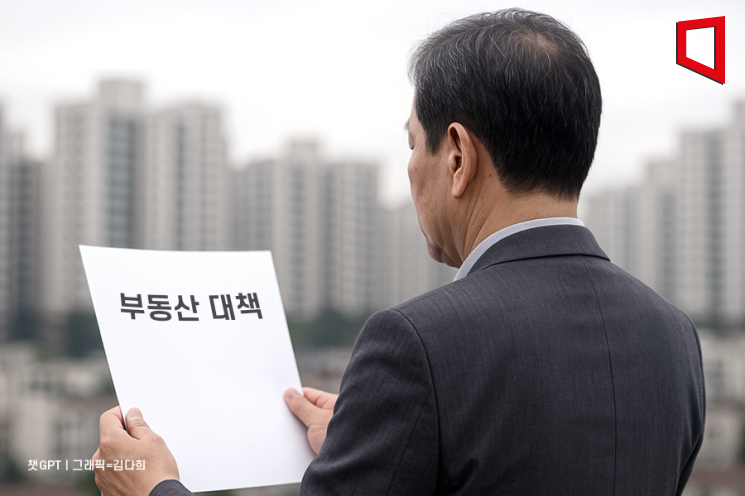
◆ Interest in Extension of Temporary Capital Gains Tax Surcharge Suspension = Amid discussions about strengthening the holding tax, there is also growing interest in scenarios involving the easing of capital gains taxes. The capital gains tax is imposed on profits from selling real estate and, along with transaction taxes (acquisition and registration taxes), directly affects market liquidity. Simply put, if you buy a house for 500 million won and sell it for 800 million won, you pay tax on the 300 million won profit. Strictly speaking, transaction taxes, which include acquisition tax, are different in nature, but since they are intertwined in the real estate sales process, they are often discussed together.
Within and outside the government, there is a prevailing view that to prevent market overheating, easing capital gains and transaction taxes should accompany any strengthening of the holding tax. In particular, attention is focused on the possibility of extending the temporary suspension of the capital gains tax surcharge, which is set to expire on May 9 next year. If the suspension ends just before the local elections in June, it is expected that public sentiment will worsen due to increased tax burdens.
The capital gains tax surcharge was introduced in 2021 to curb speculation by owners of multiple properties. For owners of two properties, a 20 percentage point surcharge was added to the basic rate (6-45%), and for those with three or more properties, a 30 percentage point surcharge applied. However, as the tax burden surged, many owners of multiple properties opted to hold rather than sell, leading to a shortage of properties for sale and further market distortion. To address this, the government implemented a one-year suspension of the surcharge from May 2022, and has since extended the measure annually, allowing owners of multiple properties to be taxed at the basic rate without the surcharge until next year. Long-term holding special deductions are also being provided.
◆ "Approach Needed from a Structural Reform Perspective, Not Political Timetables" = Experts caution that tax policy should not be swayed by political schedules or short-term real estate stabilization logic. Lim Jaeman, Professor of Real Estate Studies at Sejong University, said, "Tax reform should not be driven by political timetables or efforts to control housing prices. It should be approached structurally, with the aim of channeling liquidity tied up in real estate into productive finance and innovative growth." Seo Jinhyung, Professor of Real Estate Law at Kwangwoon University and President of the Korea Association of Real Estate Studies, analyzed, "It is difficult for a holding tax increase to immediately result in more properties for sale. In a situation where expectations for price increases outweigh the impact of holding taxes, only tax resistance may rise." He added, "Ultimately, the key is whether the government is willing to lower transaction-related taxes such as acquisition tax to ease the market burden."
A government official stated, "Since real estate tax reform has a significant impact on people's lives, it should be reviewed carefully," adding, "We will examine the direction through research studies." Regarding the possibility of extending the suspension ahead of next year's local elections, the official said, "If the current trend of easing transaction taxes continues, an extension would be a natural step."
© The Asia Business Daily(www.asiae.co.kr). All rights reserved.
![Clutching a Stolen Dior Bag, Saying "I Hate Being Poor but Real"... The Grotesque Con of a "Human Knockoff" [Slate]](https://cwcontent.asiae.co.kr/asiaresize/183/2026021902243444107_1771435474.jpg)

















