Besant: "Software Export Controls Under Review... Coordination with G7"
Countermeasure Card Against China’s Rare Earth Export Controls
Tensions Rise Ahead of U.S.-China Summit
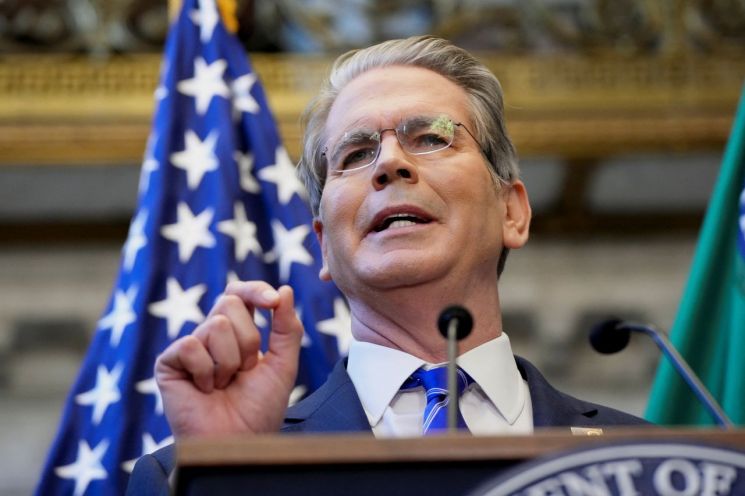
The Donald Trump administration is reviewing export control measures on products incorporating U.S. software technology to China. Ahead of next week’s U.S.-China summit, both countries are unveiling cards related to rare earths and software export controls in succession, competing for leverage in negotiations.
Scott Besant, U.S. Secretary of the Treasury, told reporters on the 22nd (local time) that “everything is on the table” when asked about the possible introduction of software export restrictions on China. He added, “Whether it is software, engines, or anything else, if export controls are implemented, they will be pursued in coordination with our G7 allies.”
This statement confirmed an earlier Reuters report that the U.S. is considering export controls on software to China. Reuters, citing multiple sources, reported that the Trump administration is discussing restrictions on exports to China of products that incorporate U.S. software technology.
These measures are seen as similar to the sanctions imposed on Russia after its invasion of Ukraine, and it is estimated that items such as laptops and jet engines are likely to be included. However, sources also indicated that these measures may ultimately not be implemented.
At the same time, Secretary Besant left the door open by stating that trade negotiations with China are proceeding “with good intentions” and “great respect.”
This move is interpreted as a countermeasure to China’s recent additional export controls on rare earths targeting the United States, announced on the 9th. Rare earths are core materials needed for advanced industries such as electric vehicle batteries and semiconductors, and China accounts for about 70% of the global supply.
The Chinese government had eased control measures in June, such as resuming exports of Nvidia’s artificial intelligence (AI) semiconductor chips, but has since tightened restrictions again. According to the South China Morning Post (SCMP), China’s exports of rare earth permanent magnets to the U.S. in September totaled 420.5 tons, down 28.7% from the previous month. If export controls are further strengthened, exports to the U.S. are expected to decrease even more.
On the 10th, President Trump announced on his social media platform, Truth Social, that he would impose an additional 100% tariff on Chinese products and start new export control measures on all key software next month.
In particular, both governments appear to be employing pressure tactics to strengthen their negotiating positions ahead of the U.S.-China summit. President Trump is scheduled to hold a summit with Chinese President Xi Jinping during the Asia-Pacific Economic Cooperation (APEC) meeting in Gyeongju next week. President Trump also stated the previous day that the U.S.-China summit would proceed as planned, but did not rule out the possibility of cancellation.
However, Reuters reported that if software export controls are fully implemented, they could disrupt global trade with China, especially in technology products, and place a significant burden on the U.S. economy. Emily Kilcrease, former Deputy Assistant U.S. Trade Representative, said, “Software is a natural area for the U.S. to exert influence,” but also expressed concern that “such controls would be extremely difficult to enforce and could backfire on U.S. industries.”
Meanwhile, renewed concerns over U.S.-China trade tensions caused all three major New York stock indexes to fall on this day. The Dow Jones Industrial Average closed down 0.71% from the previous trading day, while the S&P 500 Index dropped 0.53% and the Nasdaq Index fell 0.93%.
© The Asia Business Daily(www.asiae.co.kr). All rights reserved.
![Clutching a Stolen Dior Bag, Saying "I Hate Being Poor but Real"... The Grotesque Con of a "Human Knockoff" [Slate]](https://cwcontent.asiae.co.kr/asiaresize/183/2026021902243444107_1771435474.jpg)
















