Bloomberg TV Interview
On October 22 (local time), Deputy Prime Minister and Minister of Economy and Finance Koo Yooncheol stated that, regarding the Korea-U.S. tariff negotiations, the focus is on designing the investment structure for the $350 billion investment in the United States, rather than on a currency swap. He also predicted that the recent sharp rise in the won-dollar exchange rate reflects uncertainty caused by delays in negotiations, and that the exchange rate would stabilize once an agreement is reached.
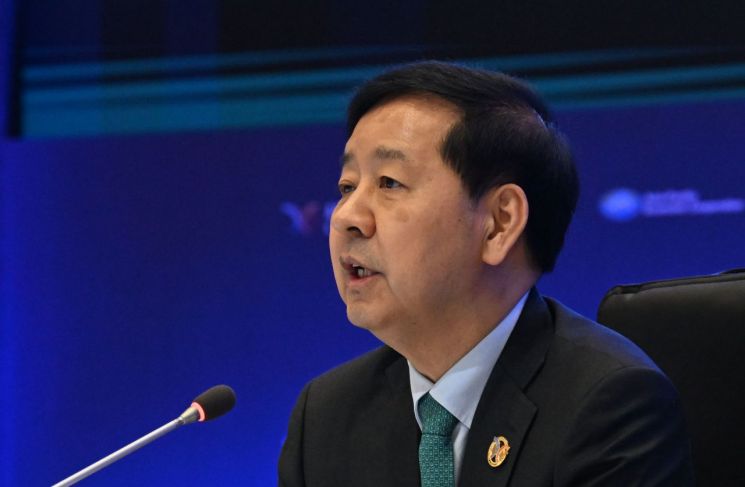
In an interview with Bloomberg TV that day, Deputy Prime Minister Koo said, "Korea is prioritizing the creation of a balanced investment package that combines direct investment, loans, and guarantees in the negotiations."
He explained, "Whether a currency swap is necessary, and to what extent, depends entirely on the structure of the negotiations. It may not be needed at all, or it could be implemented on a smaller scale." In other words, depending on how the investment package is structured, both the need for and the scale of foreign exchange market stabilization measures may vary.
Deputy Prime Minister Koo also mentioned his meeting with U.S. Treasury Secretary Scott Besant last week, saying, "Secretary Besant fully understands the difficulties facing Korea's foreign exchange market," and added, "The U.S. is currently discussing response measures internally."
Previously, when Howard Lutnick, the U.S. Secretary of Commerce and the American counterpart in the Korea-U.S. tariff negotiations, insisted on a $350 billion cash investment, the Korean government explained to the U.S. side-through Secretary Besant and other various channels-the potential for instability in the foreign exchange market if direct investment were to be expanded. It has been reported that Secretary Lutnick has recently shown some agreement with Korea's position that the proportion of direct investment should be reduced from the level initially demanded by the U.S.
Regarding the recent surge in the won-dollar exchange rate, which is approaching 1,430 won, Deputy Prime Minister Koo emphasized, "The recent weakness of the won reflects concerns over the lack of resolution in the tariff negotiations," and added, "If the tariff issue is resolved, the uncertainty will be alleviated."
He also introduced that, beyond trade and currency issues, Korea is concentrating resources on fostering innovation-driven growth in the economy, particularly in artificial intelligence (AI), digital transformation, and deep tech sectors.
© The Asia Business Daily(www.asiae.co.kr). All rights reserved.
!["I'd Rather Live as a Glamorous Fake Than as a Poor Real Me"...A Grotesque Success Story Shaking the Korean Psyche [Slate]](https://cwcontent.asiae.co.kr/asiaresize/183/2026021902243444107_1771435474.jpg)
















