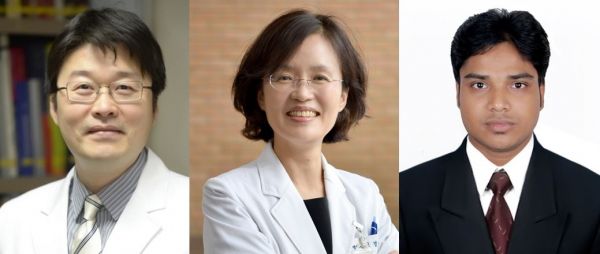
The research team at Hwasun Chonnam National University Hospital has identified the reason why cancers that have metastasized to the brain do not respond well to chemotherapy and radiation therapy.
Although standard treatments are often administered to patients with brain metastases, their effectiveness is frequently limited, and there has been no clear explanation as to why these treatments fail. This study is noteworthy because it demonstrates that not only cancer cells but also the surrounding microenvironment determines treatment outcomes.
On October 20, Hwasun Chonnam National University Hospital announced that the research team led by Professor Moon Kyungseop from the Department of Neurosurgery and Professor Lee Kyunghwa from the Department of Pathology has identified that cancer-associated fibroblasts (CAFs), which are found in brain metastatic lung cancer tissues, play a key role in treatment resistance.
According to the study, cancer cells secrete the cytokine IL26 (Interleukin-26) and the CX3CL1 signaling protein, which enable them to withstand chemotherapy and radiation therapy.
Experimental results showed that IL26 activates the JAK-STAT3 pathway, while CX3CL1 activates the AKT-mTOR pathway, thereby increasing the invasiveness and survivability of cancer cells. As a result, epithelial-mesenchymal transition (EMT) and cancer stem cell characteristics were further enhanced.
In contrast, when both signals were blocked, the tumor growth rate was significantly reduced. In particular, experiments inhibiting IL26 showed a marked improvement in treatment efficacy even in animal models.
The research team stated, "This study reveals that in brain metastatic cancer, it is not the cancer cells themselves, but the 'helper cells' in the surrounding environment that are responsible for treatment failure," and emphasized, "Controlling IL26 and CX3CL1 signaling could greatly improve the treatment response in patients with brain metastatic lung cancer."
The results of this study were published in the September 2025 issue of the international journal Experimental Hematology & Oncology (Impact Factor 13.5), with Researcher S. M. Abdus Salam as the first author.
In addition, the paper was selected for "People Who Light Up Korea," a feature by the POSTECH Biological Research Information Center (BRIC) that highlights outstanding research achievements in the life sciences, thereby showcasing the capabilities of Korean researchers to the world.
© The Asia Business Daily(www.asiae.co.kr). All rights reserved.

















