Surpassing 49,000 for the First Time Ever
"Investor Sentiment Improves as Political Uncertainty Eases"
As it became almost certain that Sanae Takaichi, president of Japan's ruling Liberal Democratic Party, would join hands with the second-largest opposition party, Nippon Ishin no Kai, to become prime minister, the so-called "Takaichi Trade" reignited on October 20, sending the Japanese stock market soaring.
On this day, the Nikkei 225, Japan's benchmark stock index, closed at 49,185, up 3.37% from the previous trading session.
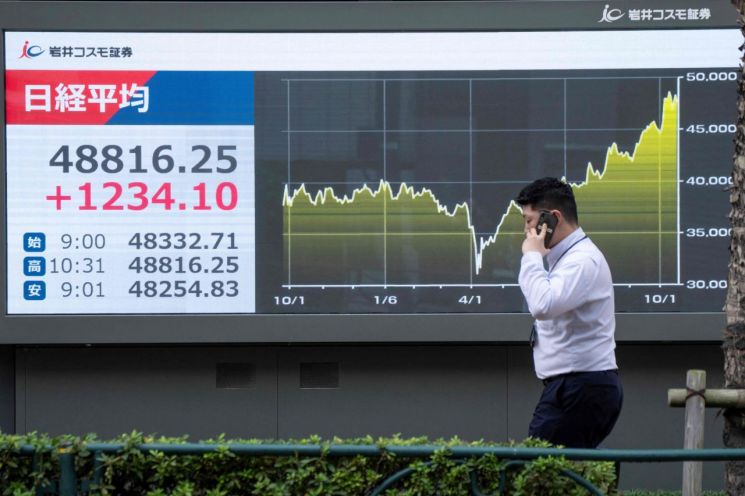
This marks the first time in history that the index has surpassed the 49,000 level, now putting the 50,000 mark within reach.
The sharp rise in the Japanese stock market appears to be driven by the announcement that the Liberal Democratic Party and Nippon Ishin no Kai plan to form a coalition government, making Takaichi’s election as prime minister in the vote scheduled for October 21 virtually certain.
Takaichi, who has supported former Prime Minister Shinzo Abe's economic policy known as "Abenomics," also pledged to pursue aggressive fiscal expansion during the Liberal Democratic Party leadership race.
Nihon Keizai Shimbun (Nikkei) described the day’s market as a "re-acceleration of the Takaichi Trade," stating, "With political uncertainty resolved and no new negative factors emerging from U.S.-driven credit concerns, investor appetite for risk assets has increased. As the Nikkei index approaches the 50,000 range, it is nearing the upper end of forecasts presented by securities firms."
Daiwa Securities explained that while expectations for large-scale monetary easing similar to the Abenomics era are low, optimism about policy initiatives such as next-generation technology investment could drive up the expected price-to-earnings ratio (PER).
However, some warn that the Japanese stock market may be overheating. Hikaru Yasuda, chief equity strategist at SMBC Nikko Securities, said, "If any one of the three factors-domestic political stability, the U.S. economy, or the artificial intelligence (AI) boom-disappears, the scenario for further stock price gains will need to be revised."
© The Asia Business Daily(www.asiae.co.kr). All rights reserved.
![User Who Sold Erroneously Deposited Bitcoins to Repay Debt and Fund Entertainment... What Did the Supreme Court Decide in 2021? [Legal Issue Check]](https://cwcontent.asiae.co.kr/asiaresize/183/2026020910431234020_1770601391.png)
















