LDP and Japan Innovation Party Solidify Coalition Structure
Both Parties to Sign Agreement at 6 p.m. on the 20th
"Hope She Will Lead Society by Addressing Inequality"
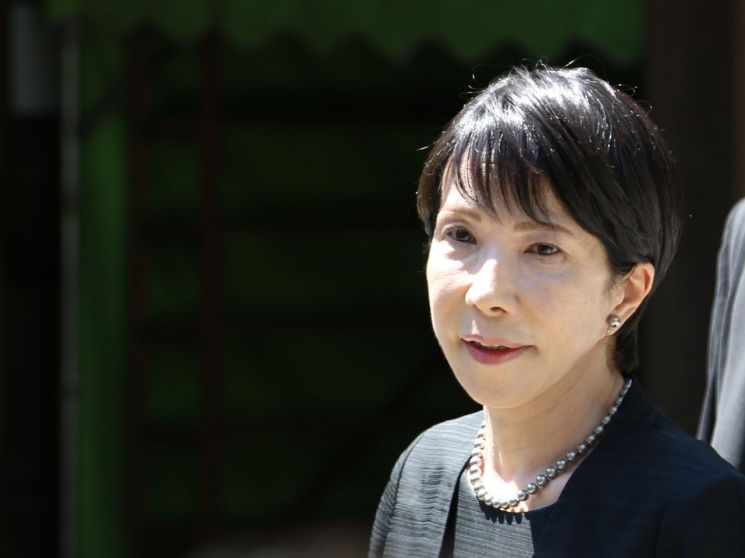 Liberal Democratic Party leader Sanae Takaichi, in her capacity as a member of parliament, visited the Yasukuni Shrine in Tokyo on August 15 (local time). Photo by Yonhap News Agency
Sanae Takaichi, leader of Japan's ruling Liberal Democratic Party, is now virtually certain to become prime minister after forming an alliance with the Japan Innovation Party, the nation's second-largest opposition party. This is expected to mark a historic moment as Japan is set to see its first-ever female prime minister, a significant milestone in the country's traditionally conservative society where women's participation in politics remains low.
Japan Innovation Party: "We will agree to a coalition with the Liberal Democratic Party"
Hirofumi Yoshimura, leader of the Japan Innovation Party, told reporters including Kyodo News on the 20th, "This morning, I formally conveyed to Takaichi, the Liberal Democratic Party leader, our intention to agree to form a coalition government," adding, "Both sides will sign the agreement at 6 p.m."
The political uncertainty that has persisted for two weeks following the resignation of Prime Minister Shigeru Ishiba earlier this month is also expected to subside. Takaichi faced a brief crisis after Komeito, the Liberal Democratic Party's coalition partner of 26 years, withdrew from the alliance due to the party's hardline security stance and unresolved funding scandals. However, she has regained stability by securing new allies.
The combined number of seats held by the Liberal Democratic Party and the Japan Innovation Party in the lower house is 231, just two short of a majority (233 seats). However, Takaichi is considered the leading candidate for the next prime minister, as she can be elected with a simple majority in a runoff vote.
Takaichi's inauguration as prime minister is expected to take place just before a visit by a former U.S. president. Her first diplomatic engagement is likely to be the Asia-Pacific Economic Cooperation (APEC) summit to be held in South Korea.
Some policy coordination required
The right-leaning Japan Innovation Party is demanding several policy concessions in exchange for joining the coalition. Yoshimura stated, "Designating Osaka as the second capital in the event of a disaster in Tokyo and reforming the social security system are non-negotiable conditions."
The Japan Innovation Party is also calling for exemptions from the 10% consumption tax on food products and a ban on political donations from corporations and organizations. However, Kyodo News reported that there is strong opposition within the Liberal Democratic Party to the ban on political donations.
Additionally, Takaichi, who is known to support "expansionary fiscal policy," advocates for tax cuts and increased government spending to combat rising prices. However, observers note that this could lead to clashes with the Japan Innovation Party, which favors small government and fiscal austerity.
Takaichi's political stance: Hardline conservative
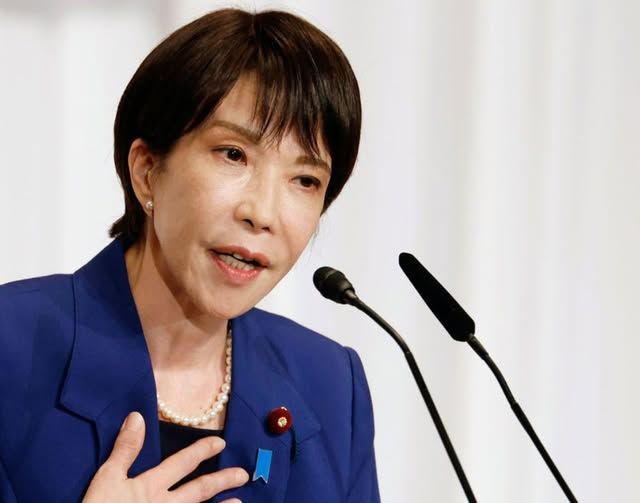
Takaichi is classified as a hardline conservative. She regards former Prime Minister Shinzo Abe, who championed the "Abenomics" economic policy centered on a weak yen, as her political mentor, earning her the nickname "the female Abe."
She has sought to revise the postwar pacifist constitution to explicitly recognize the Self-Defense Forces. Despite the increasing number of immigrants and tourists in Japan, she has consistently argued for stricter immigration controls.
Takaichi has also regularly visited the Yasukuni Shrine in Tokyo, where convicted war criminals are enshrined. Such visits by Japanese politicians are often seen as attempts to justify past wars of aggression and have sparked controversy. However, she has recently shown a more restrained approach, refraining from visiting the shrine in person and instead offering ritual offerings, mindful of her status as a likely next prime minister and of relations with neighboring countries such as South Korea and China.
There is optimism that she could be the figure to break the "glass ceiling" in Japan's conservative society. Japan still ranks among the lowest in the OECD in terms of women's participation in politics. The proportion of female lawmakers in the lower house is about 16%, placing Japan 141st out of 183 countries. There are currently only two female ministers in the cabinet.
The New York Times described Takaichi, who is poised to become Japan's first female prime minister, as someone who will "break the glass ceiling of Japanese politics" and called it a "historic moment."
Hikari Minagawa, a student at Otsuma Women's University in Tokyo, told The New York Times, "I hope Takaichi will create an environment where women can enter politics more easily." Kaori Sasaki, CEO of the consulting firm Ewomen, said, "Although I disagree with many of Takaichi's policies, now that she is about to become prime minister, I hope she will lead society in a direction that addresses the inequalities she herself has experienced."
© The Asia Business Daily(www.asiae.co.kr). All rights reserved.
![Clutching a Stolen Dior Bag, Saying "I Hate Being Poor but Real"... The Grotesque Con of a "Human Knockoff" [Slate]](https://cwcontent.asiae.co.kr/asiaresize/183/2026021902243444107_1771435474.jpg)












