A Series of Earnings Reports Begins This Week
Key Variable for Restoring Investor Sentiment
September CPI Also in the Spotlight
The key factors that will determine the direction of the U.S. stock market this week can be summarized as three main variables: the earnings reports of major technology companies, the September Consumer Price Index (CPI), and the ongoing developments in the U.S.-China trade conflict. Last week, uncertainty increased due to the prolonged federal government shutdown, renewed U.S.-China tensions, and heightened concerns over credit risks among small and mid-sized U.S. banks, causing significant volatility in the stock market. Against this backdrop, whether large companies such as Tesla and Netflix meet market expectations with their earnings, as well as the inflation level, are expected to be decisive factors shaping the trend of the U.S. stock market.
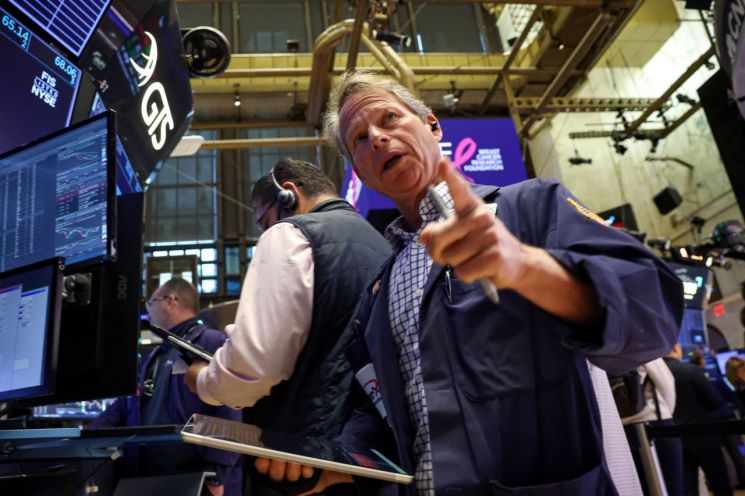 On the 17th (local time), traders are conducting transactions at the New York Stock Exchange (NYSE) in New York City, USA. Photo by Reuters Yonhap News
According to CNBC, a U.S. economic media outlet, on the 19th (local time), this week will see a series of earnings releases from Netflix, Tesla, consumer goods companies such as Procter & Gamble and Coca-Cola, aerospace and defense company RTX, and technology giant IBM. With the federal government shutdown halting the release of key economic statistics since the beginning of the month, corporate earnings are expected to provide clues about the overall health of the U.S. economy.
Additionally, from this week through next week, six out of the seven major technology companies known as the "Magnificent 7" will announce their quarterly earnings. Electric vehicle maker Tesla will kick things off by releasing its results after the market closes on the 22nd, followed by Microsoft, Google, and Meta on the 29th, and Apple and Amazon on the 30th.
Last week, the U.S. stock market experienced heightened volatility due to the rekindling of U.S.-China tensions, regional bank credit concerns, and declines in certain artificial intelligence (AI)-related stocks. The Chicago Board Options Exchange (CBOE) Volatility Index (VIX), often referred to as Wall Street's "fear gauge," surged to 28 at one point on the 17th, reaching its highest level in six months.
There are also signs of market correction. According to Adam Turnquist, Chief Technical Strategist at LPL Financial, as cited by Reuters, the proportion of S&P 500 stocks in an upward trend fell from 77% in early July to 57% as of October 15. During the same period, the proportion of stocks in a downward trend rose from 23% to 44%.
With market fundamentals weakened, the third-quarter earnings reports of major companies to be released this week are expected to be a key variable in restoring investor sentiment. Market research firm FactSet projects that third-quarter net profits for S&P 500 companies will increase by 8.4% compared to the same period last year.
The market is also closely watching the September CPI, which will be released on the 24th. Since this CPI will be announced just before the Federal Reserve's meeting at the end of the month, it is considered a critical variable in determining whether the pace of interest rate cuts will be adjusted. The CPI, originally scheduled for release earlier this month, was delayed due to the federal government shutdown, increasing market uncertainty. While the market expects the Fed to cut the benchmark interest rate by an additional 0.25 percentage points at this meeting, there are concerns that if inflation comes in higher than expected, hopes for a rate cut may diminish.
Reuters reported, "The September CPI, delayed by the shutdown, is scheduled to be released later this week and will serve as another 'test' for the U.S. stock market, which is hovering near record highs."
However, Michael Reynolds, Vice President of Investment Strategy at Glenmede, predicted, "Unless the CPI rises significantly more than expected, there is little chance that the Fed's plan to cut rates in October will be derailed."
The trajectory of the U.S.-China trade issue is also a major concern for the market. The recent trigger for market instability was the renewed tension in U.S.-China trade relations. After the United States warned that it would sharply increase tariffs on Chinese imports starting November 1 in response to China's export controls on rare earths, investor sentiment deteriorated rapidly, leading to a significant drop in stock prices.
Doug Beese, Global Equity Strategist at Wells Fargo, stated, "The key variable for the market this week is the U.S.-China trade issue," adding, "Since President Trump is scheduled to meet with Chinese President Xi Jinping in South Korea in two weeks, the messages before and after the summit will have a major impact on the market."
© The Asia Business Daily(www.asiae.co.kr). All rights reserved.
![User Who Sold Erroneously Deposited Bitcoins to Repay Debt and Fund Entertainment... What Did the Supreme Court Decide in 2021? [Legal Issue Check]](https://cwcontent.asiae.co.kr/asiaresize/183/2026020910431234020_1770601391.png)















