Kim Yongbeom Says "Substantial Progress Made on Most Issues" in Korea-US Talks, But Key Hurdles Remain
Investment Method Emerges as Main Point of Contention
US Still Insists on Up-Front and Direct Investment
Korea Maintains Phased and Hybrid Model Due to FX Market Concerns and Fiscal Burden
Authority Over Investment Destinations and Profit Sharing Also at Issue
National Security Office Reviews Economic Security Conditions and Domestic Impact in Interagency Meeting
There is growing attention on whether the follow-up negotiations to the Korea-US customs agreement can be concluded on the occasion of the Asia-Pacific Economic Cooperation (APEC) summit. The key issue is reaching a detailed agreement on the $350 billion (about 500 trillion won) investment package for the United States. Expectations are rising as Kim Yongbeom, Chief of Policy, who returned to Korea after a four-day, two-night trip to the US, stated that "there has been substantial progress on most issues." However, the US is still demanding a "blank check" regarding the US investment fund as agreed with Japan, while the Korean government is insisting on "commercial rationality" to minimize shocks to the foreign exchange market. As such, intense negotiations are expected to continue until the final agreement is signed.
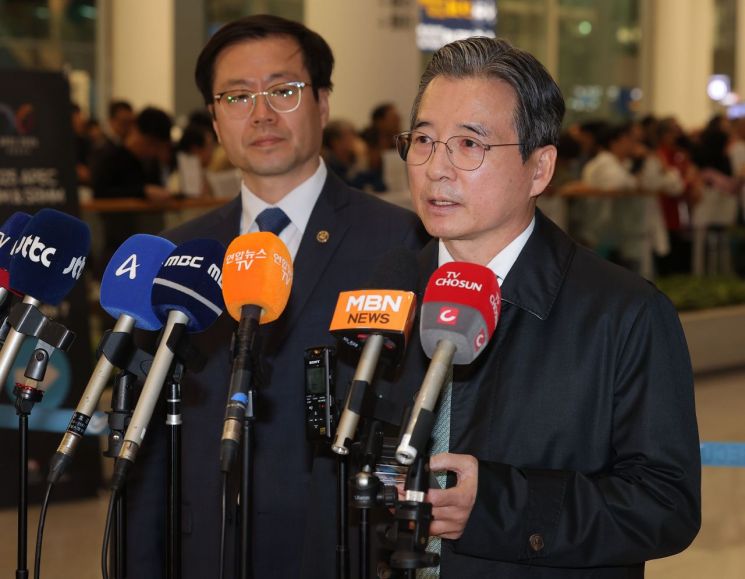
Upon arriving at Incheon International Airport on the 19th, Kim stated, "Both Korea and the US engaged in negotiations in a very serious and constructive atmosphere. In addition to the official talks, which lasted well over two hours, we also had in-depth discussions during the subsequent dinner." He added, "We are getting quite close to agreeing that the program must be mutually beneficial. Compared to before my US visit, the likelihood of reaching an agreement during APEC has increased."
The Korean government has emphasized "commercial rationality" as the core principle for the US investment package, advocating for ▲adjustment of investment amounts and phased investments ▲adjustment of the composition ratio among cash investments, guarantees, and loans ▲authority over investment destination selection and profit sharing ▲the signing of a currency swap to stabilize the foreign exchange market. Led by Kim, the government has held interagency meetings even during the Chuseok holiday, aiming to finalize the second Korea-US summit to be held during the APEC summit. The customs negotiation team, consisting of senior officials such as Deputy Prime Minister and Minister of Economy and Finance Koo Yooncheol, Minister of Trade, Industry and Energy Kim Jeonggwan, and Trade Negotiation Head Yeo Hankoo, has seized every opportunity to negotiate with their US counterparts.
The biggest point of contention is the method of investment. The US wants the $350 billion investment to be made "up-front" and as direct investment, but Korea insists on a phased investment, guarantees, and a hybrid model involving equity participation due to concerns about foreign exchange market shocks and fiscal burdens. The Korean government is designing a funding plan centered on policy financial institutions, and in practice, it is highly likely that the investment will be executed as a "package-type investment plan" divided by project units. A government official stated, "The nature of the investment funds should not be misunderstood as simply cash support," and added, "It will be a medium- to long-term project focused on cooperation in technology, infrastructure, and manufacturing."
Stabilizing the foreign exchange market and securing authority over investment destination selection and profit sharing are also contentious issues. With concerns that a large-scale US investment could destabilize the value of the Korean won, the government has proposed financial stabilization measures, including a currency swap with the US, as a prerequisite for executing the investment. While the US had previously taken a negative stance, it is reported that, following persistent explanations from the Korean government, recent working-level negotiations have seen a positive response, with the US considering "cooperative measures to mitigate market volatility." After meeting with US Secretary of Commerce Howard Lutnick and others, Kim stated, "We reached considerable agreement on most issues," but added, "There are still issues that require coordination. We need to review them thoroughly with the relevant ministries and further communicate our position during negotiations."
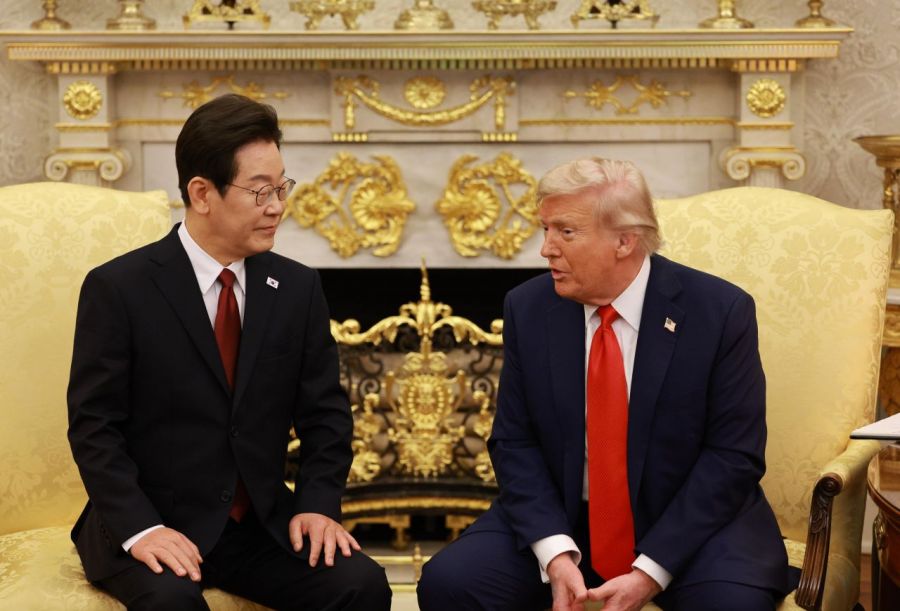
The possibility of achieving the goal of concluding the US investment package negotiations on the occasion of APEC now hinges on how quickly the remaining issues can be resolved. The two countries are aiming for a memorandum of understanding (MOU) before the APEC summit, but if the mutual conditions for investment and customs are not specified in detail, the agreement may have little practical effect. In this regard, some observers note that, due to ongoing uncertainty about US tariffs, Korea faces increasing burdens regarding item-specific tariffs on automobiles, steel, and other products. At the same time, as the US urgently needs Korea's help to strengthen the competitiveness and supply chains of its industries amid the US-China trade conflict, there is speculation that both sides may agree on language that can be presented as a win for both Korea and the US.
As the follow-up negotiations to the Korea-US customs agreement are gaining momentum, on the 20th, the National Security Office held an interagency meeting to assess the changing economic security environment, including geopolitical shifts, and to review the domestic impact. The review meeting, chaired by Oh Hyunju, the third deputy director of the National Security Office, was attended by key ministries including the Ministry of Economy and Finance, the Ministry of Foreign Affairs, the Ministry of Trade, Industry and Energy, and the Ministry of Oceans and Fisheries. The participants closely examined risk factors for Korea's supply chains in light of changes in the economic security environment and agreed to work closely together to minimize the negative impact of various risks on Korean companies.
© The Asia Business Daily(www.asiae.co.kr). All rights reserved.


















