Professor Park Sangseo's Team at UNIST Quantifies Optical Properties of Fine Dust Components Using Global Observation Data
Findings Aid Climate Research and Policy Development on Air Quality and Public Health
Published in Environmental Science & Technology
Even though the fine dust (PM2.5) blanketing the skies of Seoul and Mexico City is classified as the same type of particulate matter, its characteristics differ between the two cities.
In Seoul, the fine dust contains a higher proportion of components that reflect sunlight and help cool the Earth, whereas in Mexico City, there is a relatively higher proportion of components that absorb sunlight and contribute to global warming.
On October 20, a research team led by Professor Park Sangseo from the Department of Urban and Environmental Engineering at UNIST reported these findings after analyzing chemical samples and optical data of fine dust collected from 14 cities worldwide.
 Research team, (from left) Professor Sangseo Park, Professor Changgeun Song, Researcher Sujin Eom (first author). Provided by Ulsan National Institute of Science and Technology (UNIST)
According to the study, Seoul’s PM2.5 contains higher proportions of sulfates and nitrates, giving it a “reflective” nature that strongly scatters sunlight. In contrast, Mexico City’s fine dust contains more soot (black carbon), which is notable for its strong light-absorbing, or “absorptive,” properties.
In other words, even though both are classified as PM2.5, Seoul’s fine dust tends to reflect sunlight back into space, helping to cool the planet, while Mexico City’s fine dust absorbs solar energy, potentially accelerating global warming.
The research team reached these conclusions by comparing and analyzing chemical composition data (SPARTAN) and optical data (AERONET) from samples collected in 14 cities around the world, including Seoul, Beijing, and Mexico City.
AERONET is a ground-based data network that measures how much sunlight is absorbed and scattered as it passes through the atmosphere. Analyzing this data helps estimate the concentration of fine dust by revealing how hazy the atmosphere is.
The analysis showed that the higher the proportion of light-scattering components such as sulfates and nitrates, the higher the single scattering albedo (SSA) value. SSA is an indicator of how much of the incoming light is reflected (scattered) or absorbed by airborne particles: values closer to 1 indicate mainly reflection, while values closer to 0 indicate absorption. Conversely, as the proportion of absorptive components like black carbon increased, the SSA value decreased, especially in the longer wavelength range (870-1020 nm). The study also found that when the amount of soil dust (fine soil particles) in the atmosphere increased, the wavelength-dependent scattering characteristics (dSSA, rSSA) changed rapidly.
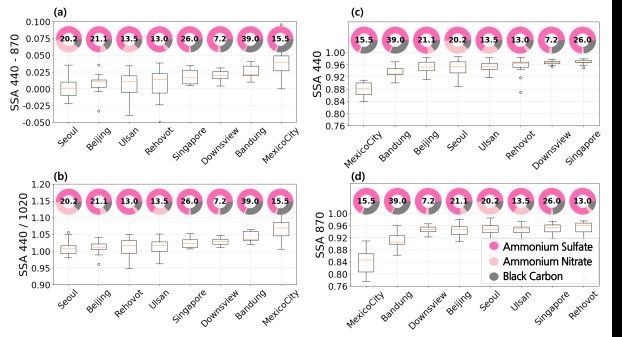
First author Sujin Eom explained, "This study goes beyond simply comparing concentrations; it is a rare case that demonstrates through direct measurement-not just modeling-how differences in composition alter the optical behavior of the atmosphere and its climate effects. It shows that changes in the composition of PM2.5, not just its concentration, must be considered in air quality and climate research."
Professor Park Sangseo commented, "We have established a foundation for indirectly estimating the toxicity differences of fine dust based solely on optical property data. This can serve as basic data to improve the accuracy of air quality forecasts and the formulation of public health policies in the future."
This research was conducted jointly with the UNIST Southeast Fine Dust Research and Management Center (Director: Professor Song Changgeun) and was published in the September 12 issue of the renowned environmental journal Environmental Science & Technology (IF=11.3), published by the American Chemical Society.
© The Asia Business Daily(www.asiae.co.kr). All rights reserved.
![Clutching a Stolen Dior Bag, Saying "I Hate Being Poor but Real"... The Grotesque Con of a "Human Knockoff" [Slate]](https://cwcontent.asiae.co.kr/asiaresize/183/2026021902243444107_1771435474.jpg)

















