"Loss of Grade Differentiation... College Admissions Standards in Turmoil"
Jin Sunmi: "Urgent Need for Measures to Restore Differentiation and Prevent Confusion"
In the first semester following the introduction of the high school credit system, the number of students in Seoul high schools who received the highest grade (Grade 1) in all subjects exceeded 1,000. As a result, concerns have been raised in the education sector that the ability of school grades to differentiate students in college admissions has significantly weakened.
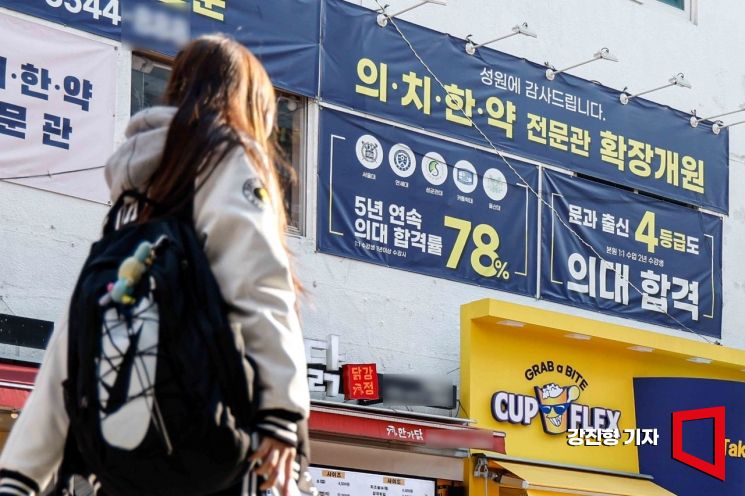 A banner related to medical school entrance exams is displayed on the exterior wall of an academy in the academy district of Daechi-dong, Gangnam-gu, Seoul.
According to an analysis of data obtained from the Seoul Metropolitan Office of Education by Assemblywoman Jin Sunmi of the National Assembly’s Education Committee on the 19th, a total of 1,009 high school students in Seoul received Grade 1 in all subjects during the first semester. This accounts for approximately 1.72% of the total 58,828 first-year high school students in Seoul.
In comparison, during the first semester of the 2023 academic year-before the implementation of the high school credit system-this figure was only 121 students (0.18%), meaning the number of students with the highest grade in all subjects has increased more than eightfold.
This dramatic increase is attributed to the change in the grading system: under the previous nine-level system, Grade 1 was awarded to the top 4% of students, but with the introduction of the five-level system under the high school credit system, this has been expanded to include the top 10%.
By educational district, Gangseo-Yangcheon District Office of Education recorded the highest rate, with 167 students (2.19%), followed by Jungbu (117 students, 1.8%), Gangdong-Songpa (111 students, 1.78%), and Nambu (106 students, 1.73%).
If these figures for Seoul are extrapolated nationwide, based on the total number of first-year high school students across the country (approximately 425,400), it is estimated that more than 7,300 students would achieve Grade 1 in all subjects. This number exceeds the combined total of the nationwide medical school quota for the 2026 academic year (3,092 students) and Seoul National University's admissions quota (3,556 students).
Admissions experts point out that as this concentration of top-performing students increases, school grades will no longer serve as a meaningful indicator in college admissions. In particular, under the previous nine-level system, Grade 2 included students up to the top 11%, but in the five-level system, Grade 2 now includes up to the top 34%, which could greatly reduce the ability to distinguish among top students.
The importance of school grades in college admissions is also gradually increasing. Seoul National University has announced that starting with the 2028 academic year, it will raise the weight of academic performance in the second stage of the regular admissions process from 20% to 40%. However, if a large number of students receive Grade 1 or 2, universities will face the challenge of developing new evaluation methods to distinguish among students with identical grades.
Some critics argue that the government rushed to implement the new system without sufficient preparation, leading to confusion. Assemblywoman Jin Sunmi emphasized, "The Yoon Suk Yeol administration pushed ahead with changing the school grading system to five levels without measures to ensure differentiation, resulting in chaos on the ground. Supplementary measures must be put in place to address the concerns of students and parents."
© The Asia Business Daily(www.asiae.co.kr). All rights reserved.

![Clutching a Stolen Dior Bag, Saying "I Hate Being Poor but Real"... The Grotesque Con of a "Human Knockoff" [Slate]](https://cwcontent.asiae.co.kr/asiaresize/183/2026021902243444107_1771435474.jpg)














