Transfer of "Good Night, Miss" Ownership... Composer Appeals
Exploitation of Differences in Korean and Chinese Copyright Registration Systems
Another incident of copyright infringement has occurred, in which a South Korean composer's music was rearranged and re-registered by a Chinese company, resulting in the original track being removed from Meta platforms. This case is known to have exploited the differences between the two countries' copyright registration systems.
Jae-kwang Lee, a composer and YouTuber who runs the YouTube channel 'Gwana,' posted on his social networking service (SNS) on October 16, saying, "The song I composed, 'Good Night, Miss,' has disappeared from Instagram. The song was rearranged and newly registered in China, which led to the transfer of the original ownership. I have neither the strength nor the knowledge to fight this," he lamented.
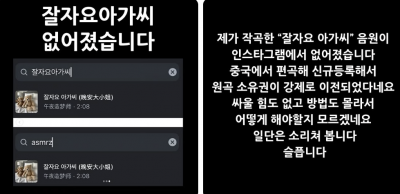 A post by composer and YouTuber Jae-kwang Lee, who runs the YouTube channel 'Gwana,' complaining about copyright infringement on his social media service (SNS). Screenshot from Gwana's Instagram.
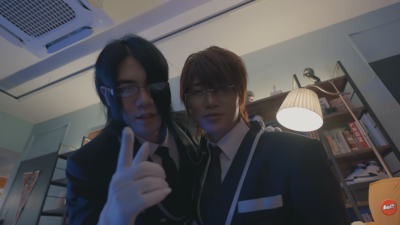
The missing track is "Good Night, Miss" by the project group ASMRZ. Lee is listed as a co-composer along with comedian Kim Kyungwook, known for his character 'Tanaka,' and influencer Nitmolcash.
However, on Meta's platforms (such as Instagram and Facebook), the Chinese version, "晩安大小姐 (Wan'an Daxiaojie)," is now displayed instead of the original. The Chinese artist Miaozhaomengs, who newly registered the track, kept the melody and lyrics almost identical, changing only the rhythm before registering it as a new song. As a result, Meta reportedly recognized it as a "separate track," deleted the original, and acknowledged the ownership of the new version.
Kim Kyungwook also stated on his SNS on October 17, "There have been repeated cases where Chinese music companies rearrange several popular tracks and re-register them with Meta, resulting in the forced transfer of original ownership. We are currently working with the distributor to find a solution."
The root cause of this situation is said to be the differences in copyright registration methods between South Korea and China. In China, the system is operated based on the ISRC (International Standard Recording Code) when registering music. In contrast, South Korea uses the ISWC (International Standard Musical Work Code), which focuses on composition and lyrics. Therefore, in China, changing only the ISRC through rearrangement allows the track to be registered as a different work.
Jung Jinhwan, CEO of 7Key Music, the official Korean branch of Haikun Music, a subsidiary of Tencent Music in China, commented, "Even if the ISWC is the same, if the ISRC is different, the platform recognizes it as a completely different track. It is difficult to understand why Meta could not distinguish between the original and rearranged versions."
This case is similar to the music copyright infringement incident originating from China in 2021. At that time, Chinese record companies registered Korean songs as adaptations, resulting in the music of many domestic artists, including Lee Seungchul, IU, Brown Eyes, and Younha, being blocked due to copyright infringement. In some cases, revenue from these tracks was distributed to Chinese companies.
© The Asia Business Daily(www.asiae.co.kr). All rights reserved.


















