52 Processed Skulls Discovered in China
Possible "Waste," Not for Ritual or Religious Purposes
In China's Neolithic civilizations, a large number of human skulls that had been meticulously processed have been discovered, drawing significant attention from the archaeological community. Some of these skulls had their tops cut off, resembling bowls, a form often referred to as the "basin shape."
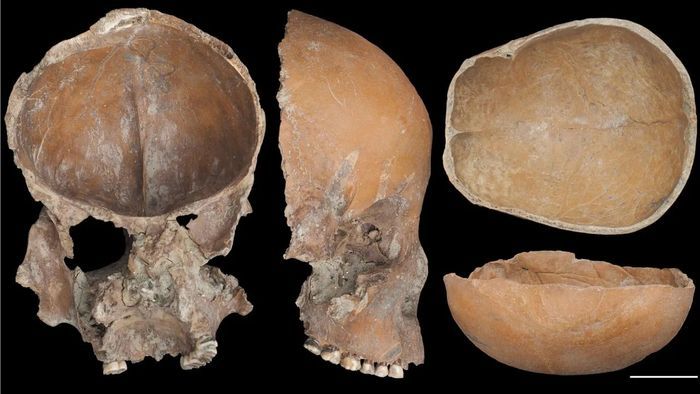 Processed human skull discovered at the Liangzhu cultural heritage site in China. Scientific Reports
According to the American science outlet Live Science and the UK-based Phys.org, Dr. Sawada Junmei, a biological anthropologist at Niigata University of Health and Welfare in Japan, recently published research findings in the international journal Scientific Reports on Neolithic human remains unearthed in the Yangtze River estuary region of southeastern China.
The artifacts in question were excavated from the Liangzhu cultural heritage site, which flourished between approximately 5,300 and 4,500 years ago. The remains were found inside ancient canals and moats at the site, and evidence of artificial processing was identified in 52 out of a total of 183 skulls. This is considered the earliest and most distinctive example of processed human remains in ancient China.
The methods of processing varied. Some skulls had their surfaces polished to a smooth finish, and small holes were drilled in specific areas. There were skulls with the front cut off, and others with the top removed and shaped like a bowl. These remains appeared to have been selected at random, regardless of gender or age, and showed no signs of violent death. The research team estimated that the skulls were processed some time after death.
Interestingly, this processing did not occur over a short period. Radiocarbon dating revealed that such modifications to the remains continued for about 200 years. However, since 80% of the processed skulls were incomplete and appeared to have been discarded like refuse, some interpretations suggest that these remains were not used for religious rituals or as symbols of authority.
In the past, skull cups with religious significance have been found in elite tombs of the Liangzhu culture, but the purpose of these newly discovered remains is unclear, distinguishing them from previous findings. Dr. Sawada analyzed, "The process of urbanization and the dissolution of existing communities, along with the formation of relationships with outsiders, may have led to a shift in perceptions about people."
Dr. Elizabeth Berger, a bioarchaeologist at the University of California, Riverside, also commented, "The key point about this discovery is that these remains do not appear to have been regarded as sacred or valuable, but rather as discarded objects," adding, "As cities grew, attitudes toward human remains may have changed."
© The Asia Business Daily(www.asiae.co.kr). All rights reserved.

















