Hwapocheon, Haebancheon, Bonggokcheon, and Sachoncheon Sections
Gimhae City in Gyeongnam Province will restrict access of livestock vehicles to migratory bird habitats within its jurisdiction until February 28 next year to prevent the spread of highly pathogenic avian influenza (AI).
Accordingly, livestock vehicles and related workers transporting poultry, including feed, manure, eggs, rice husks, and live animals, will not be allowed to enter the Hwapocheon, Haebancheon, Bonggokcheon, and Sachoncheon sections within the city.
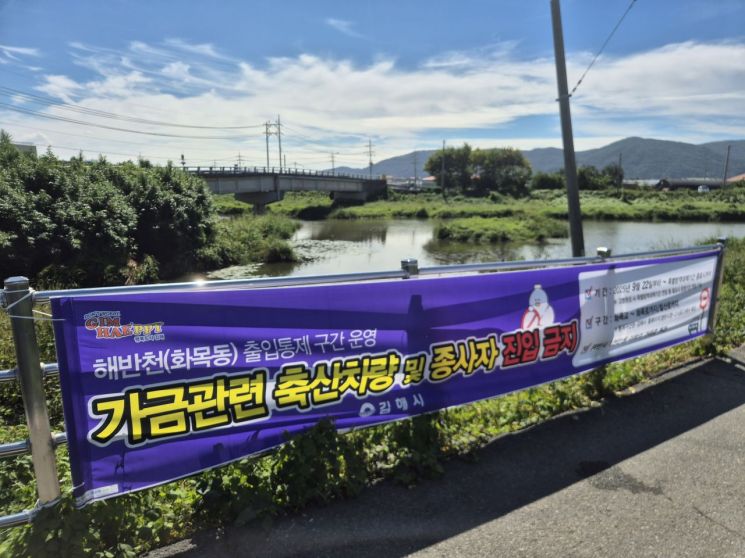 A banner notifying the restriction of access for poultry-related livestock vehicles and workers is hung at Haeban Stream, a migratory bird habitat in Gimhae City, Gyeongnam Province. Provided by Gimhae City
On October 17, the city announced that, based on an analysis of the current status of highly pathogenic AI in wild birds at migratory bird habitats, it has designated certain sections of four habitats within its jurisdiction as restricted zones due to their high risk, and has issued an order limiting the movement of livestock vehicles and related workers in these areas.
Vehicles and workers who violate the movement restriction order and enter the restricted zones will be subject to a fine of up to 10 million won in accordance with the Act on the Prevention of Contagious Animal Diseases.
According to the city, highly pathogenic AI is a fatal disease for poultry and is mainly transmitted by migratory birds that visit Korea during the winter season.
In particular, the disease is managed as a first-class contagious animal disease due to its extremely high transmissibility, with a mortality rate in chickens reaching 90 percent.
Previously, Gyeongnam Province has strictly regulated and managed livestock vehicle movement and biosecurity activities at poultry farms through 11 related administrative orders and 8 strengthened biosecurity standards.
The administrative orders include: prohibition of livestock vehicle drivers from entering migratory bird habitats; mandatory use of base disinfection facilities before visiting poultry farms and livestock facilities; prohibition of egg transport vehicles from entering densely populated egg-laying hen areas; restriction of inter-provincial movement of poultry manure vehicles; prohibition of free-range rearing at poultry farms; restriction of access by external vaccination teams and laborers; prohibition of shared equipment use between farms; and restriction on removal of manure from egg-laying hen farms.
The strengthened biosecurity standards include: checking and keeping disinfection certificates for livestock vehicles; storing agricultural machinery outside farms; washing and disinfecting rice husk spreaders and operating separate passageways at duck farms; implementing two-stage disinfection for vehicles entering farms; and restricting access through back gates of farms.
Jeong Dongjin, head of the Livestock Division of Gimhae City, stated, "If poultry-related livestock vehicles and workers enter migratory bird habitats with a high risk of highly pathogenic AI contamination, the risk of transmission to farms increases," and urged, "Please strictly comply with the access restrictions."
© The Asia Business Daily(www.asiae.co.kr). All rights reserved.

















