US Chamber of Commerce Sues Department of Homeland Security in Federal Court
Points to Violation of the Immigration and Nationality Act
"Designed to Help US Companies Secure Global Talent"
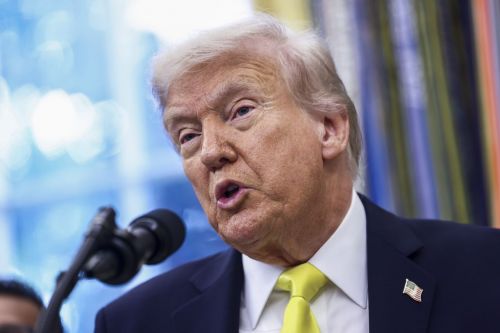 US President Donald Trump is speaking at the White House on the 15th (local time). Photo by EPA Yonhap News
On October 16 (local time), the US Chamber of Commerce filed a lawsuit in federal court against the Trump administration, claiming that the decision to increase the application fee for the H-1B visa-commonly known as the "professional visa"-by 100 times is clearly illegal.
The Chamber stated on its website that the newly imposed $100,000 (approximately 140 million KRW) fee for the H-1B visa "violates provisions of the Immigration and Nationality Act (INA) that govern the H-1B program."
Last month, President Trump signed a proclamation raising the H-1B visa application fee from the current $1,000 (about 1.4 million KRW) to $100,000, which is 100 times higher. The Chamber argues that this action violates the Immigration and Nationality Act (INA).
In a statement, Vice President Neil Bradley said, "The new fee will make it financially impossible for US employers-especially startups and small businesses-to utilize the H-1B program," adding, "Congress specifically designed this program so that American companies of all sizes could secure the global talent needed to expand their businesses within the United States."
He emphasized that while the Chamber actively supports President Trump's policies to attract more investment to the US, "our economy needs more workers, not fewer, to support such growth."
In fact, dissatisfaction is mounting not only among businesses but also in the medical and education sectors in the United States. The damage is expected to be particularly severe for technology companies, startups, and venture capital firms that rely on skilled workers from India and China.
The issue is also highly controversial in Silicon Valley. Jensen Huang, the Taiwan-born CEO of Nvidia, who previously appeared to support the H-1B visa policy, recently took a critical stance, stating, "If these current Trump administration policies had been in place back then, my family would not have been able to immigrate to the United States."
The H-1B visa was originally established by Congress in 1990. It is valid for three years and can be extended up to a maximum of six years. Including a special allocation of 20,000 slots for holders of advanced degrees (master's or higher), a total of 85,000 H-1B visas are issued annually.
© The Asia Business Daily(www.asiae.co.kr). All rights reserved.

















