Over 20% of the Population Now Aged 65 and Older, Pushing Traditional Care Systems to Their Limits
AI, IoT, and Robotics Integration... Extra Human Resources to Focus on "Emotional Care"
Establishing a Virtuous Cycle for Care Technology: Demand
As the proportion of people aged 65 and older surpasses 20% of the total population, marking the transition to a “super-aged society,” the government is accelerating the commercialization of care technologies based on artificial intelligence (AI) in response to the growing limitations of the existing care system. While the demand for care is increasing explosively, there is a shortage of caregivers and nursing assistants, making it impossible to meet needs with manpower alone. As a solution, the government has introduced “AI care” through technologies such as smart homes and care robots.
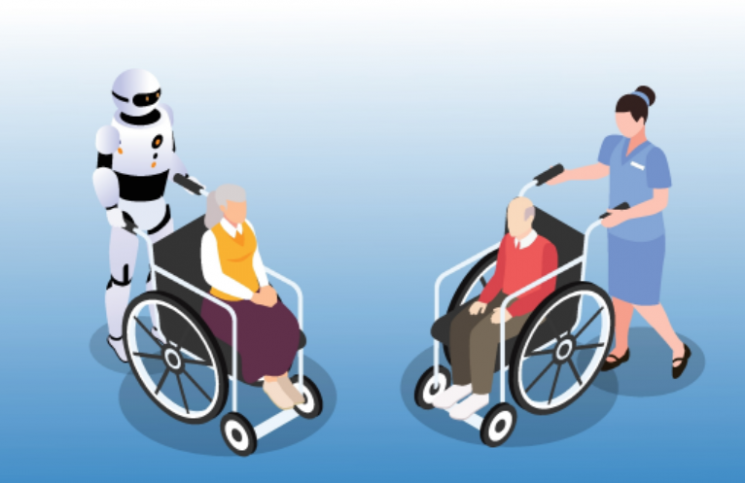
According to the Ministry of Health and Welfare on October 17, the government is currently conducting related research and surveys to design policy directions, with the goal of announcing an “AI Welfare and Care Innovation Roadmap” in the first half of next year. In the long term, the government plans to develop care services and products that combine AI, the Internet of Things (IoT), and robotics technologies, apply them in care settings, and foster the related industry as a new growth engine.
Building an Integrated Platform to Reduce Home Care Workload
Public funding for care in Korea is projected to increase by 8-10% annually, reaching approximately 35 trillion won by 2032. The main issue is that most of this funding is spent on labor costs, resulting in an inefficient structure. To address this, the government plans to integrate three areas-home-based care, facility care, and on-site support-into a smart care system that merges care services with technology.
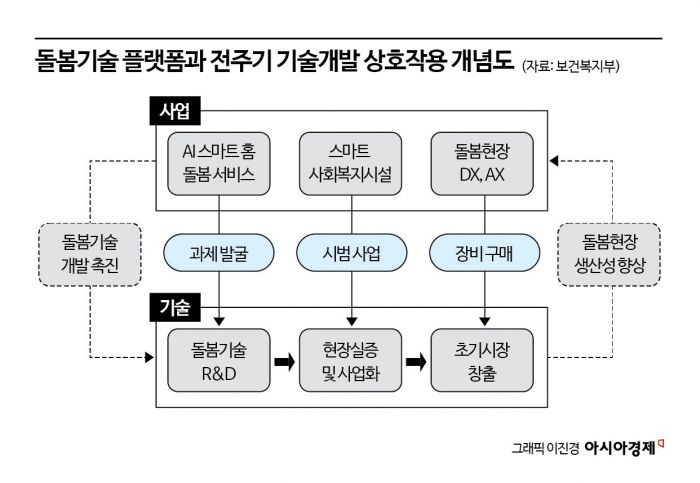
For home-based care, an “AI smart home” will be introduced, connecting sensors, cameras, and AI speakers installed in the home to a single platform that provides integrated care, including safety, health, and emotional support for older adults. If an IoT sensor detects abnormal activity patterns, AI analyzes the situation and notifies care staff, who then provide the necessary services.
For facility care, the “smart social welfare facility” model will be applied. Technologies such as AI, IoT, and robotics will be used to analyze and automate facility work in detail, identify efficiency improvements, and redesign work processes by introducing new technologies, equipment, and systems. For example, AI sensors can replace nighttime patrols, and robots can assist care staff with tasks such as helping patients with toileting, bathing, and changing positions.
To automate administrative work, digital transformation (DX) and AI transformation (AX) will also be implemented in care settings. A representative example is a system where care staff can report to AI by voice, and records are automatically generated.
Support from Care Technology Development to Commercialization
To transform these AI care policies from one-off welfare projects into an industrial ecosystem, the Ministry of Health and Welfare will establish a full-cycle support system covering “research and development (R&D) → demonstration → commercialization and productization → field application → productivity improvement.” The government will identify needs in the field, plan them as R&D projects, verify them through prototype production and pilot projects, and then move to commercialization. To support productization, a social service investment fund worth 21.5 billion won has already been established over the past two years through both government and private sector efforts.
The government aims to accelerate the commercialization of advanced care technologies and secure a foothold in the global care technology market, which is currently valued at 2.7 trillion dollars and growing at an annual rate exceeding 20%. Countries such as Japan and the European Union, which entered the super-aged society before Korea, have already made active investments in care services and product development and are utilizing them in the field.
Multidisciplinary research combining social welfare, engineering, and technology will also be promoted. The goal is not merely to introduce care technologies, but to design comprehensive models that include human-centered services and ethical standards.
If AI and IoT technologies operating 24 hours a day can replace care staff, older adults will be able to maintain independent lives in their own homes for as long as possible. For care staff, technology will take over repetitive and physically demanding work, allowing them to focus on higher-level, emotionally supportive human care. The government, in turn, will be able to respond proactively to the care crisis and significantly reduce social costs.
Lee Iran, First Vice Minister of Health and Welfare, stated at the meeting of the “AI Welfare and Care Innovation Task Force,” which launched in August, “I believe it is our ministry’s role and duty to ensure that the advancement of AI technology leads to improved quality of life for the entire society, including vulnerable groups.” She emphasized, “We will swiftly identify and promote tasks that people can truly feel, and create a social foundation where AI and humans coexist in harmony.”
© The Asia Business Daily(www.asiae.co.kr). All rights reserved.
![Clutching a Stolen Dior Bag, Saying "I Hate Being Poor but Real"... The Grotesque Con of a "Human Knockoff" [Slate]](https://cwcontent.asiae.co.kr/asiaresize/183/2026021902243444107_1771435474.jpg)











