Bank of Korea's "Financial Market Trends for September 2025"
Bank Household Loans Reach 1,170.2 Trillion Won... Up 2 Trillion Won from Previous Month
Increase in Transaction Volumes from September to October Likely to Affect Year-End Figures
Last month, the increase in household loans from banks slowed significantly, with the total increase amounting to only 2 trillion won. The total increase in household loans across the entire financial sector was also limited to around 1.1 trillion won. This was due to the continued impact of the June 27 Measures, as well as a seasonal decline in demand for jeonse funds. However, the expansion of transaction volumes in some parts of the Seoul metropolitan area’s real estate market, which has overheated since September, is expected to affect the scale of household loan growth toward the end of the year, with a lag of two to three months.
 Apartment complexes in the Seocho and Yongsan areas as seen from Namsan, Seoul. Photo by Yonhap News
According to the "Financial Market Trends for September 2025" released by the Bank of Korea on the 16th, the outstanding balance of household loans from banks at the end of last month stood at 1,170.2 trillion won, an increase of 2 trillion won compared to the end of the previous month. This increase is significantly smaller than the previous month’s 4.1 trillion won.
Last month, mortgage loans increased by 2.5 trillion won, reaching 932.7 trillion won. This is a slight decrease in the growth compared to August’s 3.9 trillion won. The continued impact of the June 27 Measures, combined with seasonal factors, led to a reduction in demand for jeonse funds. Jeonse loans decreased by 200 billion won, marking the first decline in nine months since December of last year.
According to the Ministry of Land, Infrastructure and Transport, the number of apartment sales transactions in Seoul grew from 7,400 in May to 11,000 in June, but then dropped to 4,000 and 4,200 in July and August, respectively. However, since September, the real estate market has shown signs of overheating, especially in major areas such as Seoul, resulting in a renewed increase in transaction volumes. According to the Seoul Real Estate Information Plaza, as of October 16, the number of apartment transactions in Seoul for September was 7,282, far surpassing the levels of July and August. Given that the deadline for reporting transactions is at the end of this month, the figure could rise further.
Park Mincheol, head of the Market Coordination Team at the Bank of Korea’s Financial Markets Department, stated, "There is usually a two to three month lag between sales transactions and the aggregation of loan data," and noted that "(the increase in transactions in September) will put upward pressure on mortgage loans for home purchases in the coming months." Regarding the effectiveness of the October 15 Measures announced by the government the previous day, he said, "It is welcome news in a situation where the market continues to overheat," but also added, "It is still too early to judge the effect, so we need to observe a bit longer."
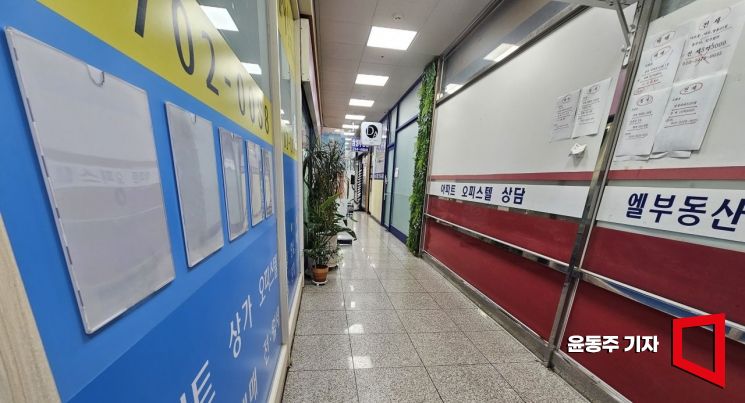 The day after the government announced the 'Housing Market Stabilization Measures,' on the 16th, the property listing board in front of a real estate agency in Mapo-gu, Seoul, was empty.
Other loans, which include general credit loans, credit line loans (overdrafts), commercial real estate loans, deposit-secured loans, and stock-secured loans, decreased by 500 billion won. The ongoing effect of reduced credit loan limits, coupled with the sale and write-off of non-performing loans at the end of the quarter, led to this decline.
Corporate loans from banks also saw a reduced increase compared to the previous month, due to seasonal factors and other reasons. At the end of last month, the outstanding balance of corporate loans from banks was 1,360.1 trillion won, up 5.3 trillion won from the end of the previous month. Loans to small and medium-sized enterprises increased by 4 trillion won. Despite the sale and write-off of non-performing loans, the expansion of lending operations by major banks and demand for funds during the Chuseok holiday resulted in a similar increase to the previous month. Loans to large corporations increased by only 1.3 trillion won. Park explained, "The increase was significantly reduced due to temporary repayments for quarter-end financial ratio management and repayments through corporate bond issuance."
In September, bank deposits increased by 31.9 trillion won compared to the end of the previous month, mainly due to a surge in demand deposits. Demand deposits saw a significant increase of 35.5 trillion won, driven by inflows of corporate funds for quarter-end financial ratio management and other reasons. In contrast, time deposits decreased by 400 billion won due to fiscal spending by local governments and corporate demand for funds during the Chuseok holiday.
Assets under management at asset management companies turned to a decrease, falling by 4.2 trillion won as money market funds (MMFs) saw large outflows. MMFs shrank by 28 trillion won due to outflows of corporate funds for quarter-end financial ratio management and withdrawals of treasury funds for fiscal spending. On the other hand, inflows into other funds, such as equity funds (+10.9 trillion won) and other types of funds (+11.5 trillion won), increased significantly.
© The Asia Business Daily(www.asiae.co.kr). All rights reserved.

![Clutching a Stolen Dior Bag, Saying "I Hate Being Poor but Real"... The Grotesque Con of a "Human Knockoff" [Slate]](https://cwcontent.asiae.co.kr/asiaresize/183/2026021902243444107_1771435474.jpg)
















