A technology capable of predicting cell and drug responses without experiments has been developed in South Korea.
Controlling the state of cells in a desired direction is considered a key challenge in the life sciences, including new drug development, cancer treatment, and regenerative medicine. However, finding the right drugs and genetic targets is not always easy.
The newly developed technology is significant in that it mathematically models cell and drug responses in a manner similar to assembling and disassembling Lego blocks, enabling the prediction of new responses and arbitrary gene regulation effects without the need for experiments.
On October 16, KAIST announced that Professor Kwanghyun Cho and his research team from the Department of Bio and Brain Engineering have developed a technology that uses generative artificial intelligence (AI) to identify drugs and genetic targets that can guide cells to a desired state.
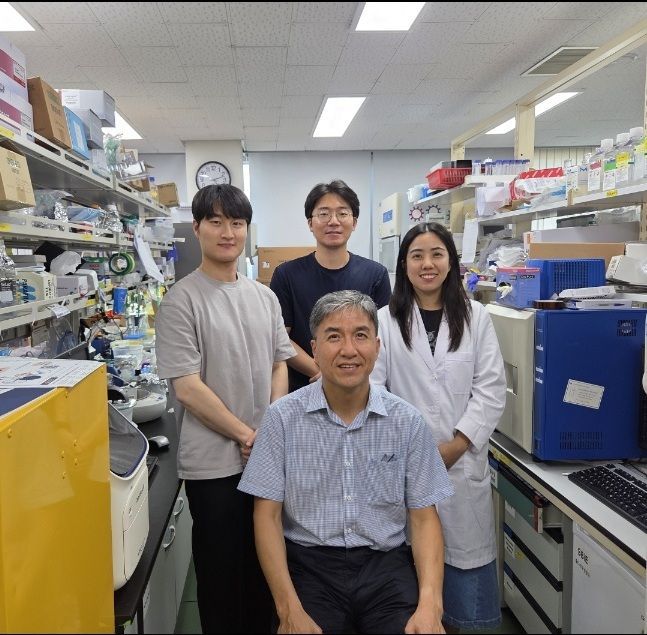 Professor Kwanghyun Cho (center front row) and his research team members are posing for a commemorative photo. Provided by KAIST
The 'latent space' is a kind of invisible 'map (space)' where image-generating AI mathematically organizes the features of objects or cells.
The research team devised a method to predict the optimal combination responses between cells and drugs without experimentation by separating the states of cells and the effects of drugs within this space and then recombining them.
Furthermore, they demonstrated that this principle could be extended to predict the changes that occur when specific genes are regulated.
The team validated this technology using real-world data. The validation results showed that the AI identified molecular targets capable of reverting colon cancer cells to a state closer to normal cells, which was subsequently confirmed through cell experiments.
This newly developed technology opens up the possibility of serving as a universal platform for predicting not only cancer treatment outcomes but also transitions between various unlearned cell states and drug responses. Most notably, the technology is meaningful in that it can reveal the underlying 'mechanism' by which a drug acts within a cell, rather than simply determining whether a drug is effective.
The research team expects that these results will serve as a tool for designing methods to convert cells into desired states in the future, and that the technology will be widely used in the medical field for new drug development, cancer treatment, and research on restoring damaged cells to healthy states.
Professor Cho stated, "This study is an example of applying the concept of a 'direction vector'-the principle that image-generating AI technology can alter cells in a desired direction. The technology developed by our team is significant in that it can quantitatively analyze the effects of specific drugs or genes on cells and can be used as a universal AI method to predict responses that have not previously been identified."
This research was conducted by Dr. Han Younghyun, PhD candidate Kim Hyunjin, and Dr. Lee Chunkyung at KAIST. The results (paper) were recently published in the international academic journal 'Cell Systems,' which is published by Cell Press.
© The Asia Business Daily(www.asiae.co.kr). All rights reserved.
![Clutching a Stolen Dior Bag, Saying "I Hate Being Poor but Real"... The Grotesque Con of a "Human Knockoff" [Slate]](https://cwcontent.asiae.co.kr/asiaresize/183/2026021902243444107_1771435474.jpg)











